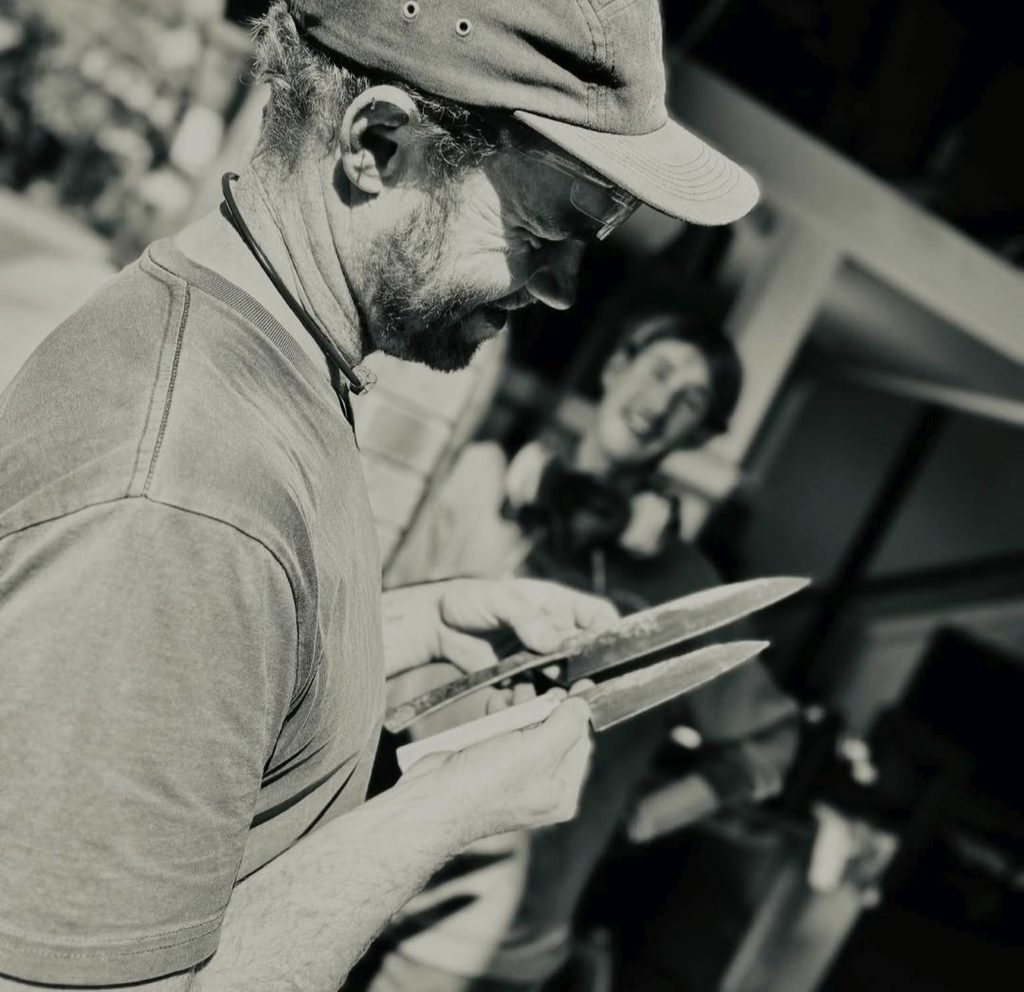
This week’s interview takes us to the workshop of Marc Josef Stewart. Ever since I have met him, he’s been a first-class guy. His work is approachable, but always lovely, and it doesn’t hurt that his photos are top notch. His passion is contagious and is a great example of what makes the knife making community in Australia so fantastic. I couldn’t be happier to share his story.
To start off, please tell us a little about yourself.
I live on the South Coast of New South Wales, Australia in a quiet coastal town called Ulladulla, with my wife and three young kids. I’m a tradesman by day but have been slowly transitioning my hobby of knifemaking into more of a career.
What sparked your interest in knives?
I got passionate about cooking around 15 years ago when I worked in a kitchen in Canada for a year while living abroad. I have always had a thing about using the best tools I can afford for the job so inevitably that rolled onto knives and after traveling through Japan and seeing the variety of profiles they use for each
individual task I was hooked.
What inspired you to do this and how did you learn?
I’ve always had this drive, when there is something that I find intriguing then I want to experience myself how to create it. Being a tradesman, I guess being a ‘maker’ goes hand in hand. In thinking back, another inspiration was buying a knife by a local knife maker as a gift for my Dad, before I had made my own. I was lucky enough to live quite close to him at that time in my life and got to know Jez from Oblivion Blades. Seeing that craftmanship of an Australian based maker was definitely a huge inspiration to know that I could learn to make one of this standard. Early on in my making days, both Jez and another maker Dave of Bat country forge were legends in sharing both their wisdom and their skills with me.
When did you start making knives?
I did my first course in 2017 at Eveleigh work in Sydney.
What did you make your first knife with?
It was a paring knife/scalpel and was made with 1084 carbon steel with a leather wrapped handle.
Do you have a favorite knife you made, tell me about it?
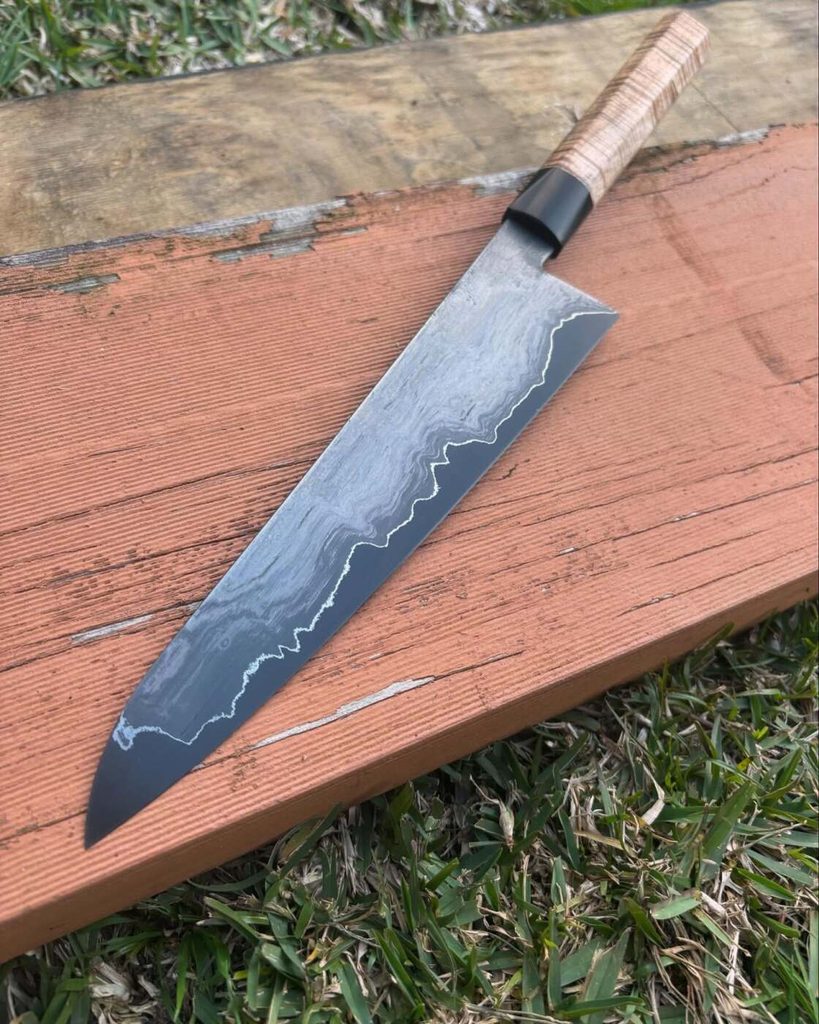
My favourite knife is the first one I ever made myself at home. It still has a home on our rack and is reached to the most of any of the knives. It is a shape that I have templated and sell as the ‘go to – gyuto’. It’s a 200mm x 45mm gyuto in 1084 carbon steel with stabilised dyed maple handle.
What is the most important aspect of a well-made knife?
Geometry.
What keeps you going?
The gratification of the final result, and also seeing the genuine appreciation from others of my craft.
Biggest struggle?
Self-Promotion, confidence, and imposter syndrome. Basically, anything involving a mental hurdle. Making the knives is the easy part.
What kinds of knives do you make?
Sharp ones.
How did your background affect your approach to knives?
My trade is architectural metal roofing and cladding, specialising in copper and other non-ferrous metals on high end residential builds. I was very lucky to learn under some master roofers from Europe and although at the time I thought they could be harsh, I can now see that they were teaching me the best skill there is and that’s an eye for detail and supplying me with the skillset needed to get it done.
Our clients were spending a ludicrous amount of money on our trade and no shortcuts were ever taken. Perfection to the millimetre was expected even on a roof only the birds would see.
Sometimes, I can look at it like it’s a bit of a curse as I am very quick to criticise things that aren’t quite right, and can definitely be my own worst critic.
One positive aspect I took from my trade, that I still use to this day, is knowing that there is a market for everything, including perfection.
Who helped you early on?
As I said before, Jez and Dave definitely helped a lot especially with all my heat treatment.
Who are your influences?
Local makers. Early on I looked up to the work of some of the more well known makers in Australia like Dimitri Popov of DP customs, Tristone blades, Mert Tansu.
All Japanese style maker and I feel a lot of my profiles still pay homage to these guys.
What other knife makers out there impress you these days? Do you take inspiration from anyone else in the field?
I think it’s pretty hard to not take inspiration from other makers. We are all a part of an online community, be it through social media or forums, I am always being inspired. We are unique community, knife makers in Australia, in that we really
support each other and have close contact.
What is the perfect knife?
One that you reach for every time. For each individual, this could be a different knife. For me it would be a medium sized gyuto.
How do you approach knife testing?
Each knife, I have a desired outcome, be it hardness or geometry. I have finally reached a point in my making that I’m confident in my geometry by look and feel.
Although I am not opposed to bringing home a half-finished project and test with a food prep session.
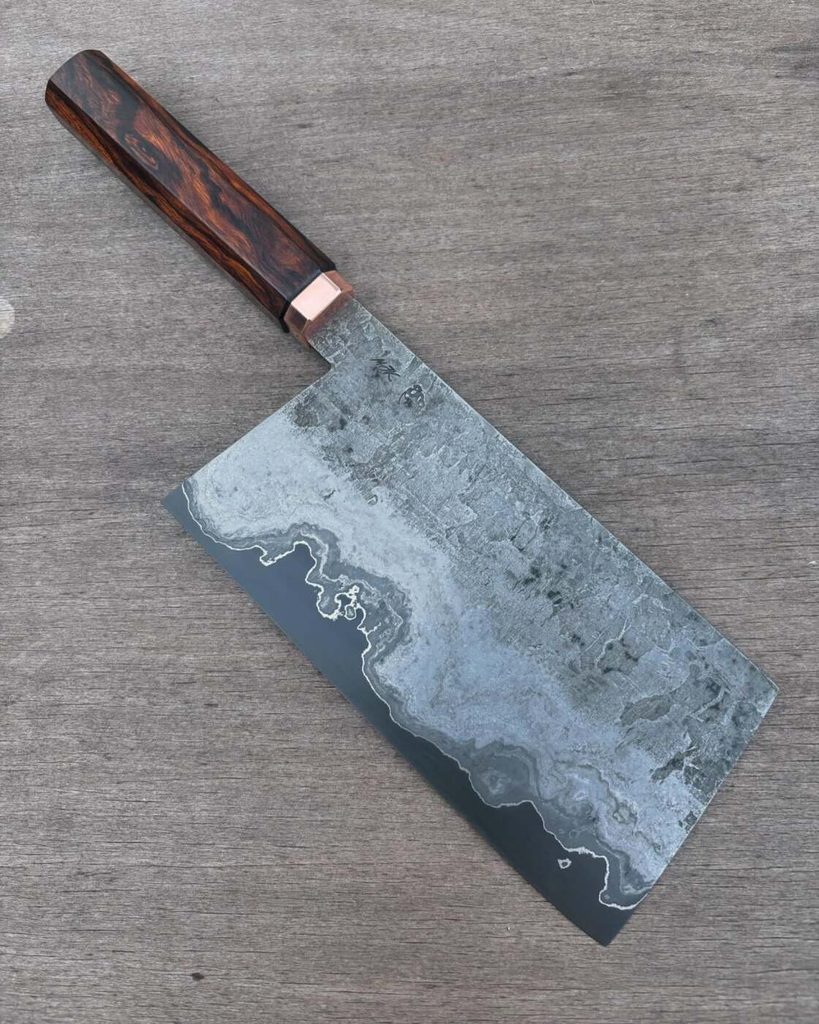
What do you like about Sanmai steels?
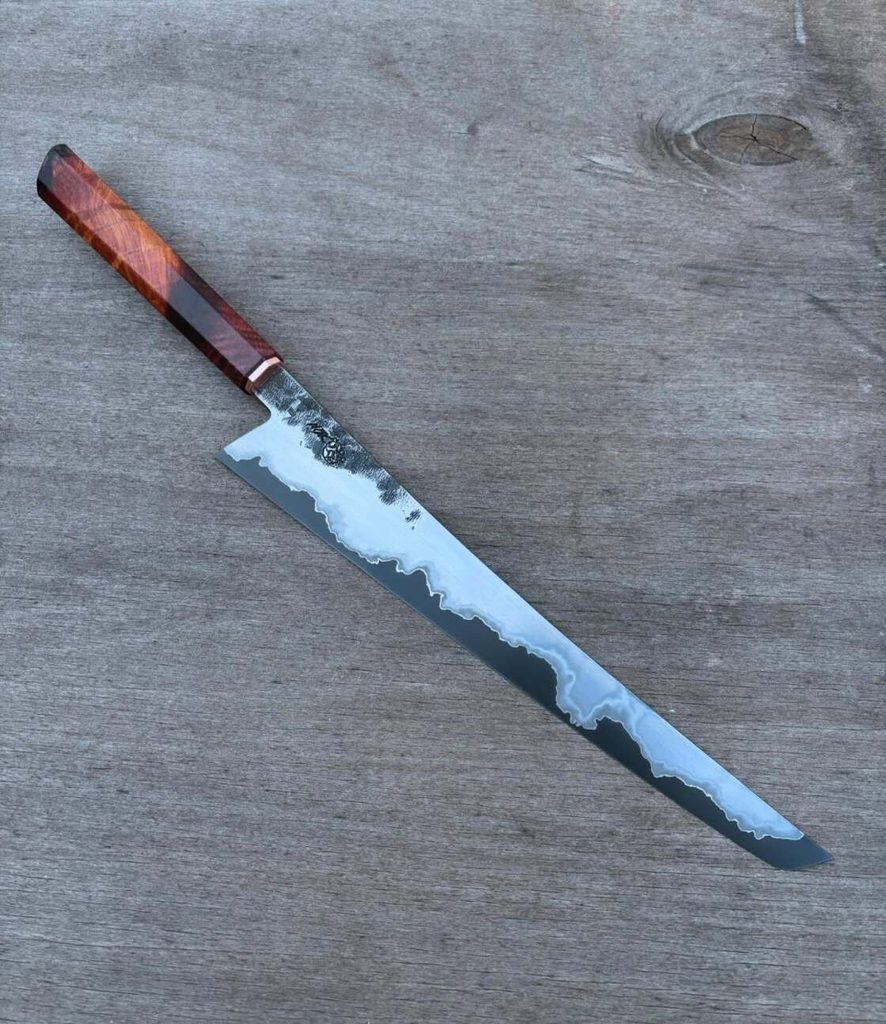
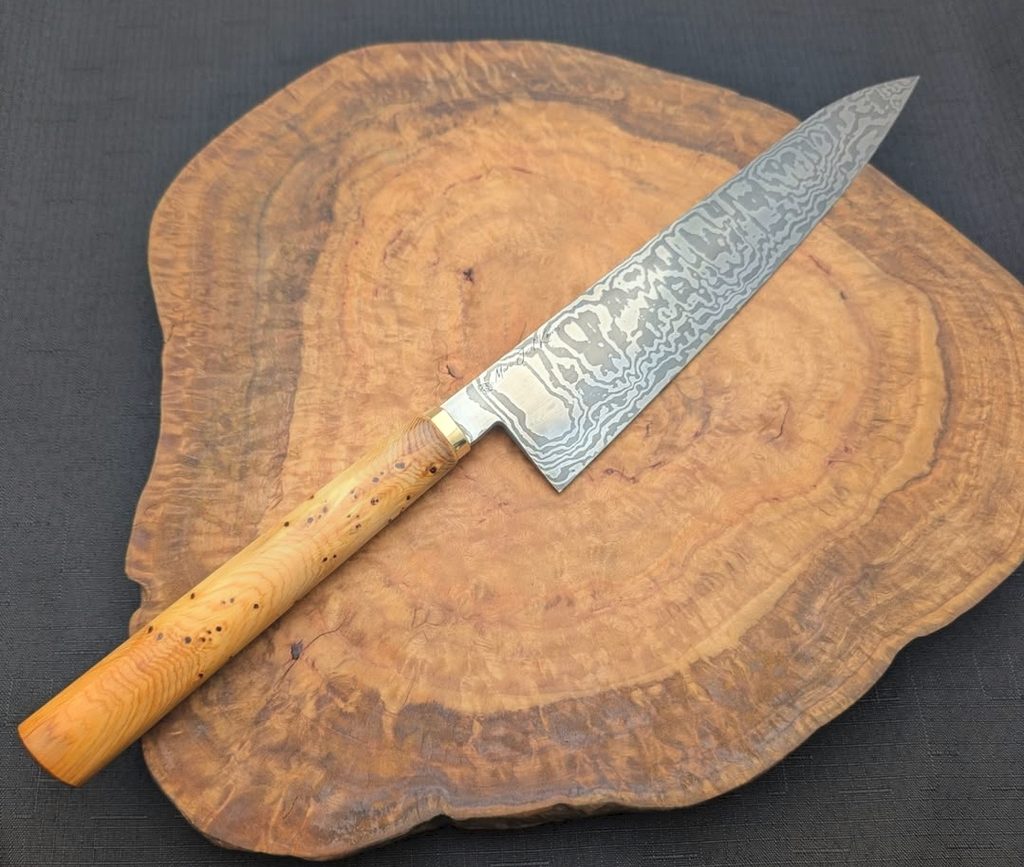
I like the way I can manipulate the layers for a unique finish. Other than the aesthetic appeal I also find them easiest to work with.
How has the knife world changed since you started?
Having started before COVID, I saw a fast and steady increase in Makers, especially in Australia. A lot of the general public were locked down for extended periods and this saw a lot of makers either starting up or evolving their skills. In saying that, with
all of these extra makers, it’s been great for the knife making community in Australia.
Makers are unconsciously challenging each other, in a supportive and non-competitive way, by lifting the standard.
What’s up next for you? Any exciting new projects to tell us about?
I’ve transitioned from my residential garage to a commercial workshop, ‘South Coast Forge’. The biggest benefit to this is I’m able to do knife making classes.
Another advantage of an external workplace is with an upscaling of machinery with a forge press, a heavy-duty mill drill and a 20kg power hammer. This is all a game changer to not only improve my productivity but also to widen my scope of works and
play around further with laminations and damascus.
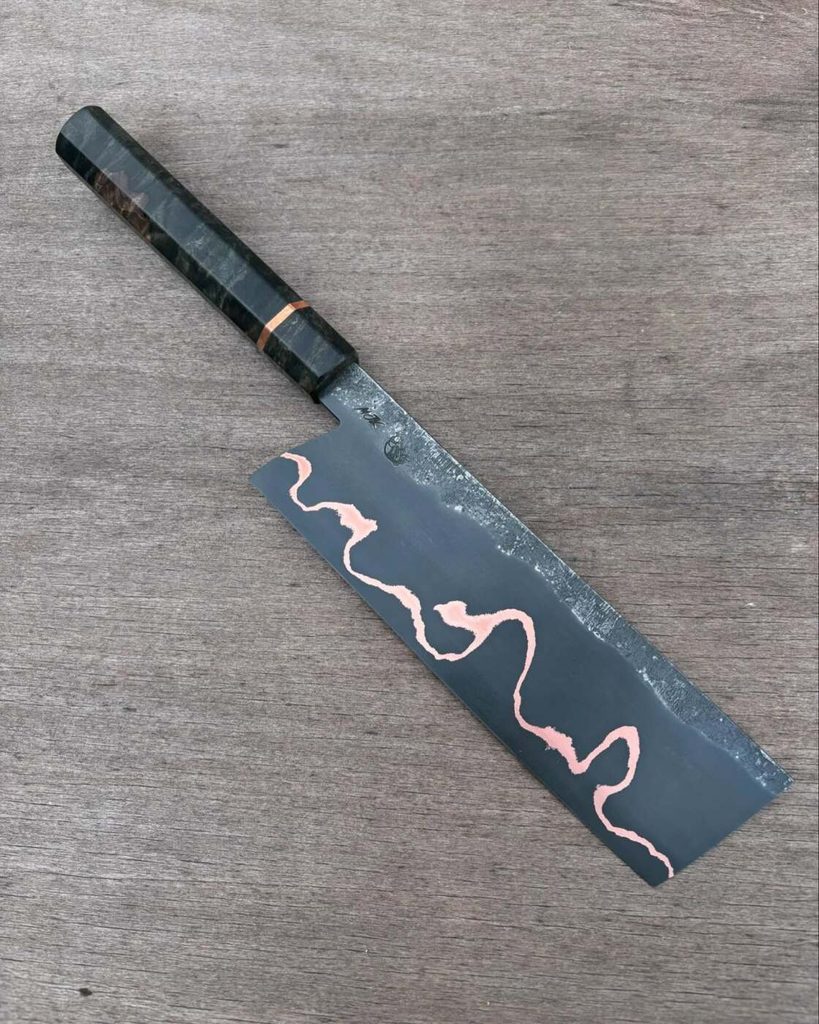
In saying that, I am going to broaden the courses to not only knife making but also other blacksmithing items. I’m also going to base some courses around artesian copperwork.
To keep up with what Marc is working on head over to his websites https://www.marcjosefknives.com.au/ and https://www.southcoastforge.com.au/ and follow him on Instagram at https://www.instagram.com/marcjosefknives/ and https://www.instagram.com/southcoastforge/
Leave a Reply