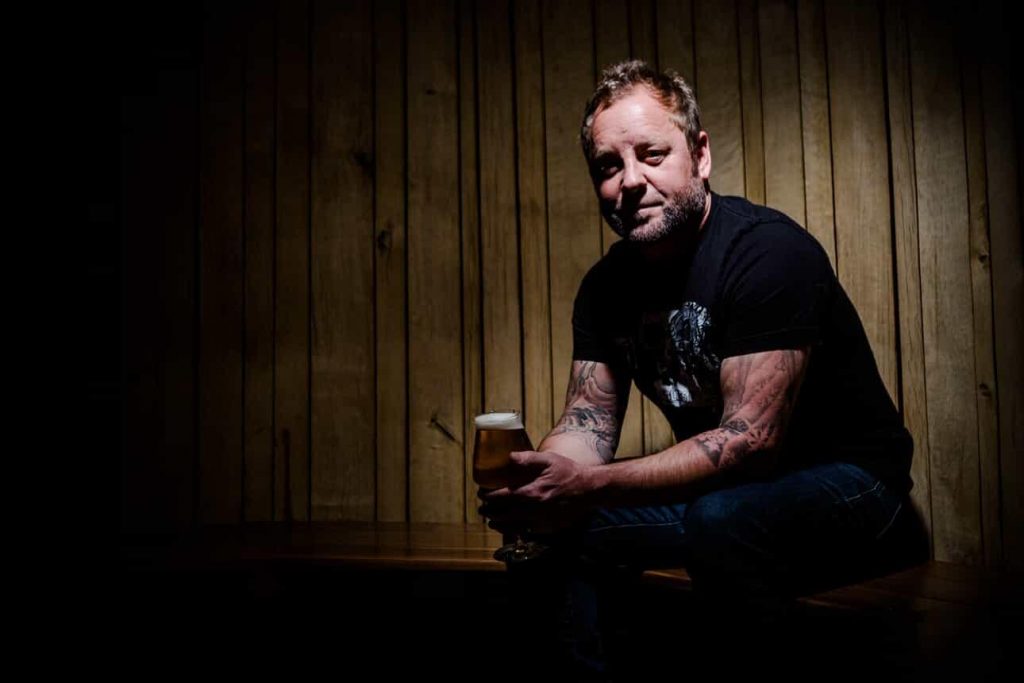
This week’s interview takes us to Alaska, USA and to the forge of Gabe Fletcher. His work is visually striking and grabbed my attention immediately. When I had the opportunity to meet him in person, I knew I wanted to get to know him and his work better. His thoughtful and creative approach is both inspiring and captivating. It is my pleasure to be able to share part of his story.
To start off, please tell us a little about yourself.
I own a brewery in Alaska, Anchorage Brewing Company. Been brewing professionally for 28 years. Started when I was 21. Have owned Anchorage Brewing for 15 years. I spend a lot of time making knives these days, but I also love to hunt, fish, cook, play music, and spend time with my incredible wife Jacenda.
What sparked your interest in knives?
I met Neil Kamimura a few years ago through my sister. We ended up at his place in Kona for my sister’s birthday four years ago and he showed me around his forge and showed me his knives. I was instantly inspired and knew right away this was something that I had to pursue. As soon as I got back to Alaska, I started trying to connect with other knife makers and also started to figure out how to build a forge out. I was fortunate that I had a space already at the brewery that I could convert into a forge.
What inspired you to do this and how did you learn?
As I said before, my initial inspiration was from Neil Kamimura. He learned a lot from Mareko Maumasi. Neil put me in touch with him, and I took my first class from him just six months into my journey. It was pretty hard to absorb everything he was teaching me, but it eventually started to sink in.
When did you start making knives?
Early 2022.
What did you make your first knife with?
I made my first knife as a gift for my wife Jacenda. It was a Santoku san mai made of 80CRV2 and 15n20. Spencer Sandison from Sandison Steel (previously Heavy Forge) helped me make it. I, of course, thought that it was the most amazing knife ever made! We still have it here at the house, let’s just say, I’ve gotten a lot better ;).
Do you have a favorite knife you made? Can you tell me about it?
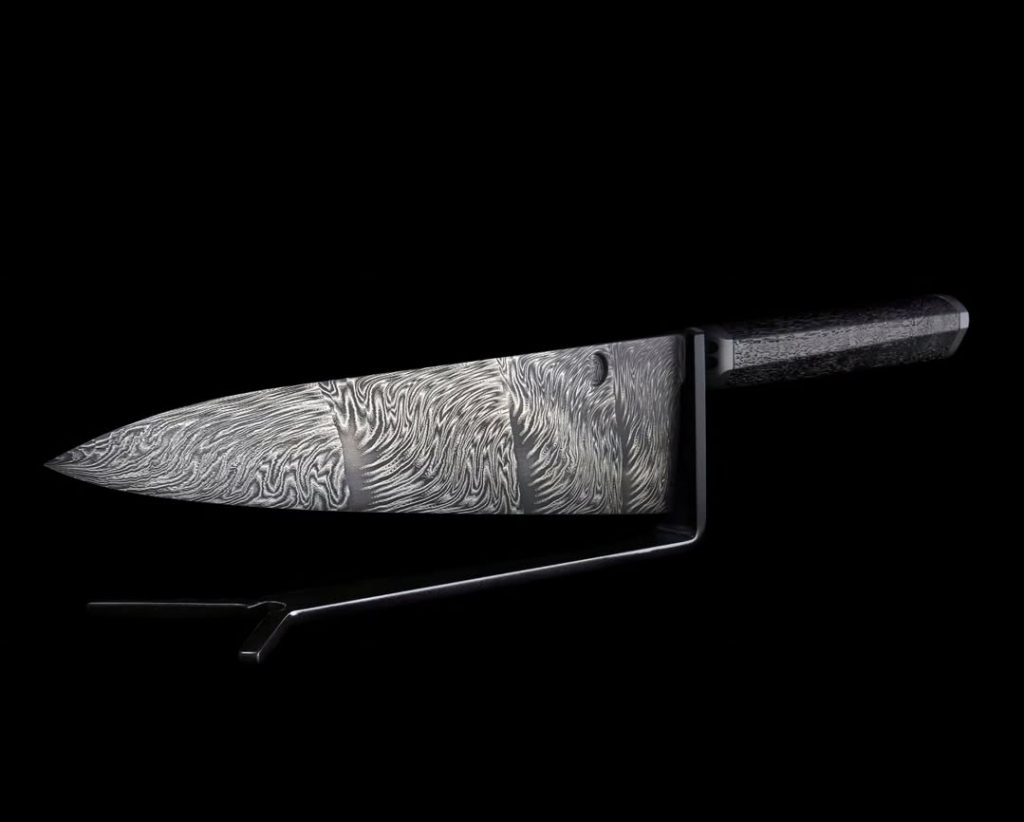
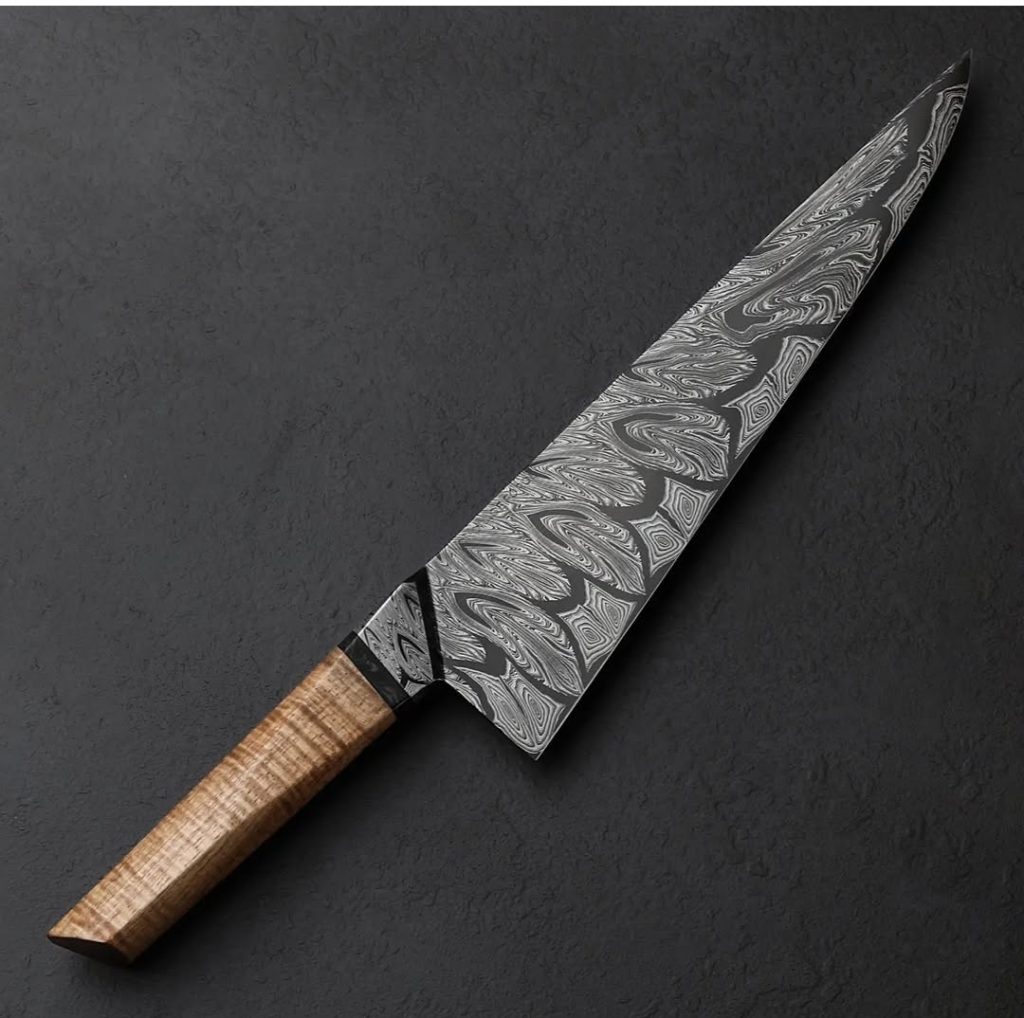
I think that would be one of my most recent knives. I was recently over in Austria for Knife Show Austria and while I was over there, Ben Kamon was gracious enough to have me at his shop for a few days. He showed me some really great techniques that I couldn’t wait to get back and try them out. The knife was a 9.5” gyuto with some special Damascus I made. I made a take down handle in the style of Kamon with textured ironwood. I also made that end cap from Damascus. That piece ended up winning Best Damascus at Blade Show Atlanta, which was a huge honor with such incredible makers entering that category.
What is the most important aspect of a well-made knife?
Performance of course, but I really strive to try and hit on every aspect. I don’t always get there, but I’m always trying to improve.
What keeps you going?
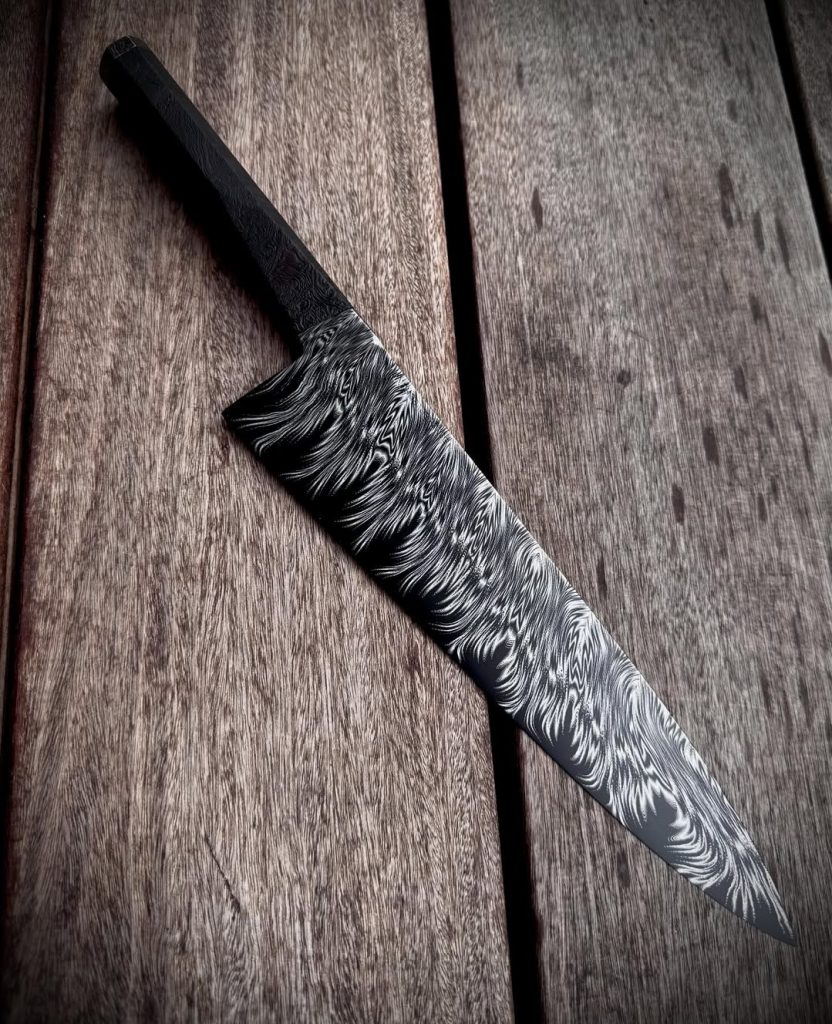
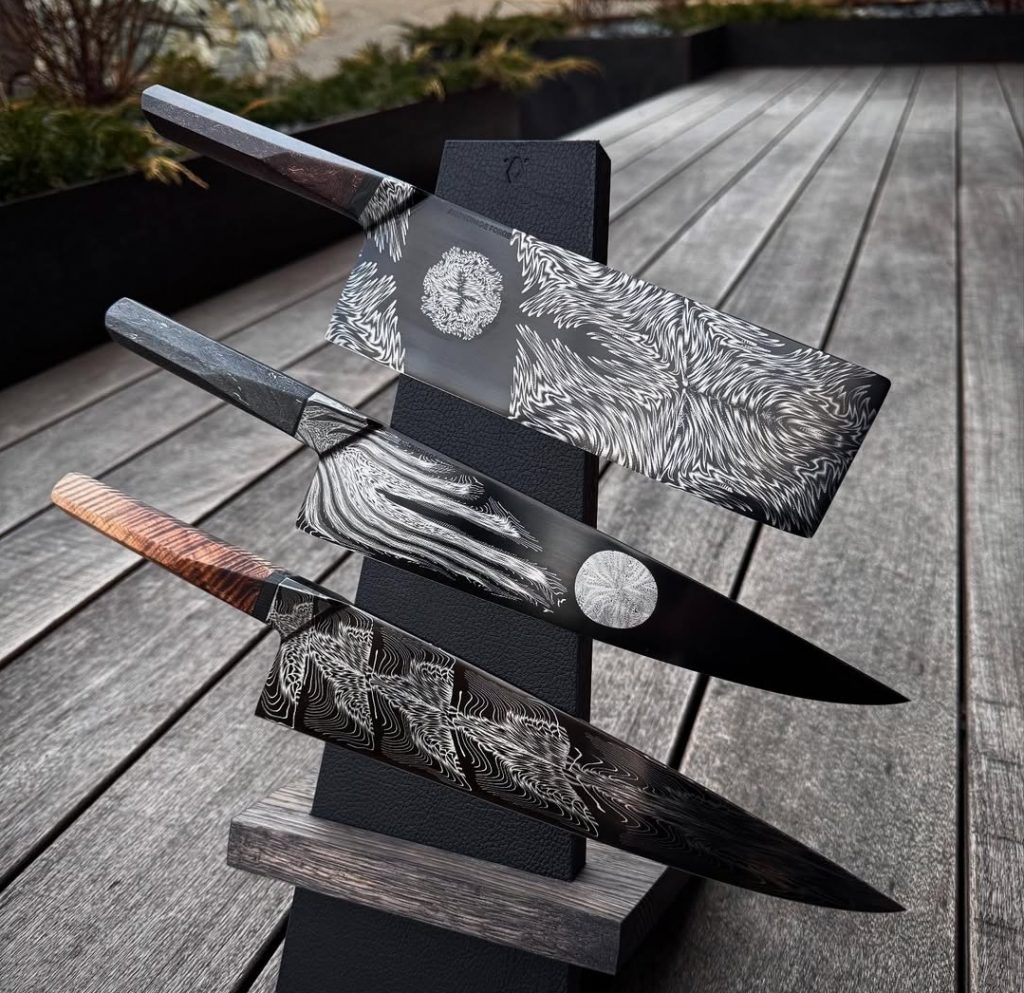
Learning more. Especially with Damascus patterns. I’m always trying to think of new ways to create unique flowing patterns. In the beginning I was pretty much just copying Mareko’s patterns step by step. Those building blocks I learned from him helped me understand how materials move and how I can start to make my own patterns from those techniques.
Biggest struggle?
Seems like every step is a struggle! But I just keep pushing through. I think the hardest thing for me was getting my geometry right. I think it’s pretty good now, but I’m always trying to improve it.
What kinds of knives do you make?
Mostly Culinary and some hunting knives. I like to make tools that I can actually use. I’m not into the fantasy thing, also I wouldn’t mind making a katana someday.
How did your background affect your approach to knives?
It definitely helped me learn faster. I have a lot of skills that I have learned over the years owning a brewery. Like metal fabrication, wood working etc, etc. I have always had a pretty creative mind, whether it’s writing music, painting, or building something. I grew up working with my hands in some way or another.
Who helped you early on?
As I said before, Mareko Maumasi. I would consider him my mentor and a friend. But I have also learned a lot from amazing makers out there that are always willing to share. Josh Prince has helped me a lot creatively. He has a really unique way of creating patterns, I’ve definitely incorporated some of those techniques into my work. I also took a class from Salem Straub which really helped me dial my finish work in. One day I’d like to make it back to his shop and just work on Damascus. I’ve learned a few things from Neil Kamimura but mostly he’s just always been very supportive of me.
Who are your influences/inspirations?
Well pretty much the same people, Mareko Maumasi, Salem Straub, Josh Prince, Steve Swarzer, Jason Knight, Adam DeRosiers, Ben Kamon, Neil Kamimura, Charlie Ellis, Will Brigham, Don Nguyen and the list goes on and on… it’s hard to list everyone. There’s sooo many incredible makers out there that inspire me. Some people who inspire me may not even make knives they just create incredible things.
How do you think those inspirations translates into your work?
I think every part of my knives are somehow inspired by someone else. I think that is true for everyone in some way. I’m always trying to figure out ways to set my work apart from others, but there is always something in there that was inspired by someone or something I saw.
Any specific breakthroughs or revelations in your knife making journey?
Constantly. I think my most recent breakthrough was an etching technique that I came up with. It spawned from some techniques that I learned from Mareko, but I figured something out recently that really made my etches as close to perfect as I can get.
What is the perfect knife?
For me, it’s a 9.5” Gyuto with nice thin convex geometry.
How do you approach a new concept and that concept’s implementation?
It’s usually just in my head. I’m good at visualization. I can move images around in my head and see them pretty well. As I learn more about Damascus, it gets easier to see the end result.
How do you approach knife testing?
I don’t test every knife. Maybe I should, but I usually run out of time.
How do you develop a design, select a steel, and fine-tune a heat treatment?
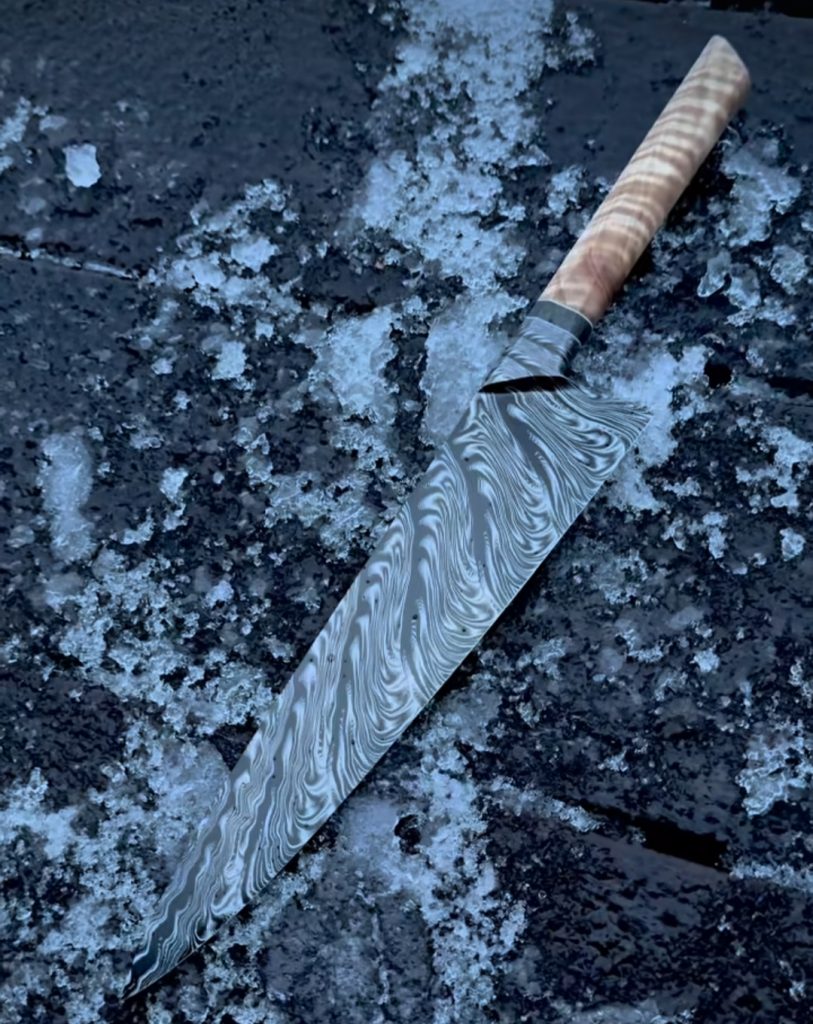
Just in my head really, I don’t mess around with many different steels. It’s mostly 15N20 and 1080. Heat treating that is pretty basic. I’ve worked with Apex Ultra a bit and there are definitely some different ways to heat treat that steel. I’m just about to start making Stainless Damascus. I started forging it about a year ago, but I realized that it was a waste of time until I got some bigger machinery to move the material.
What do you like about 15N20 and 1080 steels? They are predictable and easy to work with and make Damascus with a very high contrast. It might not be the most high-performance steel out there, but I think it’s good enough!
How has the knife world changed since you started?
Well, I’m still pretty young in it. I would say it seems like the machinery side of things has exploded. Seems like every day there some new grinder or jig out there that makes a certain task easier. There has also been an explosion of new makers, probably starting right around the time I started. It will be interesting to see who stays the course and who decides to keep making. It seems selling knives has gotten more difficult for makers as well. I’ve been very fortunate I haven’t had that issue yet, but I’m also lucky to not have this be the income I rely on.
What’s up next for you? Any exciting new projects to tell us about?
Lots of new beer and knife collabs coming up with Adam Derosiers, Will Stelter, Fingal Ferguson, and Spencer Sandison for now. I have two Beaudy power hammers a 150# that came on line in July and a 400# I got from Will Stelter that just got going a couple weeks ago. I am in the process of making Damascus for a custom gun maker Appellation Armory incorporating steel from the World Trade Center.
For more information and to keep up to date with what Gabe is working on, give him a follow on Instagram https://www.instagram.com/anchorageforge/ and you can also get info on his brewery and check out his merch here https://www.anchoragebrewingtogo.com/
Leave a Reply