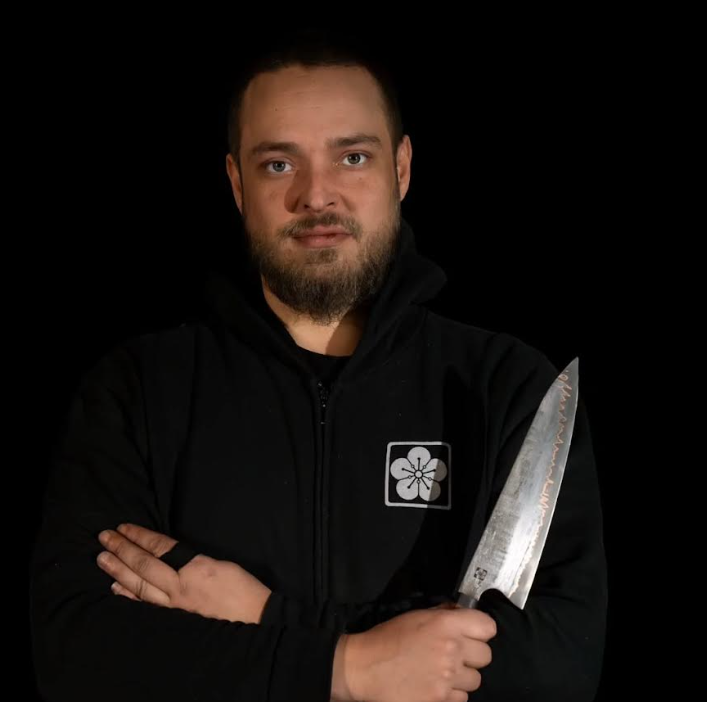
This week’s interview is with a knife maker who has very quickly gained a reputation for making knives that embody functional art. He is both meticulous and adventurous a combination that allows even his experiments to be refined. I have greatly enjoyed watching his style evolve and to share his story with you.
To start off, please tell us a little about yourself.
Hi, my name is Kurt Glatt, I’m 40 years old and I live in the beautiful city of Freiburg, super close to the Black Forest in Germany together with my two daughters and my wonderful wife.
What sparked your interest in knives?
I guess the interest in knives is something every boy has from birth and it’s the most important tool of mankind. For me it’s mostly about cooking. I really enjoy cooking for my family even if time is limited with both parents working and two small kids. I still cook every day and try to make the best out of it.
What inspired you to do this and how did you learn?
I work as a designer for all kind of things like web design, print, interior, and so on. But it is very imaginary if you only create things on paper or the computer that’s why I started woodworking in the first place. I even ran a small carpentry company for a couple of years while still designing and developing code. Then our landlord had to shut the shop down and I moved in with my current shop mates who do a lot of machine construction, development and metal works. One day a friend of theirs showed up and told me that he’s forging knives in his shed. I was super thrilled right from the first moment. I never thought it would be possible to do
this, but now everything seemed very reasonable. I was tired of what I saw as a “throwback culture” in the industry and was inspired to create something modern and high-quality myself.
When did you start making knives?
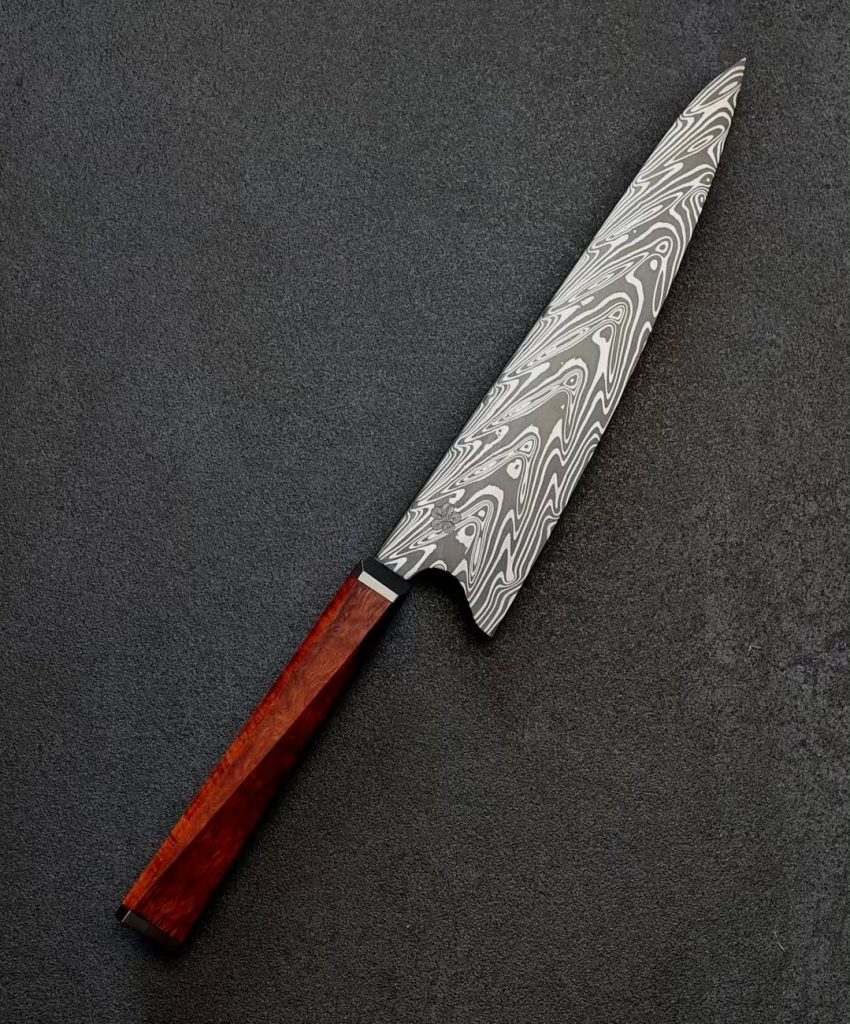
Exactly three years ago I bought my first forge and a small used anvil and tried to forge my very first piece of Damascus. But I didn’t make my first knife for another year.
Why did it take so long?
I guess you could say I’m a bit ambitious and don’t like to cut corners. My goal wasn’t to make something that just looked like a knife; I wanted to build a high-quality tool from the beginning. This meant I needed better equipment than I had, so I decided to build my own hydraulic press and a proper belt grinder from scratch. It took time, but it was essential for achieving the level of quality I was aiming for.
Do you have a favorite knife you made, tell me about it?
This is really hard to tell and probably the main reason I enjoy knife making so much. I’m getting bored super quickly. But when forging knives there is a progression over the years which doesn’t seem to end. So today my latest build would be my favourite, but maybe only until I finish the next one.
What is the most important aspect of a well-made knife?
Unpopular opinion but for me: geometry, profile of the cutting edge, balance in this order. Of course, proper heat treatment is fundamental and has to be done properly in terms of grain size and so on, but I believe the physical qualities of the blade are what a user will notice and appreciate every day. While a beautiful fit and finish is a hallmark of quality, if the edge isn’t ground thin enough or the profile is too fat as seen on many convex grinds or the knife feels too heavy or slow, you won’t enjoy using it, and that’s what a knife is made for.
What keeps you going?
The daily process of developing new shapes, patterns, and processes is what drives me. I’m constantly pushing to get better every day.
Biggest struggle?
My concerns about overall quality, fit and finish, pricing. It’s a constant effort to be confident in my work and the value it provides. And I have struggled with depression since I was a teenager which makes it hard sometimes to get myself up for work when there is a break.
How did your background affect your approach to knives?
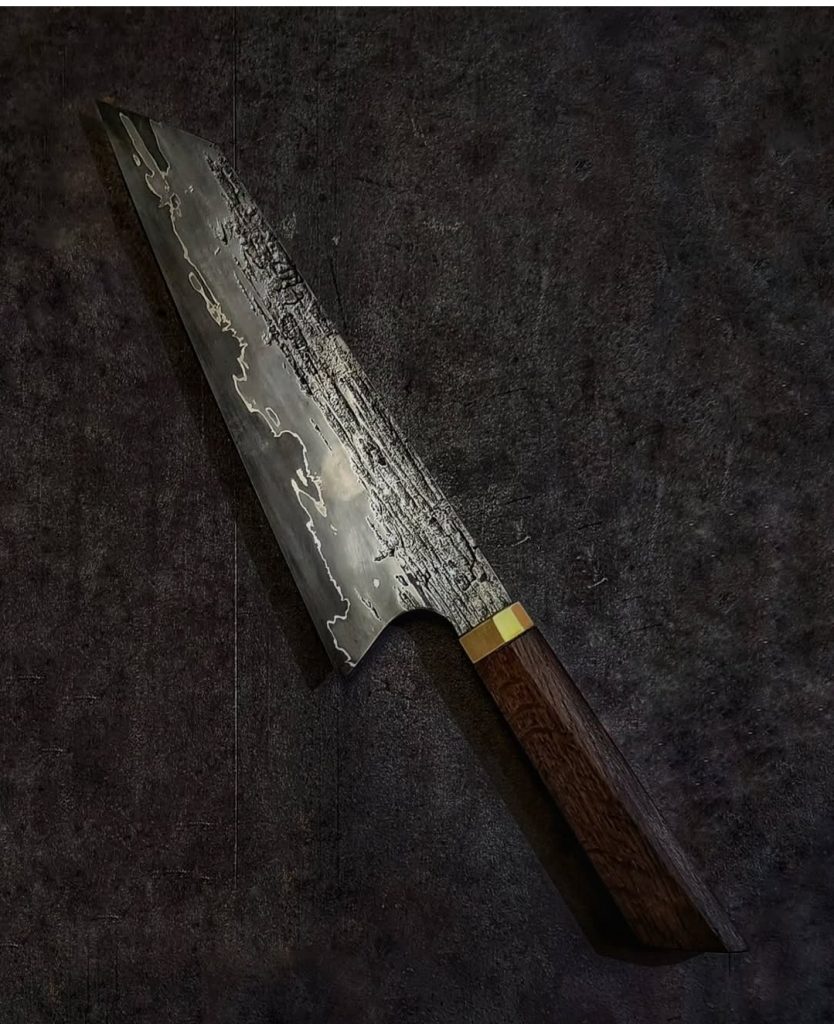
Form follows function. That’s the most basic rule you learn as a designer to keep you on track and not get too crazy. Also, I’m very into numbers which helps me a lot. For example, I want the blade always ground to <0.1mm behind the edge, then <1.3mm at 10mm
above the edge, <1mm at 10mm before the tip, and have a flat spot of at least 60mm or a quarter of the length and so on.
Who helped you early on?
The community is just awesome and something you won’t find in any other craft! So many great makers answered my questions from the beginning and supported me. To name a few,
Jonas Nöding, Shirknives, Tobias Hangler and many more.
Who are your influences/inspirations?
Hard to tell because there are so many. I would say Jeroen Knippenberg for his insane pursuit of perfection. Mareko Maumasi for his pattern development and the way he changed the art of pattern welding. Tobias Hangler for his mind-blowing molecular understanding of steels. Karol Karys! Design genius and he made my favourite knife to date. But there are so many more… Don Nguyen, Eric Gullikson, Ben Kamon, Martin Huber, Julian
Roche, Antoine the Adonis, Timo Hardent and many many more.
How do you think those inspirations translates into your work?
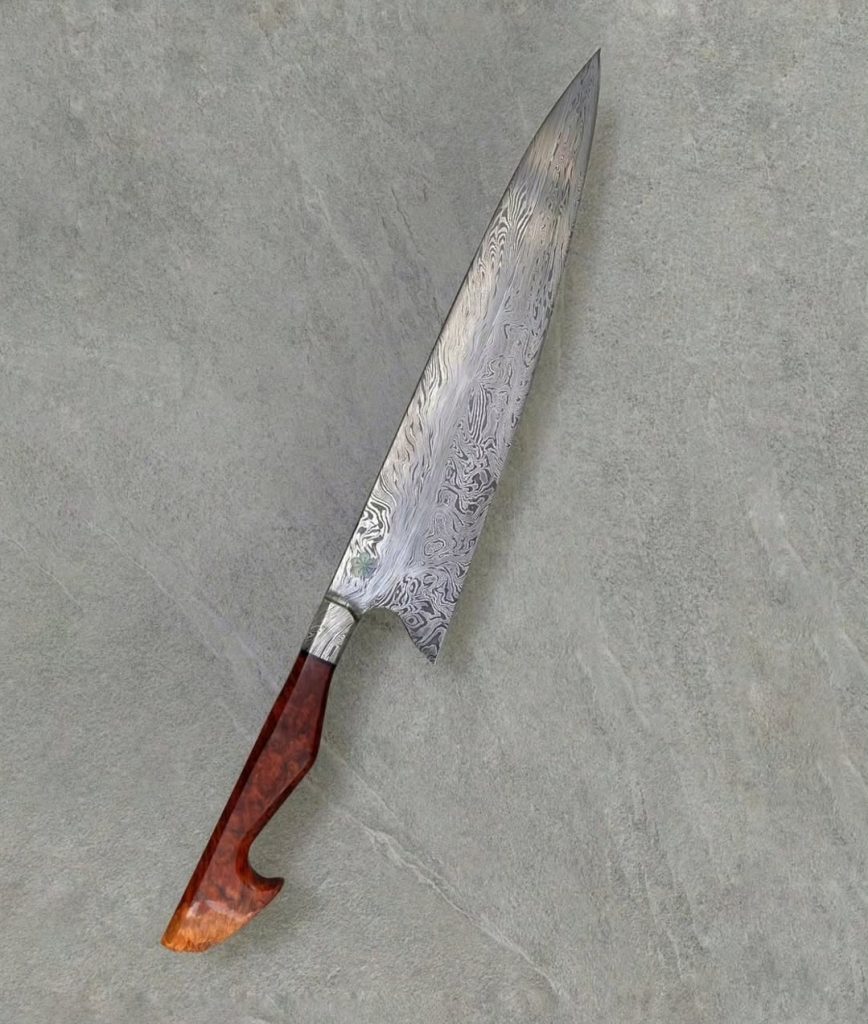
I think there are more obvious influences like the floating Damascus patterns from Mareko or the titanium fittings from Ben. But also, more hidden ones like the steady improvement of fit
and finish from Jeroen.
What is the perfect knife?
That’s very much about user preference and depends on many aspects like your cutting technique, body height, strength and so on. But I think everyone should have a good Nakiri. For me that’s the most underrated knife since we all cut mostly vegetables.
So, the perfect knife would be a Nakiri with about 180mm cutting edge, 60-65mm height, spine of 3,5 tapered down to 2mm. Bevel height of about 40mm so it gets thin without becoming too much of a laser. Some kind of C-Grind, S-Grind, or random hollows for the food release starting at 10mm above the edge. With a nice long balanced modern wa style handle to keep track of the edge position. This is a knife everyone could use and enjoy.
How do you approach a new concept and that concept’s implementation?
I do draw a lot, and I really love lists, so I make a lot of them,haha. That’s also why I love forging Damascus even that my personal preference would be mono or SanMai in terms of aesthetics. But the process of developing a pattern and reverse engineering is fascinating.
How do you approach knife testing?
To be honest, I’m not like Jeroen testing every single knife for days at home. Some of the knives I do the basic testing on some potatoes, cucumbers and carrots. But many you can tell from just the profile, edge and weight that they will perform well.
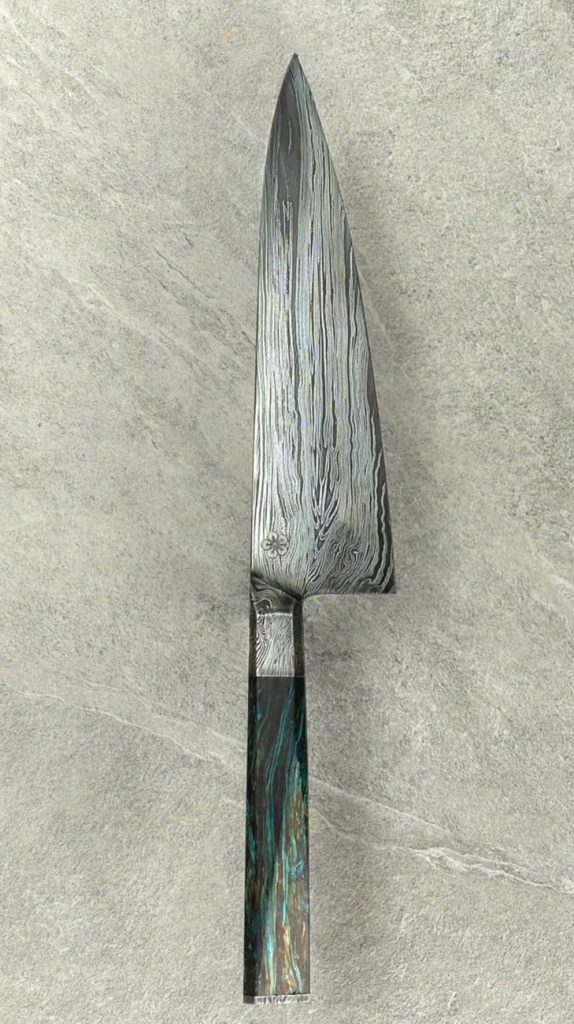
How do you develop a design, select a steel, and fine-tune a heat treatment?
Again, form follows function! Mostly there is a drawing either on paper or just in my mind with an idea of the rough shape, pattern, bolster and so on. I don’t use that many different steels
but enjoy trying new things like a full Aeb-L CuMai. But basically, there are a few steels I use often: Apex Ultra for the Performance knives, 02 and 15n20 for Damascus, Aeb-L for stainless and 1.2419 tungsten steel for mono knives. So, these steels I have dialed in pretty well, I think. I do have all my lists where I noted the best results from all my testing, and I am quite happy with the results.
What’s up next for you? Any exciting new projects to tell us about?
I do have lists and ideas for the next 10 years probably. If everything works out like intended, I will move to a much bigger shop soon with more space and possibilities to increase what I can produce. I recently dropped a batch of the Elementary production knives and hope to have a new series in the spring.
To keep up to date with what he is working on head over to his website https://glattknives.com/ and follow him on Instagram https://www.instagram.com/glatt_knives/
Leave a Reply