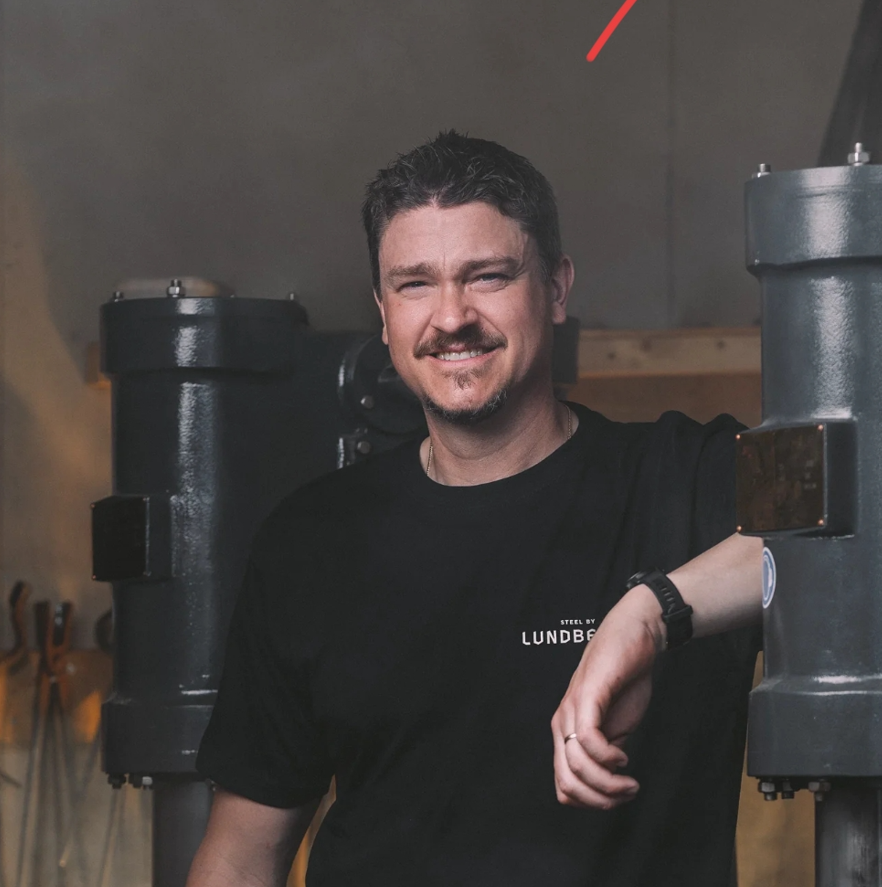
This week’s interview takes us to Sweden. A full-time knife maker for several years, he has built a great reputation for making fantastic kitchen knives. I really appreciated his openness in sharing how his craft evolved. We all start somewhere, but where we end up often relies heavily on the effort we put in. I am very happy to be able to share his story.
To start off, please tell us a little about yourself.
My name is Mattias Lundbergs and I’m 42 years old, married with two kids, 11 and 8 years old. I also have a dog, a 4-year-old golden retriever called spicy white (we just say Spicy to make things easier)he got that name as spicy white (26c3) is my favourite steel to use.
I started Steel by Lundbergs in 2017 as a hobby maker. I’ve been a full-time knife maker since 2020, and besides myself there are 4 full-time employees at Steel by Lundbergs.
What sparked your interest in knives?
I’ve always been fascinated by knives, and I got my first knife, a small folder, when I was 4 years old. Things were different back in the 80’s and giving a 4-year-old a knife wasn’t as strange as it would be today. I did cut myself really bad with that blade, but that’s part of learning I guess.
My interest in knives just grew bigger, and I started collecting knives when I was like 10 years old. I remember buying a really bad Rambo replica at a fair, it had a really bad plastic handle, you know that one with a screw on end cap (a compass) that holds like matches, fishhooks and stuff inside the handle. That handle broke almost immediately, and me and my father tried to make a new handle for it, I remember that we used pine wood and painted it black, so a very bad plastic handle became a very bad soft wooden handle but I loved that knife since we made that handle ourselves and it was my first meeting with “knife making.”
When I was 14 years old, I made my second knife. This time I was at a work shop since we were having work experience as a school subject, the guys working at that workshop was a bit better equipped than me and my father was at our first poor project, so knife number two came out a lot nicer than the first, and we used a old refurbished Mora blade and the handle was a beautiful piece of rosewood. I loved that knife too but unfortunately, I left it in my first car and forgot about the knife and when I sold that car the owner probably got a bonus knife with the car.
After my 9 years in elementary school, it was time to choose an education for high school and for some reason my choice was the culinary art education and training to become a chef.
When I look back on that choice now 27 years later, I’m most certain that I made that choice just to be able to work with knives, because cooking was absolutely not one of my skills before entering that education. I didn’t even know how to cook pasta, but it was a job that suited me well and I learned so much and developed as a chef and person during the 20 years I worked as a chef.
What inspired you to do this and how did you learn?
For about 10 years ago, in 2015-2016 I started to look into the world of knife making. I was thinking of making myself a set of knives and at first my idea was to buy finished blades and just make the handles for them, but as I often approach things, I have a hard time just going halfway, and often find myself taking a deep dive, headfirst, into new interesting stuff. YouTube had shown me some interesting videos of how to make a knife, and my first thought was,”how hard can it be?”
I’m very happy that I didn’t know the answer to that question at that time, because I would probably not have taken that headfirst dive otherwise.
What did you make your first knife with?
So, after checking some more YouTube videos, I took an old piece of steel (it was mild steel, but I didn’t know the difference at that time) starting to hog off some material with my amazing 40-dollar belt grinder that I bought at a grocery store.
After a few minutes I learned that the belt grinder was not amazing, it was bad, and the belts were even worse. So, after a couple of days I had some knife looking thing in front of me (I think it was a Bowie) but it could not hold an edge.
That’s the moment that I heard about the heat treat stuff that I until that day had never heard of before. Of course, I had heard about different hardnesses in steels since I’d used knives for all my life, but I thought they just came with different hardnesses from the start.
I made myself a small forge, some bricks and a blow dryer, charcoal and some matches, and I had an awesome heat treat oven (no, it was not very awesome, haha) but after quenching the blade in some kind of oil (can’t remember what kind I used) the knife was still soft, and that was the time that I learned about martensitic steels (are there more than one?).
So, I bought myself a piece of 1095 steel, spent 3-days hogging off material with my “amazing” grinder, and then melted half my blade in the blow dryer bbq station. Is there such thing as controlled heat treat oven?
There was quite a bit of struggling before my first functioning knife was made, but after about one or two years, I think it was 2017, I had my first proper knife made, and it was a kitchen knife.
Do you have a favorite knife you made, tell me about it?
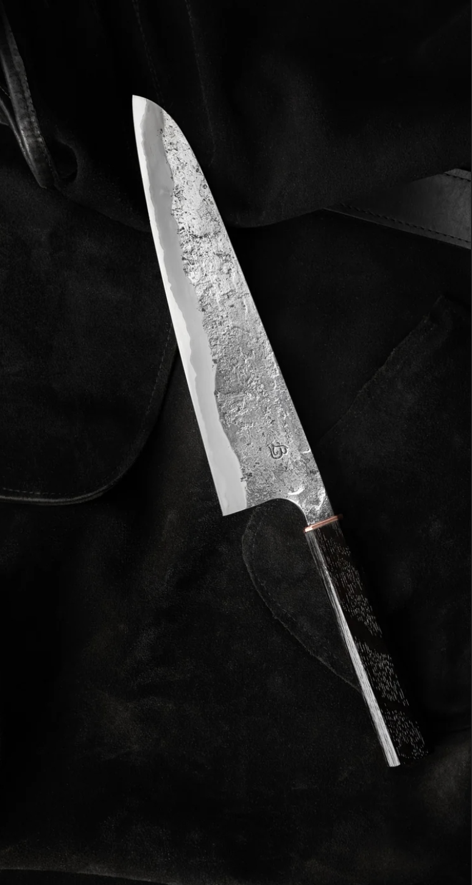
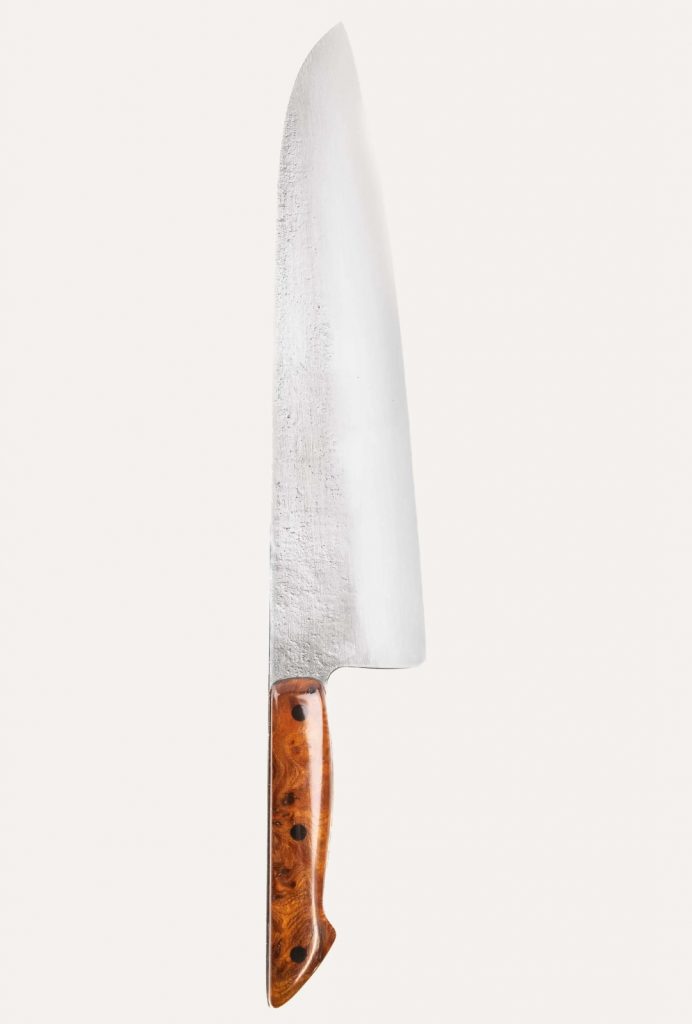
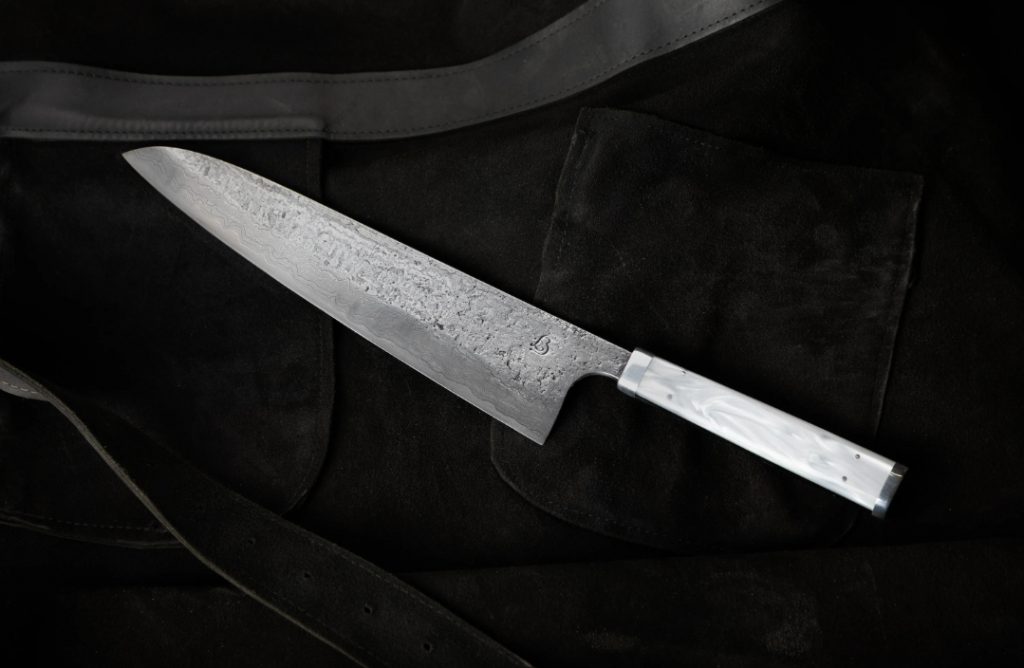
I have made a couple of knives that I keep a little closer to my heart, for example I had some real struggle doing the first proper San Mai blades, and when I say proper, I mean to get everything tuned in with forging, geometry, steel/cladding ratio, etc. Nowadays most of my knives are San Mai or Go Mai, but I try to remind myself sometimes about the struggle I had to get them as I wanted in the beginning.
My ”dream knife” concept is also one of my favourites, it’s a full tang construction with handle scales that are a bit smaller than the tang itself. The idea came to me when I was sleeping (a lot of ideas do) and I had to draw a sketch of it so I would remember it the next day and make it for real. The knife turned out great, and the handle was much more comfortable than I was hoping for. It also had the advantage of not leaving sharp corners of the tang if the handle material shrinks as the ”normal” full tangs can.
What is the most important aspect of a well-made knife?
Function. Of course, looks are important, you wouldn’t sell a drop-dead ugly knife, but the most beautiful knife in the world would not be very great if it couldn’t cut.
So, a combo of profile, geometry and good heat treat is crucial, and that the final product is user friendly.
What keeps you going?
The journey to become better. My goal has always been to make the best knives in the world, and at the same time make it in a sustainable way. I know I aim high, but why aim lower?
Sustainability is something very important to me from all aspects, I like to make products that can serve for a long time, to have a good working environment, work with as little impact on our environment as possible and at the same time have a sustainable economic aspect of it all. That final point is probably the hardest one, it’s not easy to make money doing this small production thing and also have employees. But making a small production and keeping everything handmade is also what makes businesses like this special, so you have to learn to love the struggle I guess.
Biggest struggle?
As I said, the economical aspect is the hardest one in a business like this. So, you have to keep the balance of everything, otherwise you don’t stand a chance.
Also, my biggest struggle when learning about knifemaking was that I didn’t have anyone to ask when I ran into problems, since I didn’t know any other knife makers. So, YouTube and social media were key to me. I do not want to know how many thousands of hours I’ve spend on YouTube checking knife making videos and I still do, but now more for entertainment.
Also, Dr. Larrin Thomas’ book, and his ”knife steel nerd” site has been a huge help for me!
What kinds of knives do you make?
99.9 % kitchen knives, we also make some hunters and bushcraft knives.
How did your background affect your approach to knives?
I would say a lot! Since I’ve been working professional in kitchens for 20 years, I’ve more or less been working with knives my whole life.
Who helped you early on?
YouTube and social media.
Who are your influences/inspirations?
I’ve seen so many knives and knifemakers during these years, and I have probably picked up a little here and there to create some kind of style of my own, but if there is one maker that has made a bigger impact on me, I would say William Catcheside, I love his work!
How do you think that inspiration translates into your work?
When I see a detail in someone’s work that I really love, I like to try it out and then transform that into my own style. And I never want to stop developing, so there will probably always be small changes in the details, and that’s what I love, to never stop trying to be better. If I would have settled in one kind of style and say,”Hey, I’ve made the best knife that I ever could make, I’m happy with this and won’t change anything more” then I would probably stop making knives that same day.
Any specific breakthroughs or revelations in your knife making journey?
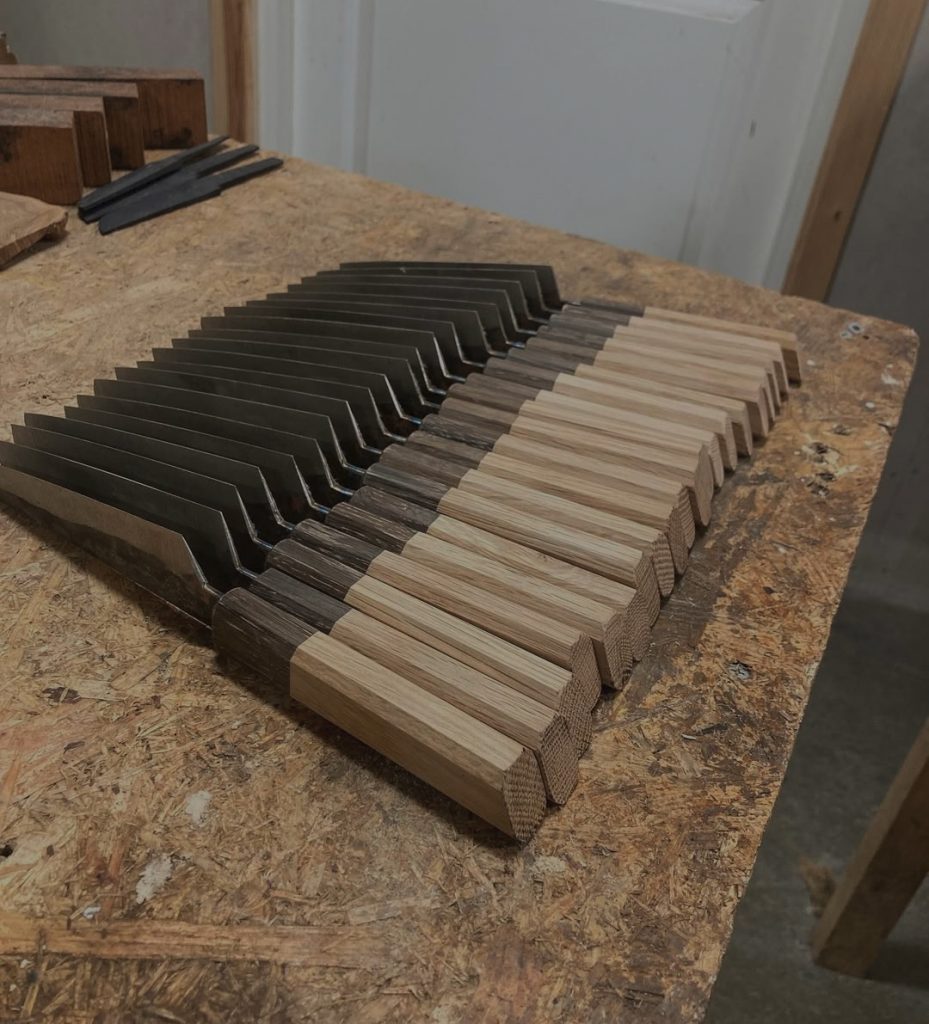
As I mentioned earlier, when trying to dial in the details in San Mai/Go Mai I spent so much focus and energy, so when I’ve finally made a blade that felt ok, took me a long time and a lot of trial and error, it felt like I won the World Cup or something, haha.
I still develop that game, but the main edge of that work is more or less in place.
What is the perfect knife?
Most boring answer in the world: there is no such thing.
But to give some kind of answer to that question I would say: The handmade one, a knife made by a passionate person that has put all his/hers heart, love and soul into a piece of steel, to make a sustainable tool that will serve for ages, that will be used by your kids when you have left this planet, and most importantly, is totally unique, there will only be one of that knife made, and it will never be able to be made again, every hammer blow has made it like its own fingerprint.
That is a perfect knife. Will it be perfect in every detail? No…. (If you ain’t Kyle Royer) but in my opinion you have a piece of historical treasure when having a handmade tool.
How do you approach a new concept and that concept’s implementation?
I dream about it, I think about it during my daily morning runs, I think about it when driving home from work, before bedtime….. I try to not think about it when hanging out with my wife and kids but most of my waking hours (and obviously also in my sleep)
I make drawings and sketches (I draw like a 4-year-old) I have this clear image of the piece in my head, but I can’t draw it, so I almost always make wood or steel templates to develop the product. And I can’t let it go until it’s made for real.
How do you approach knife testing?
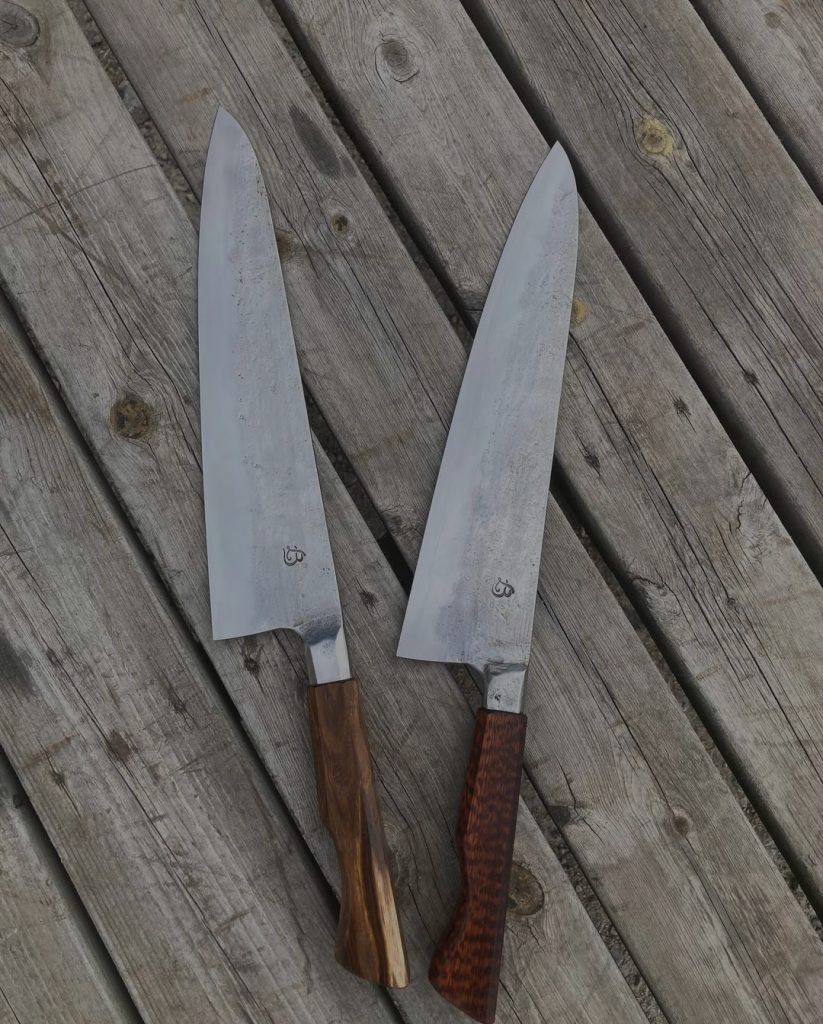
My standard test is test cutting on carrots, potatoes and onions, that tells me a lot of the performance of the knife and lets me know how to proceed when shaping the bevels.
How do you develop a design, select a steel, and fine-tune a heat treatment?
It’s like I mentioned before, it always starts as a thought, and what triggers that thought is different from time to time. Sometimes when I want to try out a new steel, I think about applications that could suit that steel. Sometimes I think of a special model and what steel could suit that kind of knife. It’s not very unusual that new ideas come to me when I sleep.
When trying out a new steel I try to analyze the heat treatment data of that specific steel. And most often I start to check out the attributes of that steel when heat treated to the ”max”, and that is not necessarily always what I look for in a knife, I try to find a good balance between hardness and toughness.
When I do heat treatment of a new steel, I always make a couple of test pieces and do different treatments to them. And then try them out by breaking them to check out grainsize and toughness, grinding and sharpening to test edge stability and sharpness, and of course I check for hardness on our hrc tester.
We heat treat in a PID controlled furnace so it’s easy to make different controlled heat treat tests.
What are your favorite steels to use, and what do you like about them?
26c3 is my favourite steel to use. It is a Swedish razor steel which is called spicy white since it’s an equivalent to Japanese white number 1 steel, with a few differences.
Why do I love that steel so much? Well, it’s amazing to forge and forge weld to about any material, gets extremely hard and gets probably as sharp as a steel could possibly get. It’s not the easiest steel to heat treat, and I’ve spent a lot of time to fine tune the methods that I use. At the same time, it’s a steel that can be heat treated with simple methods to extremely good results. I’ve probably made like 2000+ knives out of this steel.
Another steel that I really love to use is Damasteel (another Swedish steel I know, I’m a bit of a patriot)
It’s on the other end from 26c3, low alloy high carbon steel, I like to use Damasteel when making more luxury knives in stainless steel.
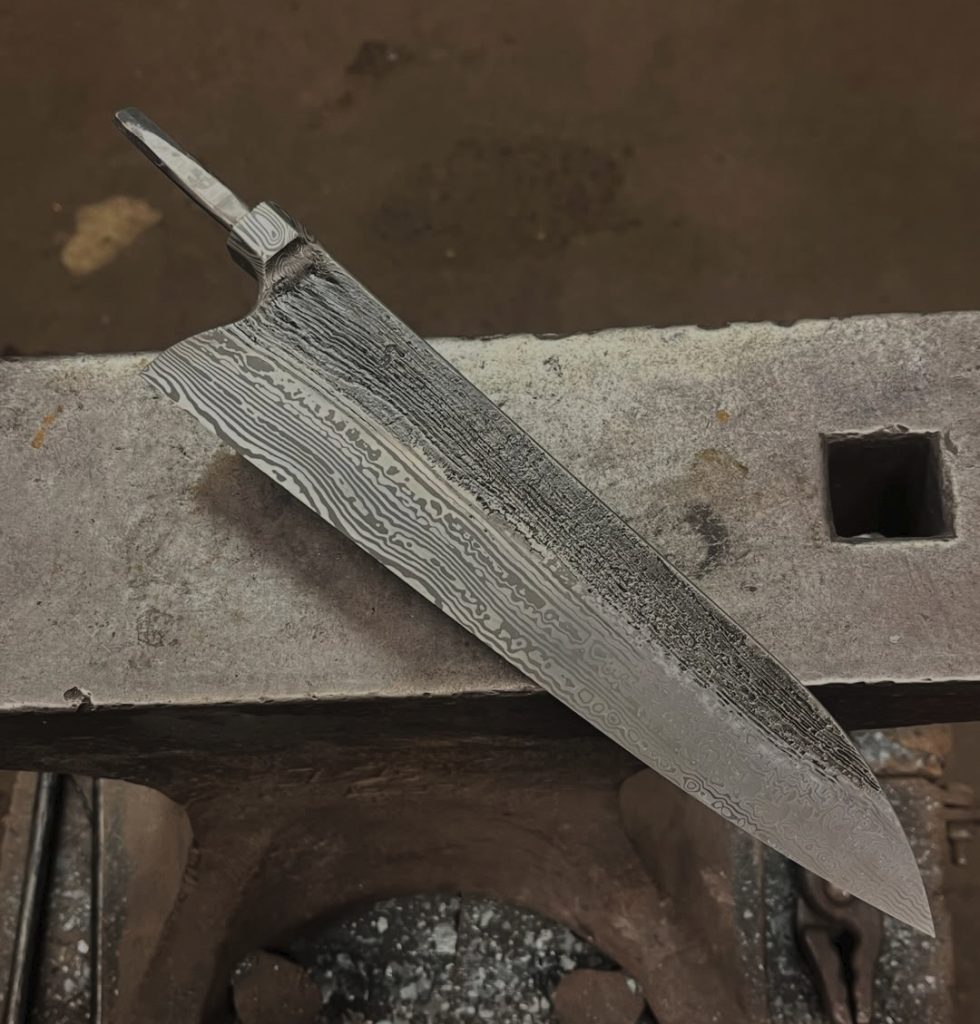
Damasteel is most likely the best stainless Damascus steel in the world, made from awesome powdered steels.
It’s forgeable, rather easy to heat treat (with a PID controlled furnace) easy to grind and polish for being a stainless powder steel, gets high hardness, sharpness and toughness and holds that sharp edge for a long time. And the different range of patterns available is amazing.
A ”new” steel I’ve had my eyes on for a long time now, and finally have started to use and making tests with is Apex ultra. I guess that most people in the handmade knife forums have heard about it nowadays, but here is a small presentation anyway.
Apex Ultra was created a couple of years ago by Larrin Thomas, Marco Guldimann and Tobias Hangler, three very experienced gentlemen in the world of knife steels and knife making.
Apex Ultra is a very extreme steel in every way except for not being stainless since it’s a high carbon steel. It gets extremely hard, is extremely tough, extreme edge retention. All if these applications are shown when working with this steel, it’s tough in every way. But when you have a finished knife made from this steel, you will have an amazing knife that will perform for a long time!
How has the knife world changed since you started?
It has grown, I started working full time as a knife maker in the middle of Covid summer 2020, and it felt like the community doubled in size at least during that period of time.
It’s not just more people that get into the knife making world as customers, it’s also more people that start making.
What’s up next for you? Any exciting new projects to tell us about?
Yes, a lot of exciting things are happening at Steel by Lundbergs, for example we took over Castra steel this autumn, a knife making supply business that was our supplier before. That is super exciting and we are developing that business like crazy right now if you want to check out that part of our business the web page is https://castrasteel.com
Also, some knife making news regarding my own knife making, the past years I’ve been working on a huge order. A Swedish company made an order for 2000 knives from me a couple of years ago, those knives were going to be produced over a 5 year period, and I started that order before any of the other guys started to work with me.
So for the last couple of years my colleagues Markus and Elias has been making like 98%of the knives for our web store, I’ve not been able to do pretty much anything else other than my huge order (I make those knives by myself since they have my makers mark on them) so it has been just a few projects here and there made by me available in the shop.
It’s like 1 year left on my big order so I have started producing a little bit more for the store. I am starting my own line for the store, and hopefully you will see some of these knives available,I am looking forward to this like crazy. What kind of knives, materials kind of forging, etc will be revealed, but I have some really cool ideas of what to do.
Fredrik Spåre at Spåre knives and I have also been working an awesome project together. We are making a ”Swedish classics” that’s a sports challange with different big races in skiing, cycling, running, and swimming. For every race we make a knife each and auction them off to raise money for the Swedish child cancer fund. So, follow us on Instagram and help us raise some sweet money for a good cause, and get yourself an awesome knife at the same time.
To keep up to date on what Mattias and the rest of the team at Steel by Lundbers head over to their website https://steelbylundbergs.se/en-en and follow them on Instagram https://www.instagram.com/steel.by.lundbergs/
Leave a Reply