This week’s interview takes us to the workshop of a former chef turned talented knife maker. I got to know him, first through experiencing his work, and then through the interview process. It certainly drove home for me what his priorities are and how those manifest in the finished product. The result is something special.
To start off, please tell us a little about yourself.
My name is Michael, I make culinary knives out of my workshop based in Birmingham, UK.
What sparked your interest in knives?
There is a sense of satisfaction when you are working with fresh seasonal ingredients, and this is intensified when you are using the perfect tool for the job. A chore becomes a pleasure. And so my quest to find the perfect blade for the job began, I became a knife nerd. I have been lucky enough to work with some very well renowned knives, each having their own charm, way of working. Subtle changes in form, shape, material can alter the performance dramatically. It is a balance between engineering, or really science, and art.
What inspired you to do this and how did you learn?
Soon I began to wonder if I could take my favourite components from those knives, I have worked with and craft something unique. I had particularly enjoyed working with Japanese knives. It inspired me to learn how to design the form most suited to both, the function and the end user. The majority of the learning process was through trial, error and a lot of plasters!! As I am self-taught, I was keen to explore a range different strategies, some worked, others did not. But in time I found my way of making.
When did you start making knives?
My knifemaking journey began in 2017 where it was initially a hobby, but I was able to progress this to a full time vocation in 2020.
What did you make your first knife with?
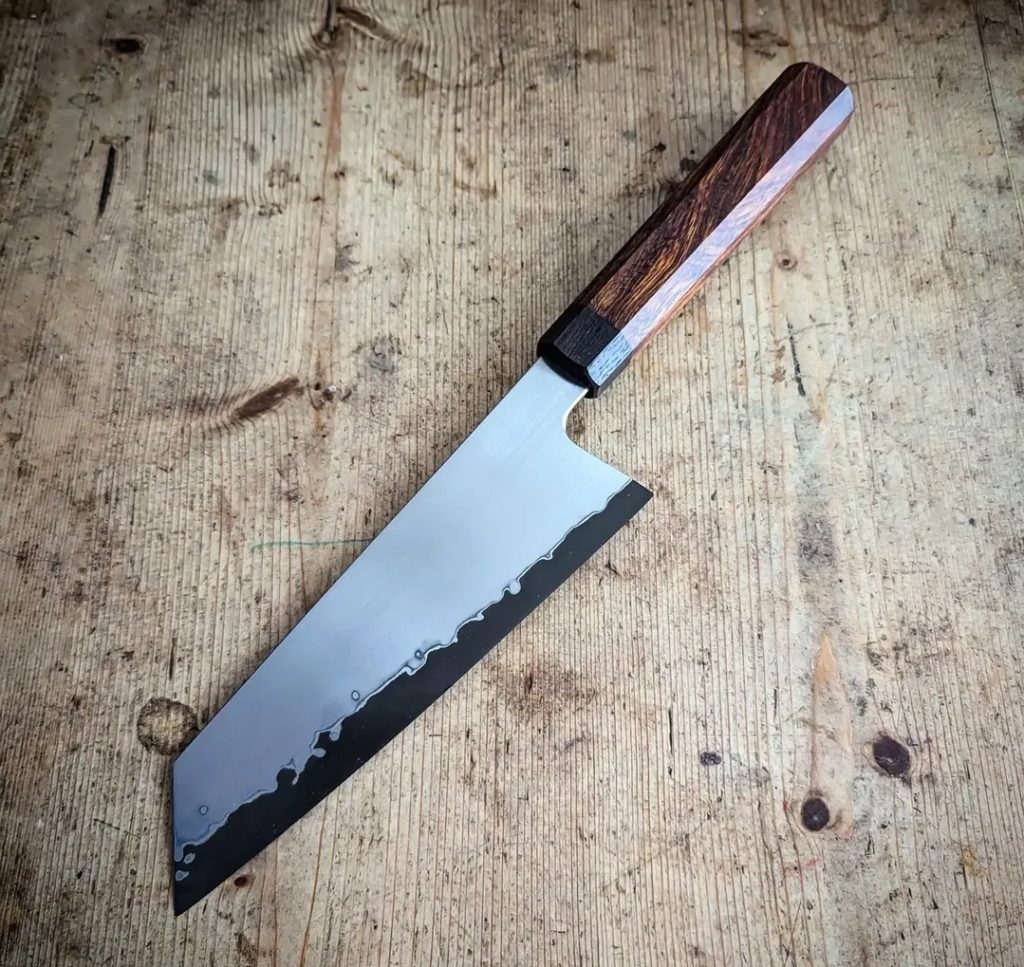
01 steel and a beautiful, rough cut piece of walnut, using my first homemade 2 x 72 grinder.
Do you have a favorite knife you made, tell me about it?
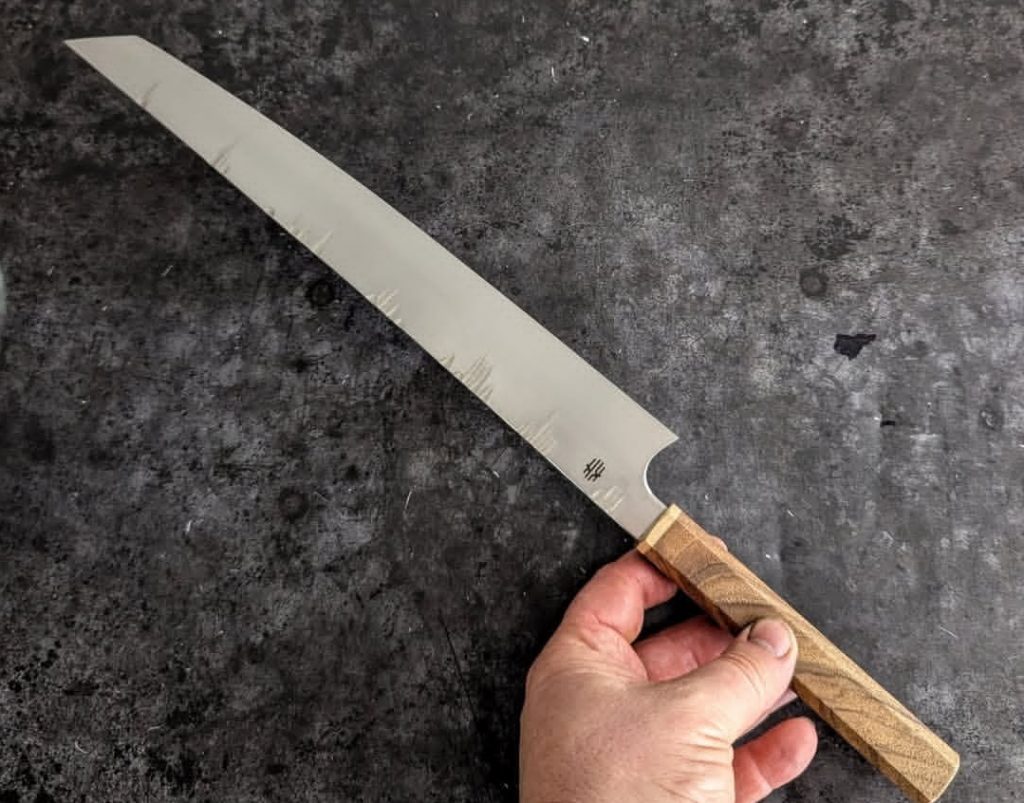
Oh, that is a tricky question, they are all so individual, it is like asking me to choose my favourite child…but harder! But one I am very fond of is a stainless sakimaru sujihiki with an English walnut handle and saya.
What is the most important aspect of a well-made knife?
All aspects of the knife must work in harmony. It is no good having a knife that has the perfect cutting ability but has poor edge retention or not aesthetically pleasing to the user.
What keeps you going?
Receiving feedback from those using my knives, now in all the corners of the globe. And perhaps the most motivational aspects are that I am lucky to have a great set of returning customers who are building personal collections from my work. I have even been sent a photograph from one guy, with a knife I made him, tattooed onto his leg!
Biggest struggle?
I am very keen to work directly with other people who are passionate about their craft. Sourcing the very best materials in an ever changing political landscape has been changeling. Plus I am rather an introvert, so promoting my craft is a bit of a mission!
What kinds of knives do you make?
I make chef’s knives, for professionals and keen home cooks.
How did your background affect your approach to knives?
Having worked with the end product for so many years as a chef, I had a very clear plan for what I wanted to create. So I guess you could say I worked backwards from that to the beginning of the knife’s journey.
Who helped you early on?
My family were very supportive, basically accepting that I was living in the workshop and only coming in to patch up injuries!
Who are your influences/inspirations?
I am influenced by the work of Japanese makers such as Yoshikane and Kobayashi. But I guess there are some many talented makers that influence you as your evolve your craft.
How do you think that those inspirations translates into your work?
I have been developing my own versions of laser knives, taking the geometric influence from those makers. These then feed into the methods that I have tested over the years.
Any specific breakthroughs or revelations in your knife making journey?
Every week there seems to be a new idea or tweak that I am keen to try out. It is rather like a knife evolution at the moment.
What is the perfect knife?
I will let you know when I find it, but the quest is half the fun. No, seriously, I think it depends on good heat treatment, geometry and cutting ability, our own expectations, and an attachment to the blade your are working with.
How do you approach a new concept and that concept’s implementation?
I have scattered drawings half finished all over the house, drives my family crazy. But those crucial first steps being right make or break the end product. I love seeing these come to life in the form of a prototype blade, ready for testing. Following successful tests, and the death of many carrots, the production process can begin.
How do you approach knife testing?
So this is where the carrots, potatoes and onions are the stars of the show, following the all important Rockwell test for hardness. It is also really important to me that I create the correct sharp edge on a blade, so I test for this also…queue the grapes to stage left.
How do you develop a design, select a steel, and fine-tune a heat treatment?
Making a knife is a little bit like cooking – source ingredients, plan a recipe and trust the process. However, if you follow the recipe there are always tweaks and variations along the way, I guess that is what makes it interesting. But any risks can be managed by a good set of check points.
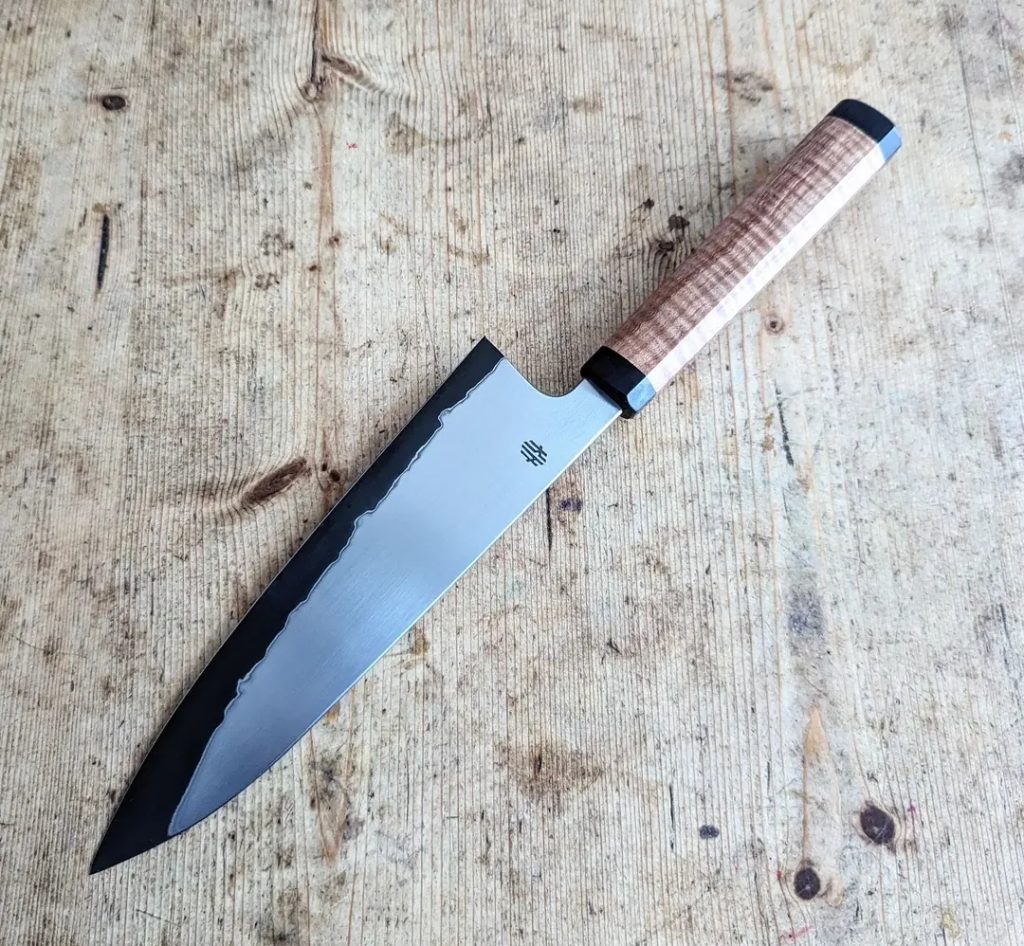
What do you like about sliver fox 100 (SF100 steel)?
Being stainless it is easy to maintain for the end user, it is relatively straight forward to heat treat reliably, grind and finish. I also love that it is produced close by in the UK, for those who are unfamiliar with this steel it is a British equivalent of AEB-L steel.
How has the knife world changed since you started?
The American market has really opened up during the last 3 years, there are also far more people looking for quality products, specific to their needs and so investing in timeless pieces. It is a really exciting time for knife makers.
What’s up next for you? Any exciting new projects to tell us about?
Yes, it is time for me to look at improving my building skills alongside my knife making…I need a new, bigger workshop!
To keep up to date on what Michael is working on head over to his website https://www.knothandcrafted.com/ and follow him on Instagram https://www.instagram.com/knot.handcrafted/
Leave a Reply