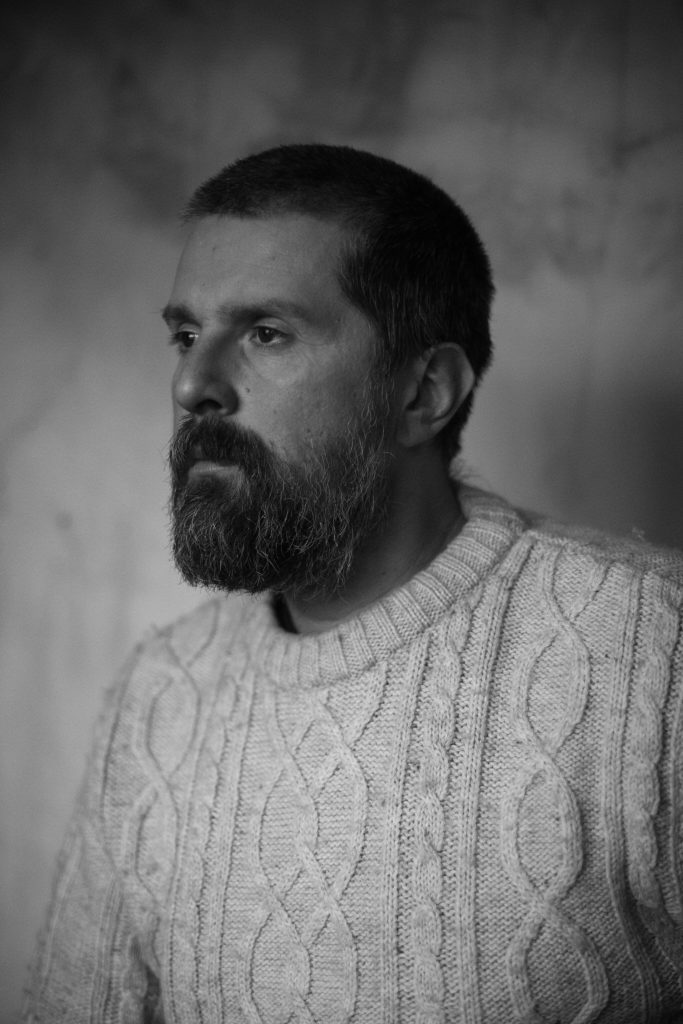
This week’s interview takes us to a workshop (Radiona) in Breg, when I was doing this interview it struck me how, in many ways, the attributes he likes to include in his knives are quite often the things I gravitate towards for my own collection. Of course I love a wide variety of approaches, but I am very pleased to be able to share the story of a maker whose sensibilities mirror my own, but from the opposite side of the forge.
To start, please tell us a little about yourself.
Hello, my name is Tomislav, and I’m an older millennial from Croatia who makes knives and enjoys taking long forest walks.
What sparked your interest in knives?
Since I was born into a family that worked in metal fabrication, I was surrounded by machinery and steel. We also made a lot of forged railings, so I started forging when I was in my teens.
Then, in my early twenties, I started to have an interest in Japanese swords, but when I learned that I needed iron ore from Japan to make a katana, that interest died quickly and transitioned to Japanese kitchen knives.
What inspired you to do this, and how did you learn?
Later in my life, I’ve worked in the film and theater industry, and that work was not entertaining enough for me, and I guess pure dissatisfaction with that kind of work inspired me to find something else.
The fact that at home I’ve had a power hammer that was collecting dust, and a suggestion from a friend, sparked the old kitchen knife interest, and a few YouTube videos later, I was in the rabbit hole.
The best way to learn is to start doing it, with some help from different online forums that educated me on geometry and metallurgy. I started on my journey of ruining a lot of steel and learning the trade.
When did you start making knives?
I started around 8-9 years ago, with the first year and a half of getting to something I could say is marketable.
What did you make your first knife with?
My first knife was made from a file, and it was something that you could use, but you wouldn’t because somehow it made you look uglier than you are.
But it was forged, I learned a lot, and the second one was much better.
Do you have a favorite knife you made? Tell me about it?
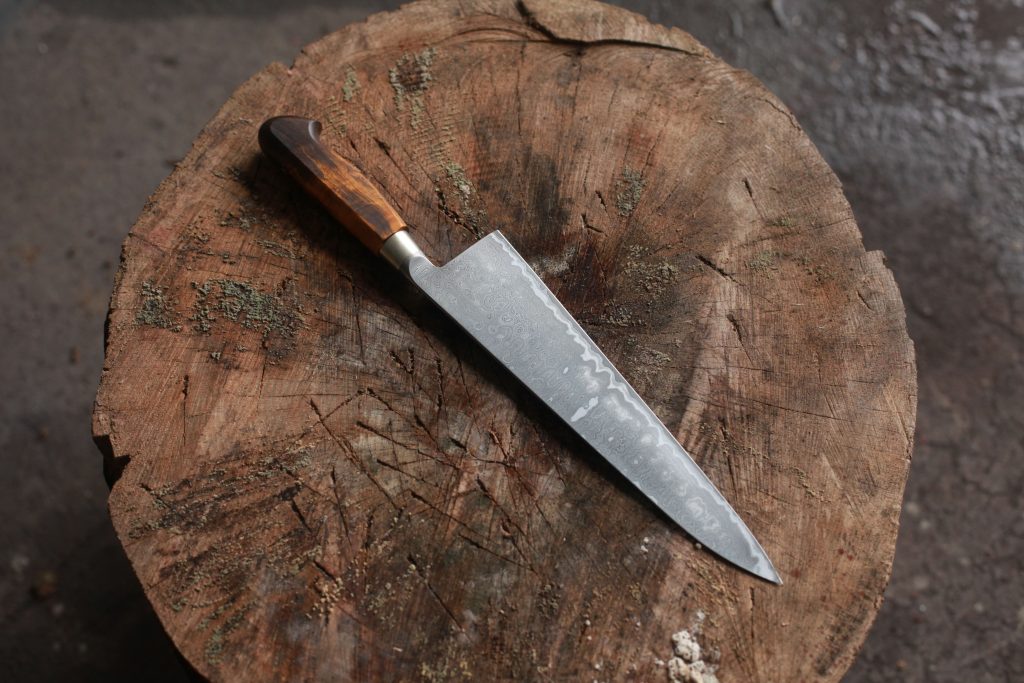
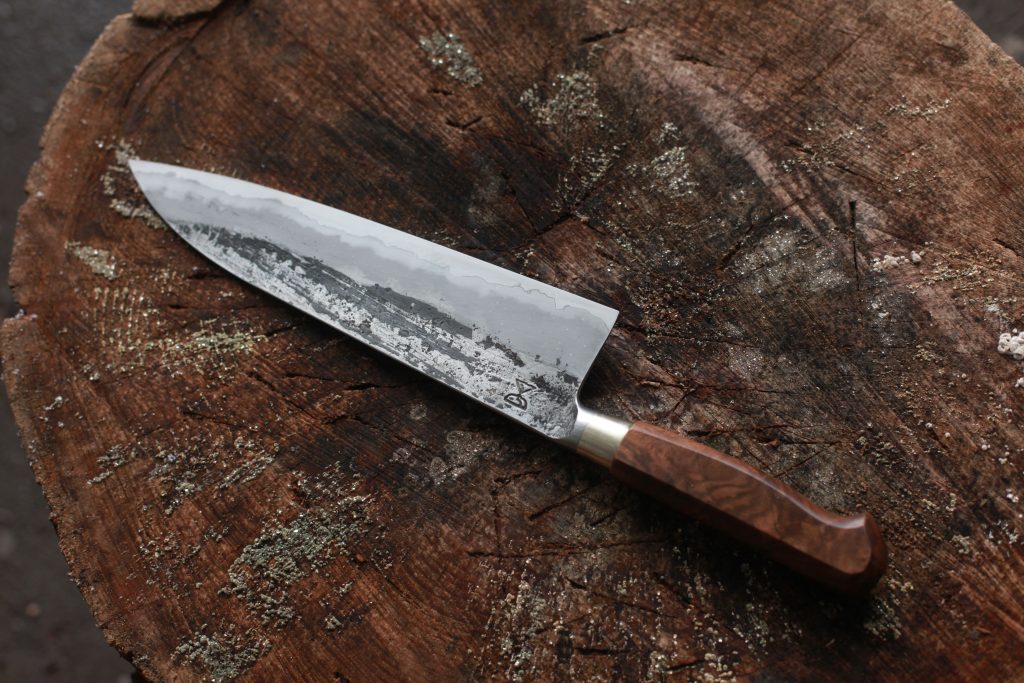
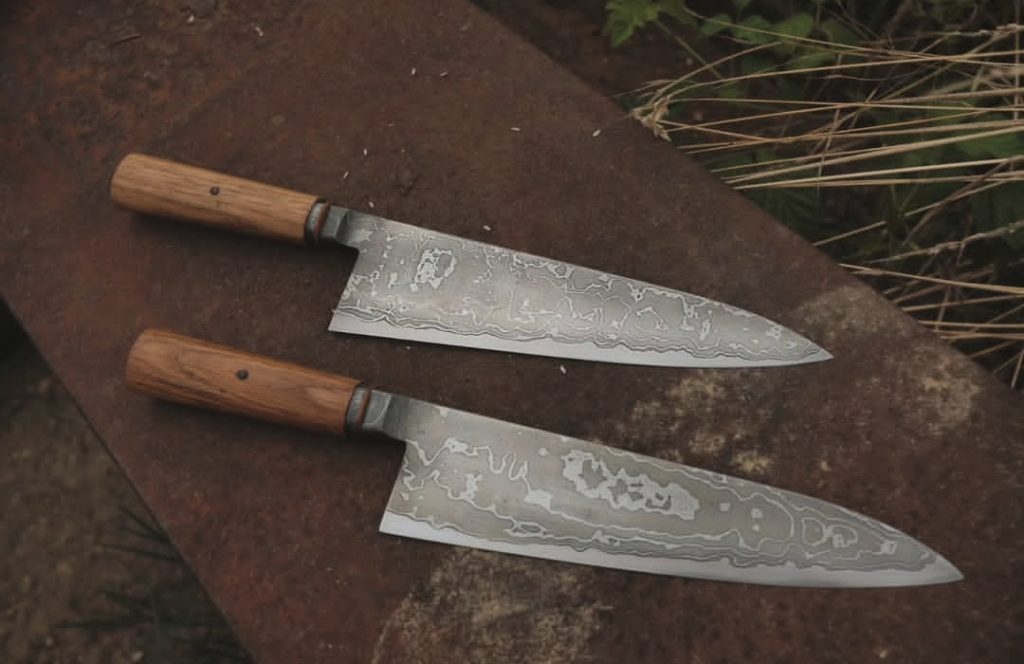
I don’t have a favorite one, but two years ago, I started to do my take on the French Nogent style knives, and I just love how it looks. Maybe if I try to make it from damasteel, titanium and mammoth bone, I would love it more, but I doubt it. I recently used boxwood for the first time, and I really liked how that handle looked. I’m a simple kind of a guy.
What is the most important aspect of a well-made knife?
I would say geometry, heat treatment, and fit and finish. And there’s not much more; it’s a simple tool, make it pretty, make it work.
What keeps you going?
I start counting from 5 to 1, and before I reach 1, I need to get off my butt and go to work. Great technique.
Biggest struggle?
It’s the organizational stuff, logistics, something that I would love to have an employee for.
Also my spine collapsing.
The work is hard on the body, and remedy is to exercise.
So my biggest struggles are not exercising and forgetting to order consumables.
What kinds of knives do you make?
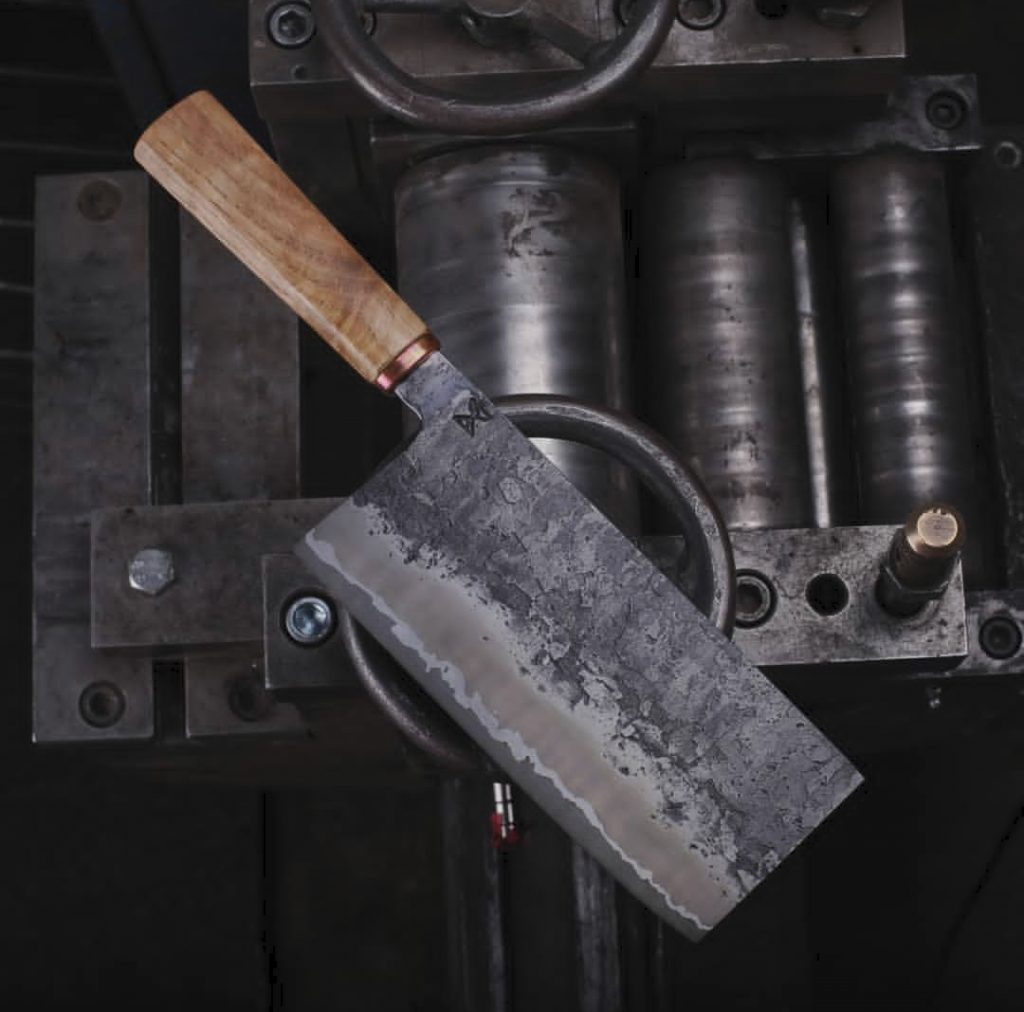
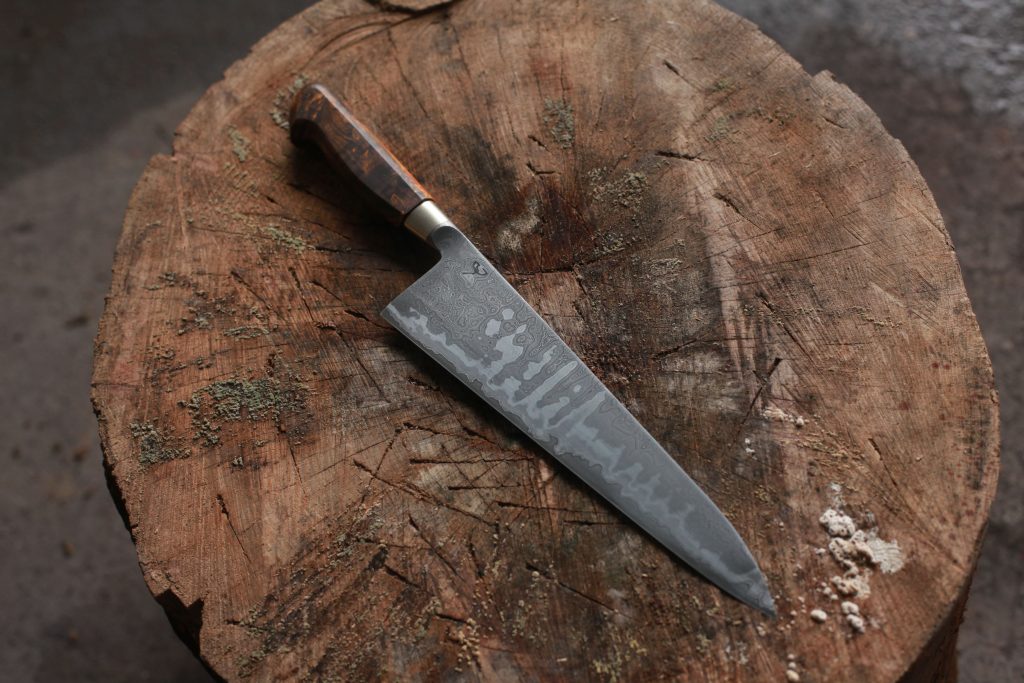
I make kitchen knives primarily. Lately, I’ve been only doing chef knives in various sizes and profiles. But I need to throw in a slicer or Chinese cleaver, Nogent style.
There is an occasional dream in recreating something from the blade making past, something like a dagger or short sword. But that would be something for myself and for my investment in a new skill.
How did your background affect your approach to knives?
Maybe the biggest thing was that I owned forging equipment and did forge stuff.
So I was determined that my knives were forged, and I also wanted to show it in design. That’s why all my knives have this small integral bolster, and my billet needs to be 15mm thick when I start to forge the knife. That’s a lot of material manipulation, and the challenge of getting more and more proficient is something that keeps me lighting the forge.
Who helped you early on?
I’m not the type to seek direct help, but there are a lot of people on different forums who do seek help, and have their answers answered by the good and knowledgeable people who I could say were a great help.
But in the end, the biggest thing is failure and learning from it.
Any specific breakthroughs or revelations in your knife making journey?
I think the biggest revelation was that I actually like European style handles more than minimalist Japanese style, and every time I saw a vintage Nogent style chef knife, I told myself that I need to be making something in that direction.
What is the perfect knife?
I don’t know, perfection is a hard category to put something into. If I try to imagine a perfect knife, and please allow me to be cheesy, I think that would be an heirloom that your parents used in a beautiful family environment, and now you are using it with your family, and so on it goes through time, leaving only positive experiences until it breaks into dust.
How do you approach a new concept and that concept’s implementation?
A lot of sitting and staring into nothing, while trying to visualize everything in my head, and then trying it until some of the ideas or concepts stick. A lot of experimenting is involved in how to get efficient and more precise, so every part of making the knife goes as smoothly as possible.
How do you develop a design, select a steel, and fine-tune a heat treatment?
The design is pretty much developed now, it was tightly connected to the process and what machines I use, and European/Japanese influence. I still need to upgrade some of the steps in the handle making part, I’m always on the edge of losing my fingers, so it’s good to make it fool proof.
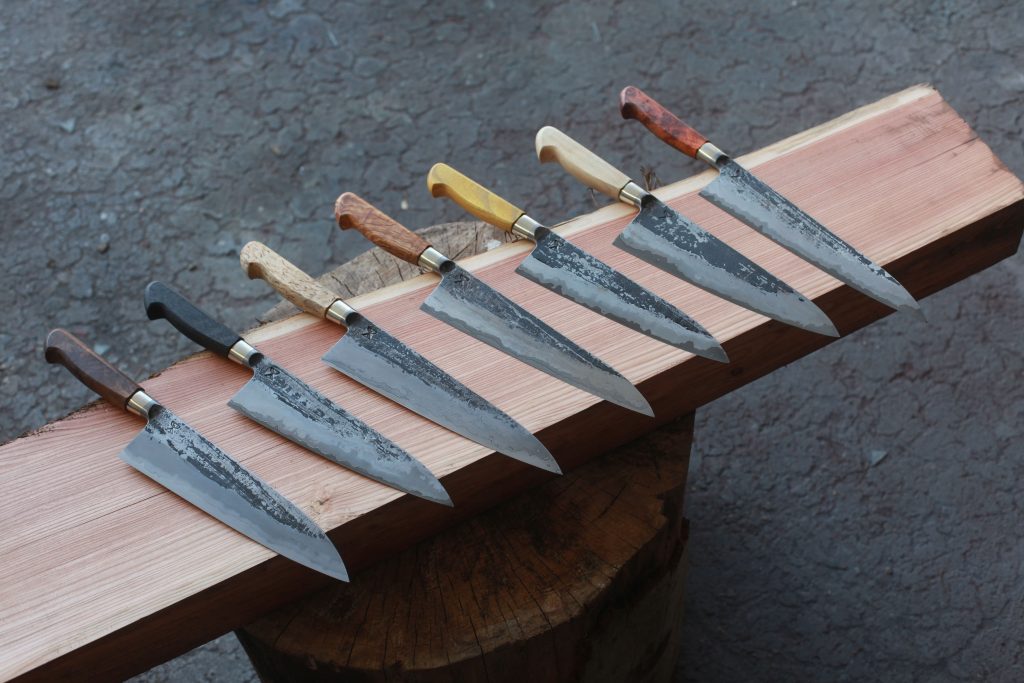
I’m trying to have a theme with handle material when I do batches.
Three themes, the Oaks, the Bushes and the Fruits. I would use different types of oak, fruit trees and bushes or shrubs.
It would be nice if I could collect as much of those species and that would be my main handle material design choice.
Maybe throw in the Weirdo theme and use synthetics sometimes.
I’ve been an avid user of Apex Ultra Steel since it hit the streets, so there’s a regiment I use from forging to heat treatment, and that is pretty much my normative.
The only thing I switch is the cladding. I use everything from wrought iron, pure iron, mild steel, and Damascus. I rarely do mono steel blades.
Mono steel apex ultra would be nice to have with a machine finished surface, but I’m not at the point where I can do that. I shape my bevels after the rough grind on the machine with stones, and finish them with hand sanding, and I’ve done it with mono steel and it’s not fun for me.
Cladded knives are just easier to grind and polish, but also maintain, and you can’t deny the cool factor.
What do you like about ApexUltral?
Even if I use Apex Ultra exclusively, I’m sometimes drawn to something a little more “primitive”. I would like to make crucible steel.
The process has some complexity that kept me away from trying. I love the idea of making your own steel, even if there’s no way of getting the quality of modern steel, it has, like the kids would say, an aura.
How has the knife world changed since you started?
I haven’t been much in it, so my experience is limited.
I entered the period where social media already brought the “small production self-employed” craftsmen to the world.
And that relationship has been effective throughout my involvement in this business. Customers are super nice, other knife makers also, and the knife world is a happy place.
Maybe it would be better to talk about where it is going. And that would be a topic for a longer conversation with no real conclusion. As long as the world spins, so does the knife world with it.
What’s up next for you? Any exciting new projects to tell us about?
I would like to work more with wood, and I like sitting on chairs, so maybe combine those two interests and make a chair, a brettstuhl, but that also sounds like a retirement project.
For now, no new projects, just trying to be better at what I do, and exercise more.
To keep up to date with what Tomislav is working on follow him on Instagram https://www.instagram.com/radiona_breg/
Leave a Reply