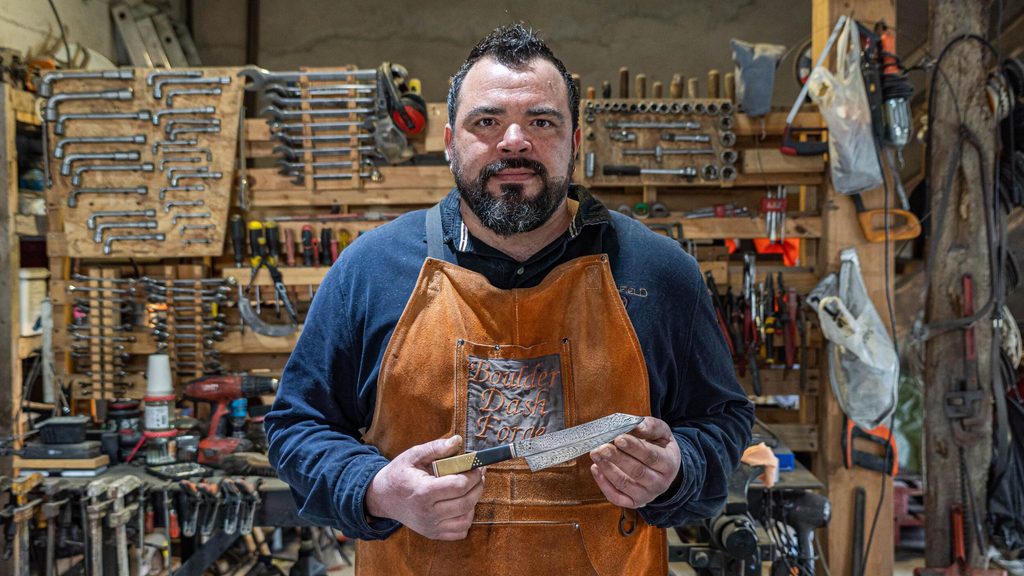
This week’s interview brings us to the workshop of Rémi Pizzolato located in Beaucroissant Isére, France. Situated in the southeast of the country he embarked on a journey of discovery. He possesses a wonderful combination of talent and curiosity that is just joyful to me. When I see his creations, I am reminded of how magical the world is. I am very pleased to be able to share his story.
When did you start making knives?
I started knife making in a rather unexpected way. One Christmas, my wife’s family decided we would all do a “DIY Christmas” — everyone had to make their gift instead of buying it. I drew my father-in-law’s name. I’d always wanted to try making a knife, so I thought, “Alright, now’s the time.”
When I mentioned it to my own father, he asked, “Do you know what Damascus steel is?” I said no. He told me, “You should look into it — I think you’ll love it.”
So I watched some YouTube videos, took my barbecue, a hair dryer, some charcoal, and I started hammering away. That was in 2016 — and honestly, that’s where everything began.
What inspired you to do this and how did you learn?
What really hooked me was working with steel itself. I’m a trained boilermaker, so the metalwork immediately spoke to me. But I also grew up around art — my uncle was a painter and sculptor, and I used to spend hours tinkering with him. In knife making, I found all of that again: wood, leather, form, and creativity.
I learned everything on my own — from YouTube videos, from books about Damascus, and mostly from countless failures. But I’m stubborn, and I don’t give up easily.
At first, I’d only forge on weekends. I wanted to finish something each time, so my early knives were rough but complete. After about four years, I realized my level had grown enough that I could start selling my work. Before that, every knife I made was a gift for friends or family.
What did you make your first knife with?
My very first knife was pure improvisation: a barbecue for a forge, a hair dryer for air flow, a piece of scrap steel, and an old file. I didn’t even know about traditional forging — I jumped straight into making Damascus steel, and I’ve never really stopped since.
Do you have a favorite knife you made, tell me about it?
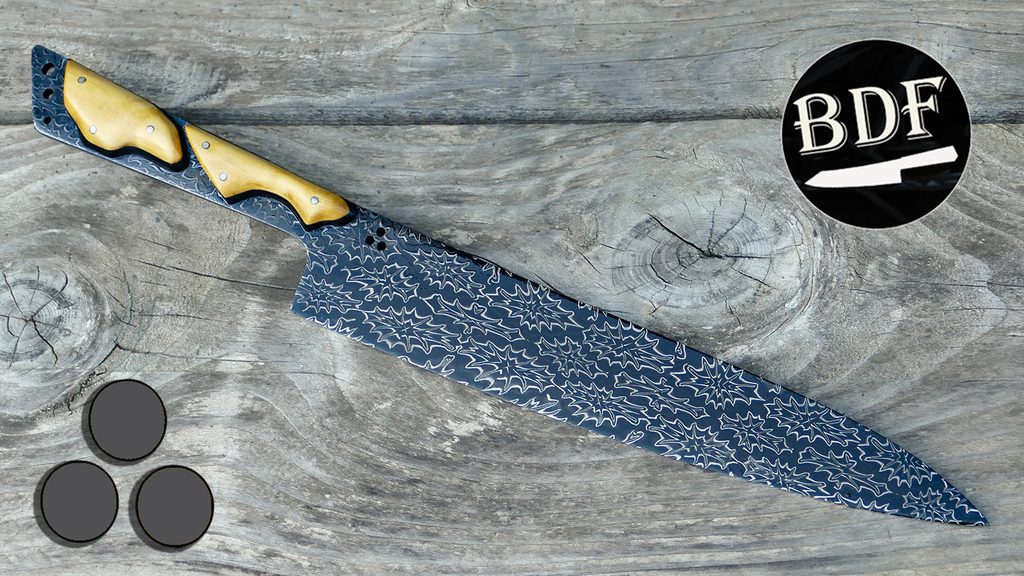
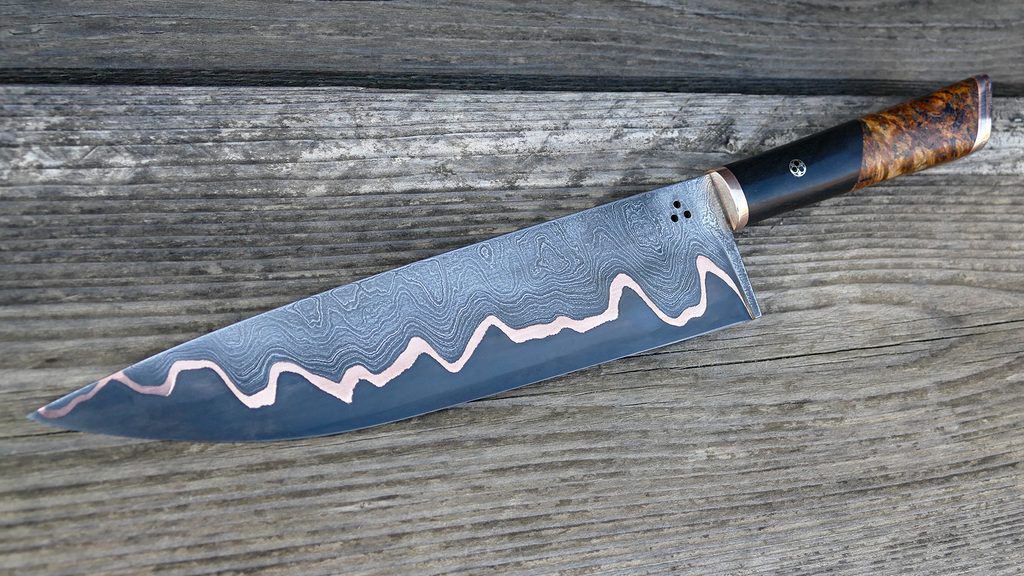
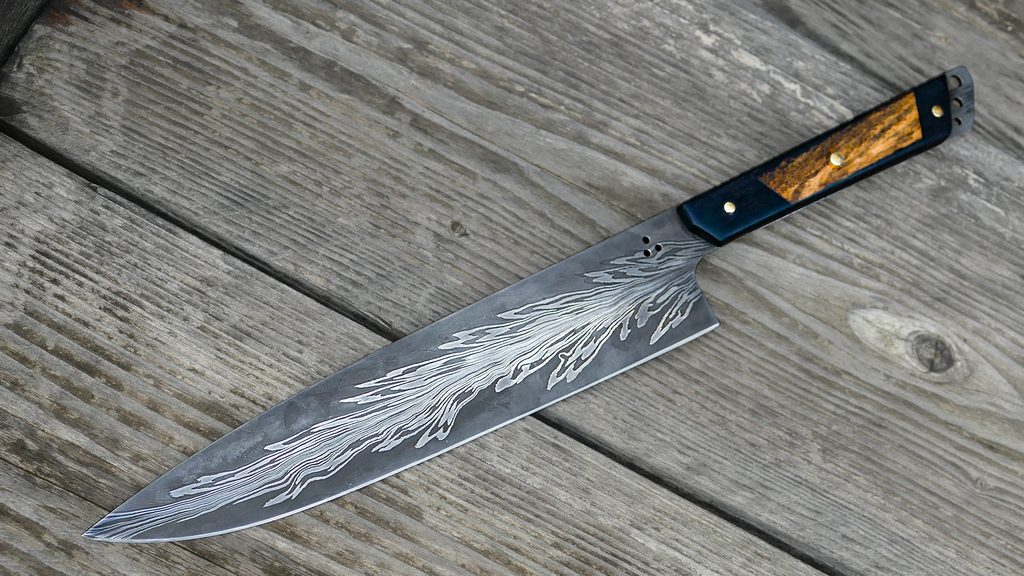
Over time, I’ve developed a few favorites — like my first successful feather-pattern Damascus, my first mosaic, and my first Cumai. Each breakthrough pushed me further, and that’s what keeps me hooked: I always want to push Damascus patterns to the extreme.
What is the most important aspect of a well-made knife?
For me, a great knife has to be beautiful and balanced. I love clean lines, elegant forms, and a perfect razor-sharp edge. But the most important thing is that a knife must fit its purpose. It has to feel right in the hand and perform flawlessly in use.
What keeps you going?
What keeps me going is that I never get bored. In other trades, once I’ve understood something, I move on. But with knife making — especially Damascus — there’s no end. Every pattern, every combination of materials can create something new. It’s infinite. I know I’ll never run out of ideas.
Your biggest struggle?
Always the next knife. I’m constantly trying to push my technical limits — that’s what makes it exciting.
What kinds of knives do you make?
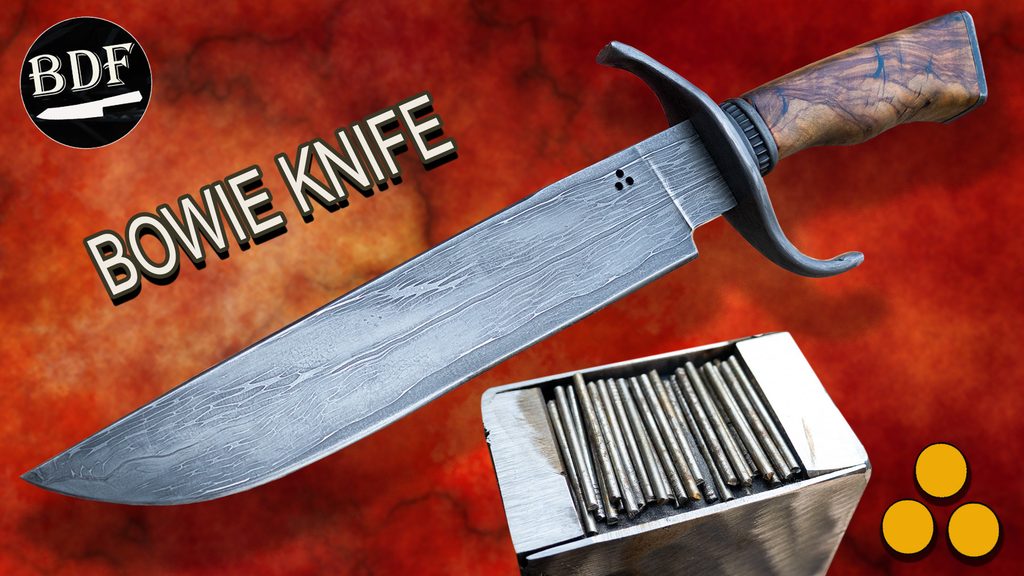
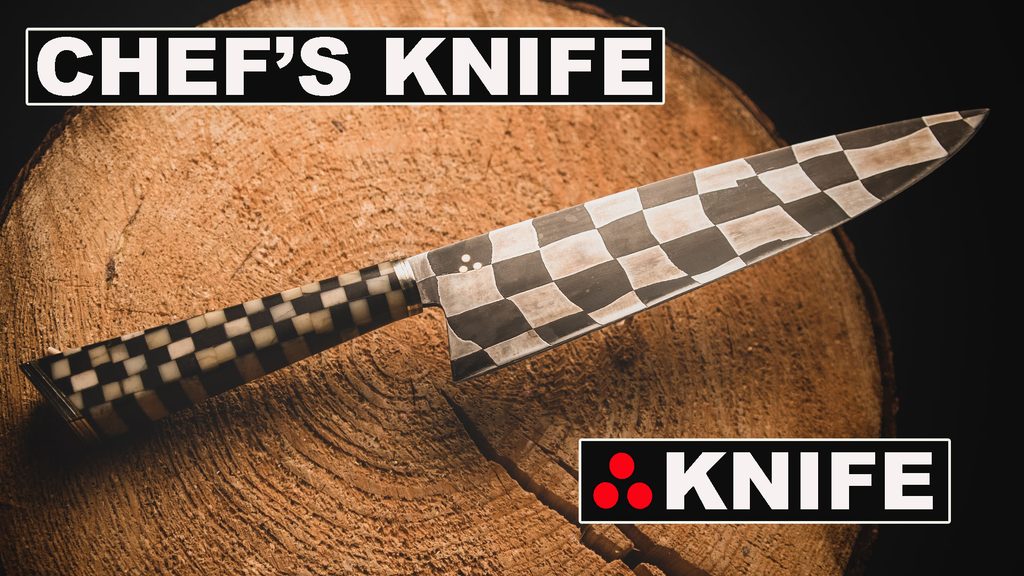
I mainly forge Japanese-style kitchen knives because I love their philosophy: every shape has a purpose. But I also enjoy big knives — Bowies with through-tang construction and rear-bolted handles that can be completely disassembled. Technically, I’m focused on mosaic Damascus and Cumai — those are my playgrounds.
How did your background affect your approach to knives?
My background influences everything I do. As a boilermaker, I learned to observe and respect materials. And throughout my life, I’ve always been curious — I’ve watched carpenters, plumbers, masons, and taken bits of technique from each. My uncle’s influence shows in my handles — mixing materials, searching for harmony, and keeping a sense of beauty without overdoing it.
Who helped you early on?
As for mentors, I’ve had many virtual ones — YouTubers who unknowingly guided me. Shurap, for instance — for me, he’s the best at using reclaimed steels. Then there’s Bigunas from Brazil, with his unique artistic touch, and of course Kyle Royer and Claudio Sobral.
When I see what they create, it inspires me to reach that level — maybe one day even surpass it. But that takes time and a lot of hammering.
Any specific breakthroughs or revelations in your knife making journey?
One of my favorite memories is the first time I truly understood the feather pattern. I had watched Bigunas’s video at least 2,500 times. One night, around 4 a.m., I woke up and said, “I got it!” The next morning, I forged my first feather Damascus — and it worked.
What is the perfect knife?
For me, the perfect knife has a pure line, perfect balance, and a Damascus pattern that blows your mind — but it must also cut perfectly. A knife isn’t just art; it’s a tool. I always aim for beauty and performance together.
How do you approach a new concept and that concept’s implementation?
When I design something new, I’m always sketching ideas — new shapes, new patterns. My mind never stops. Between workshops and family life, whenever I find five spare minutes, I test new concepts. It’s a constant need to create.
How do you approach knife testing?
Testing is essential. I use Japanese hardness files before finishing, slightly bend my kitchen blades to test flexibility, and strike oak beams with the big knives to test resistance. Then I check the point and finish by cutting paper to see if the edge held up.
How do you develop a design, select a steel, and fine-tune a heat treatment?
For steel, I mainly use 90MCV8 and 15N20 — they create strong contrast in Damascus. I do my heat treatments in a dedicated oven, and the tempering in a classic kitchen oven. The more I learn, the more I love the technical side — discussing metallurgy with engineers, understanding what really happens inside the steel.
What is your favorite steel?
If I had to choose one steel, it would be 90MCV8 — for that deep, black cutting edge it gives in both Damascus and san-mai.
How has the knife world changed since you started?
Since I began, I think the knife world has evolved in a great way. Shows like Forged in Fire brought visibility and pride back to the craft. And thanks to YouTube, anyone can learn — even without formal schooling. That’s why I share videos too: to pass on what I’ve learned and hopefully ignite new passions.
What’s up next for you? Any exciting new projects to tell us about?
Looking ahead, I’ve drawn new Damascus patterns that I can’t wait to forge and film. I’m also collaborating with other makers — like Stech Blanc in Thiers, who invented a reverse-folding knife and orders Damascus bars from me; and I plan to spend time with Guillaume Antoninucci, one of the best in folding mechanisms. I also exchange ideas a lot with Les Couteaux de la Berchère, finalist of Forged in Fire France — an outstanding craftsman. Sharing knowledge between makers helps all of us grow, and that’s something I truly believe in.
To keep up with what Remi is working on follow him on Instagram https://www.instagram.com/boulderdashforge/
Leave a Reply