Author: steelf_Admin

  • Boulderdash Forge

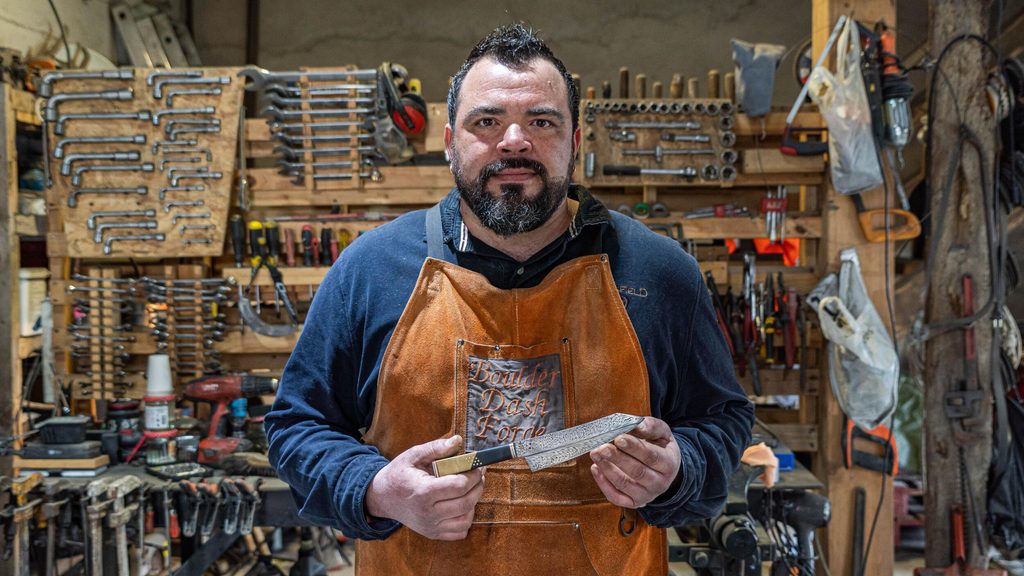
    This week’s interview brings us to the workshop of Rémi Pizzolato located in Beaucroissant Isére, France. Situated in the southeast of the country he embarked on a journey of discovery. He possesses a wonderful combination of talent and curiosity that is just joyful to me. When I see his creations, I am reminded of how magical the world is. I am very pleased to be able to share his story.

    When did you start making knives?

    I started knife making in a rather unexpected way. One Christmas, my wife’s family decided we would all do a “DIY Christmas” — everyone had to make their gift instead of buying it. I drew my father-in-law’s name. I’d always wanted to try making a knife, so I thought, “Alright, now’s the time.”
    When I mentioned it to my own father, he asked, “Do you know what Damascus steel is?” I said no. He told me, “You should look into it — I think you’ll love it.”
    So I watched some YouTube videos, took my barbecue, a hair dryer, some charcoal, and I started hammering away. That was in 2016 — and honestly, that’s where everything began.

    What inspired you to do this and how did you learn?

    What really hooked me was working with steel itself. I’m a trained boilermaker, so the metalwork immediately spoke to me. But I also grew up around art — my uncle was a painter and sculptor, and I used to spend hours tinkering with him. In knife making, I found all of that again: wood, leather, form, and creativity.

    I learned everything on my own — from YouTube videos, from books about Damascus, and mostly from countless failures. But I’m stubborn, and I don’t give up easily.

    At first, I’d only forge on weekends. I wanted to finish something each time, so my early knives were rough but complete. After about four years, I realized my level had grown enough that I could start selling my work. Before that, every knife I made was a gift for friends or family.
    What did you make your first knife with?

    My very first knife was pure improvisation: a barbecue for a forge, a hair dryer for air flow, a piece of scrap steel, and an old file. I didn’t even know about traditional forging — I jumped straight into making Damascus steel, and I’ve never really stopped since.

    Do you have a favorite knife you made, tell me about it?

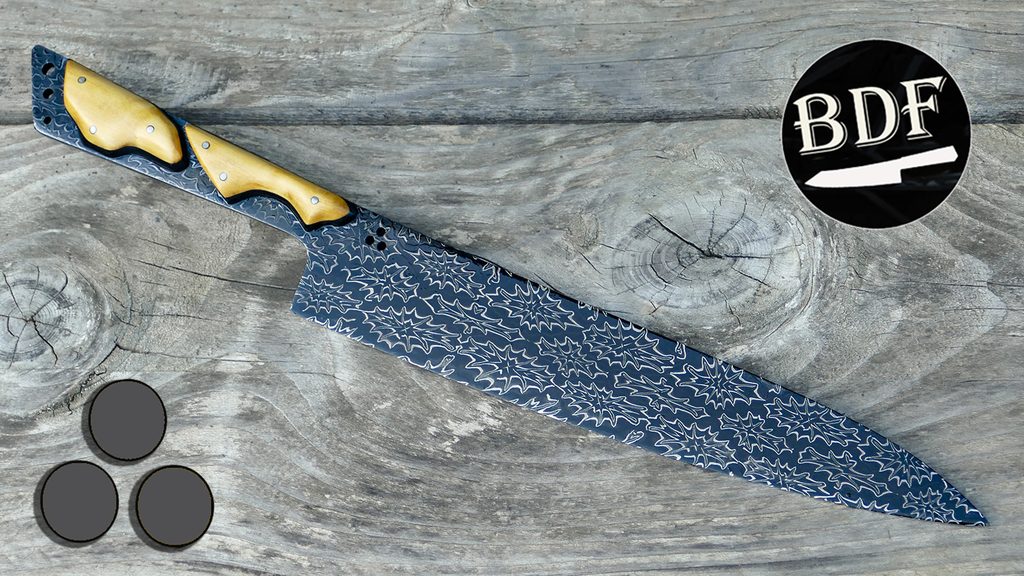
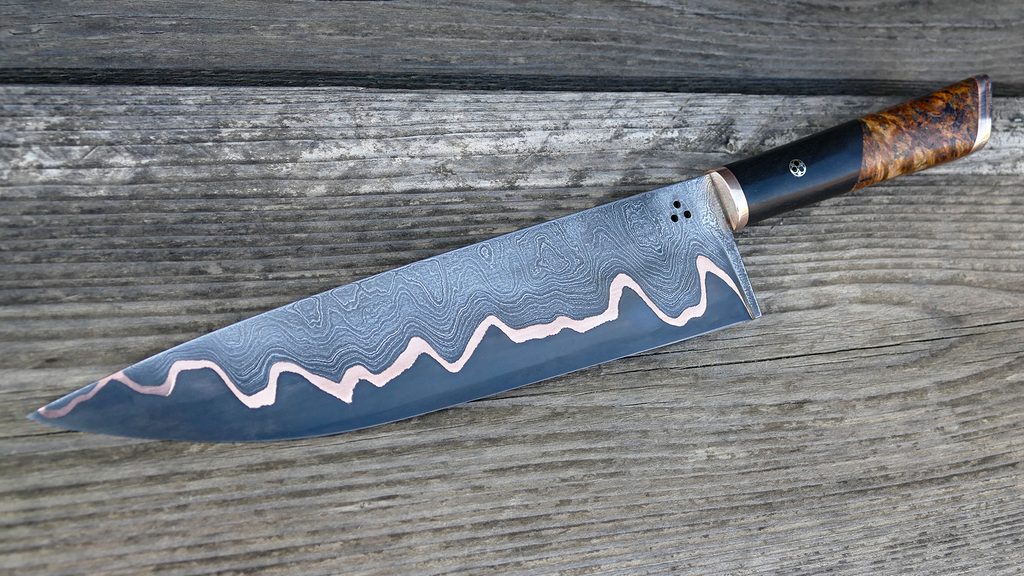
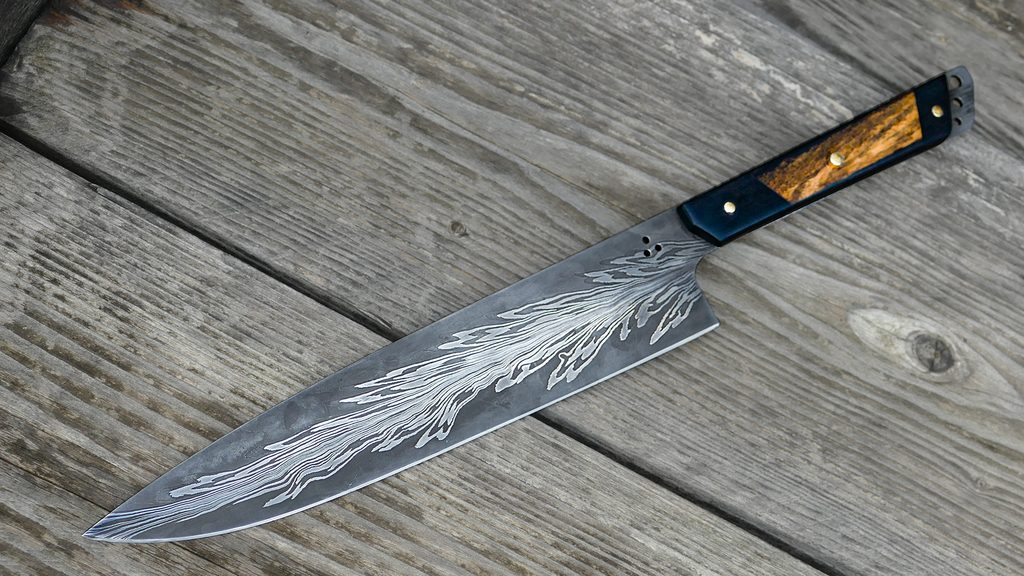
    Over time, I’ve developed a few favorites — like my first successful feather-pattern Damascus, my first mosaic, and my first Cumai. Each breakthrough pushed me further, and that’s what keeps me hooked: I always want to push Damascus patterns to the extreme.

    What is the most important aspect of a well-made knife?

    For me, a great knife has to be beautiful and balanced. I love clean lines, elegant forms, and a perfect razor-sharp edge. But the most important thing is that a knife must fit its purpose. It has to feel right in the hand and perform flawlessly in use.
    What keeps you going? 

    What keeps me going is that I never get bored. In other trades, once I’ve understood something, I move on. But with knife making — especially Damascus — there’s no end. Every pattern, every combination of materials can create something new. It’s infinite. I know I’ll never run out of ideas.

    Your biggest struggle?

    Always the next knife. I’m constantly trying to push my technical limits — that’s what makes it exciting.

    What kinds of knives do you make?

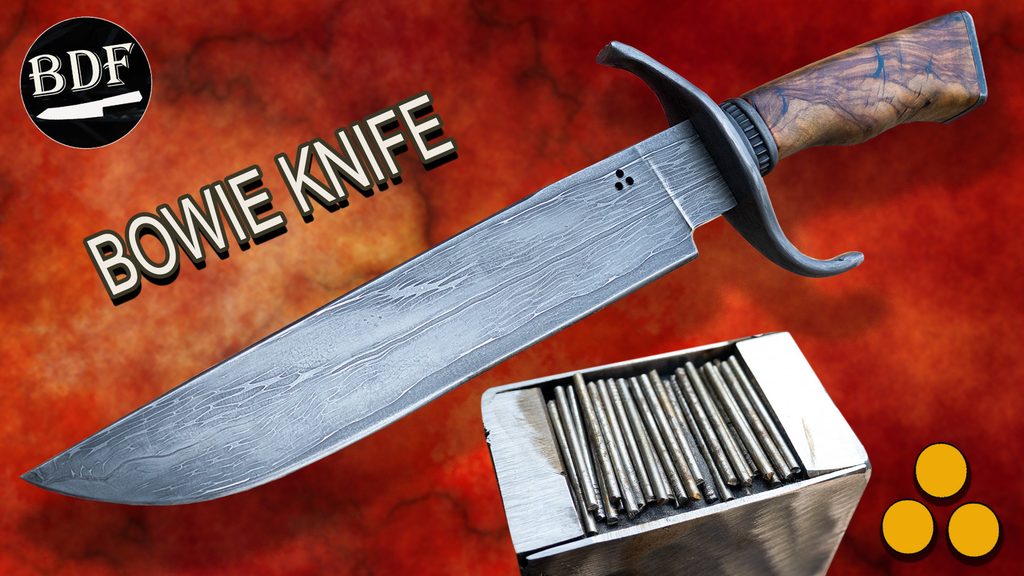
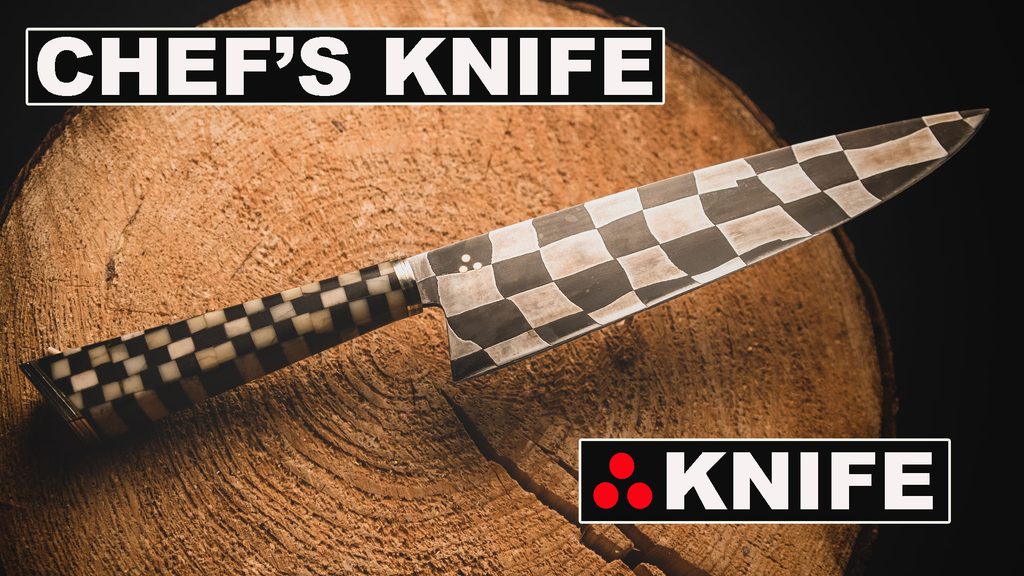
    I mainly forge Japanese-style kitchen knives because I love their philosophy: every shape has a purpose. But I also enjoy big knives — Bowies with through-tang construction and rear-bolted handles that can be completely disassembled. Technically, I’m focused on mosaic Damascus and Cumai — those are my playgrounds.

    How did your background affect your approach to knives?

    My background influences everything I do. As a boilermaker, I learned to observe and respect materials. And throughout my life, I’ve always been curious — I’ve watched carpenters, plumbers, masons, and taken bits of technique from each. My uncle’s influence shows in my handles — mixing materials, searching for harmony, and keeping a sense of beauty without overdoing it.
    Who helped you early on?

    As for mentors, I’ve had many virtual ones — YouTubers who unknowingly guided me. Shurap, for instance — for me, he’s the best at using reclaimed steels. Then there’s Bigunas from Brazil, with his unique artistic touch, and of course Kyle Royer and Claudio Sobral.

    When I see what they create, it inspires me to reach that level — maybe one day even surpass it. But that takes time and a lot of hammering.

    Any specific breakthroughs or revelations in your knife making journey?

    One of my favorite memories is the first time I truly understood the feather pattern. I had watched Bigunas’s video at least 2,500 times. One night, around 4 a.m., I woke up and said, “I got it!” The next morning, I forged my first feather Damascus — and it worked.

    What is the perfect knife?

    For me, the perfect knife has a pure line, perfect balance, and a Damascus pattern that blows your mind — but it must also cut perfectly. A knife isn’t just art; it’s a tool. I always aim for beauty and performance together.
    How do you approach a new concept and that concept’s implementation?

    When I design something new, I’m always sketching ideas — new shapes, new patterns. My mind never stops. Between workshops and family life, whenever I find five spare minutes, I test new concepts. It’s a constant need to create.

    How do you approach knife testing?

    Testing is essential. I use Japanese hardness files before finishing, slightly bend my kitchen blades to test flexibility, and strike oak beams with the big knives to test resistance. Then I check the point and finish by cutting paper to see if the edge held up.

    How do you develop a design, select a steel, and fine-tune a heat treatment?

    For steel, I mainly use 90MCV8 and 15N20 — they create strong contrast in Damascus. I do my heat treatments in a dedicated oven, and the tempering in a classic kitchen oven. The more I learn, the more I love the technical side — discussing metallurgy with engineers, understanding what really happens inside the steel.

    What is your favorite steel?

    If I had to choose one steel, it would be 90MCV8 — for that deep, black cutting edge it gives in both Damascus and san-mai.
    How has the knife world changed since you started?

    Since I began, I think the knife world has evolved in a great way. Shows like Forged in Fire brought visibility and pride back to the craft. And thanks to YouTube, anyone can learn — even without formal schooling. That’s why I share videos too: to pass on what I’ve learned and hopefully ignite new passions.

    What’s up next for you? Any exciting new projects to tell us about?

    Looking ahead, I’ve drawn new Damascus patterns that I can’t wait to forge and film. I’m also collaborating with other makers — like Stech Blanc in Thiers, who invented a reverse-folding knife and orders Damascus bars from me; and I plan to spend time with Guillaume Antoninucci, one of the best in folding mechanisms. I also exchange ideas a lot with Les Couteaux de la Berchère, finalist of Forged in Fire France — an outstanding craftsman. Sharing knowledge between makers helps all of us grow, and that’s something I truly believe in.

    To keep up with what Remi is working on follow him on Instagram https://www.instagram.com/boulderdashforge/

    Leave a Reply

    Your email address will not be published. Required fields are marked *

  • Knippenberg Knives

    To start off, please tell us a little about yourself.

    My name is Jeroen Knippenberg, 32 years old and from the Netherlands. Married to an amazing and very supportive wife. My background is in Mechanical Engineering. Knifemaking is a part time job for me at the moment, and I have a daytime job as a process Engineer in a high-tech heat treatment facility.

    What sparked your interest in knives?

    In my spare time a lot of it is about working out, health and especially food. Both me and my wife are avid home cooks and that is where the handmade kitchen knives come in.

    When did you start making knives?

    Knifemaking started for me about 7 years ago as a way to experience fulfillment of working with my hands, while my studies and work up to that point were mostly theoretical and computer-based. As many people, I was on YouTube a lot looking at videos of traditional crafts like blacksmithing and woodworking. Forging knives looked very cool, but most of these videos are shot from big workshops with expensive machinery, that was completely unavailable to me.

    Then I stumbled upon videos by Aaron Gough in which he explained how to make knives with very basic hand-tools. It was around that time my wife and I bought a house, where I had the opportunity to set up a small workshop in the garage. This was all I needed to give stock removal knifemaking a try, and from the passion for cooking, two small kitchen knives were a logical start.

    Once you started making knives what inspired your approach?

    My background in Engineering and work in academia gave me a methodical approach both in researching upfront and documenting during and after I made my first knives. This helped me to start with a clear plan, and a good idea of which are the most important parameters for the knives’ performance (hardness, thickness behind the edge, etc). This way of working has served me a lot during my journey as a knifemaker, to learn and improve quickly and consistently. Also regularly challenging myself to make new things that were well above my current skillset helped with improvement and “keeping things interesting.” And again, a lot of research upfront and documentation while taking on such a new project greatly increases the chance of success, in either the first or second attempt.

    What motivates you in your creative process?

    Already early on in my knifemaking journey, I was captivated by intricate Damascus patterns, especially on integral knives. Makers like Maerko Maumasi and Jordan LaMothe have been big sources of inspiration over the years and were “responsible” for getting me into Damascus integral kitchen knives.

    I like to keep pushing myself to make better and more exclusive work. In terms of design, performance, Metallurgy, heat treatment, Damascus patterns, etc. There is just so much to learn and explore in knifemaking. Plenty for a lifetime or two, and that makes it so exciting.

    How did your knifemaking evolve?

    The first 5-6 years of my knifemaking journey were completely focused on making the best, most exclusive knives I could. All about the quality with no concessions. More recently, I have been focusing more on the business side of knifemaking in order to make this a viable fulltime career. I realized that I had very little knowledge and skill in this area, so I decided to join with a business coach to learn more about it. That helped me setting up sharpening courses and knifemaking courses. And for the knives I have set up a Performance line of knives, focused more on performance, high quality steels, and less on visual appearance. While maintaining the design of my integral kitchen knives, I will be making small batches of these performance knives, besides the very exclusive Damascus knives of the Artisan line.

    I love how you are approaching the two different lines, tell us a bit more about how you refine your work?

    A challenging aspect about kitchen knife making, is that a lot of what makes it really, really good depends on the preference of the user. There are some general rules to kitchen knives, coming from the intended use (on a cutting board, for certain kind of produce you cut with it, comfort, etc) that you should abide by, and some general styles and principles that have proven to work well over many years, but the rest is about preferences. And a lot of how a (hobby) chef would assess a knife is based on feelings and experiences, which you, as a knifemaker, need to translate into millimeters, grams, and hrc (hardness) to be able to make a knife that the customer likes and wants to use.

    For me, important aspects for a kitchen knife firstly come from use: the balance and weight should be right. The profile should match the cutting style from the user. The grind should aid in cutting effortlessly with good food release. And in particular these two are an interesting balancing act, as they are more or less opposites in a way but also go hand in hand. Certainly, an area I will keep studying and experimenting with in the future. Also, the knife should be comfortable and practical, as it is a tool to be used after all.

    With all that set, there is some room for visuals and artistry. Fit and finish is very important to me, because it shows the level of care you, as a maker, put into a knife. And the care and love you put into it, is the whole reason it is much more than a mass manufactured knife from a store. The blade part of the knife is a nice big canvas where you can use a lot of creativity to make beautiful Damascus patterns. I really like it when the pattern flows nicely with the shape of the blade and both complement each other. Especially with Damascus integrals the pattern flow from the bolster into the blade is one of the coolest parts if you’d ask me.

    I know one of the first knives of yours that caught my attention was an integral with a feather Damascus pattern that flowed from the blade into the handle so well.

    One of the things I visually really like in a knife design is if the entire knife (blade + handle) is on harmonious unity. When I design a knife, I draw an outline that speaks to me and afterwards determine where the transition from handle to blade should be. With integral knives, it is much easier to blend the two into a single three-dimensional piece, which I enjoy a lot.

    Other than design what else goes into the making of your blades?

    It is important to not only design for the practical use but also test this continuously as a maker. Not only as a quality control step but also as experience of the effects of small variations and changes to the design and execution first-hand. I test each knife I make in my own kitchen for a few days before I finish it, especially for the one-offs, so I know for sure it is up to my standards when a customer gets it. Also, feeling how it responds to different sharpening stones gives an idea about the steel’s performance.

    But already during the manufacturing process there is a lot of testing on various production steps. Mainly dimensional and weight measurements to assure the geometry is as it should be and reproducible on the different knives I make. After heat-treatment I do Rockwell hardness testing on each blade to assure the heat-treatment results are as they should be. Also, this hardness testing helps me to dial in the heat treatment processes of my own Damascus steel.

    There are many parameters throughout the Damascus making process that influence the end result in terms of hardening response, hardness, and toughness. The hardness testing is one part, but since there is so much more going on in the steel, I like to do micrographs to metallurgically assess the microstructure of the steel after forging, normalizing, grain refinement, annealing, hardening and tempering on my Damascus steel, once in a while to assess the results of heat-treat recipe improvements. For the future I’d like to dive more into toughness testing as well, because hardness measurements are only half the story of hardened steel.

    What ‘s up nest for you? Any exciting new project to tell us about?

    In the short term: I am working on another Turkish twist Samascus integral knife for Knifeshow Austria. I did one about a year ago, but I think I can do better, so now the second attempt. Hopefully, I’ll be able to finish it before the show. Still plenty of work to do in not too much time….And after that I’ll be working on a new batch of Performance line knives and preparing for the show in Solingen.

    But the biggest project it to transition towards fulltime knifemaking in the end of the year! A lot of work has gone into the preparations already, but still plenty to do before I can make it happen. An exciting, and a little terrifying prospect for sure, but I am looking forward to it.

    I am confident we are all rooting for you in your successful transition to a fulltime knifemaker. Your dedication to your craft is clear, and the knifemaking community is certainly benefited by your contributions.

    If you have any personal experience with Jeroen’s knives, or have a question for him. Please share your comments/reviews/questions below. And thanks again to Jeroen for taking the time to share a window into his knifemaking journey.

    You can get more information at http://www.knippenbergknives.com or check his Instagram https://www.instagram.com/knippenbergknives