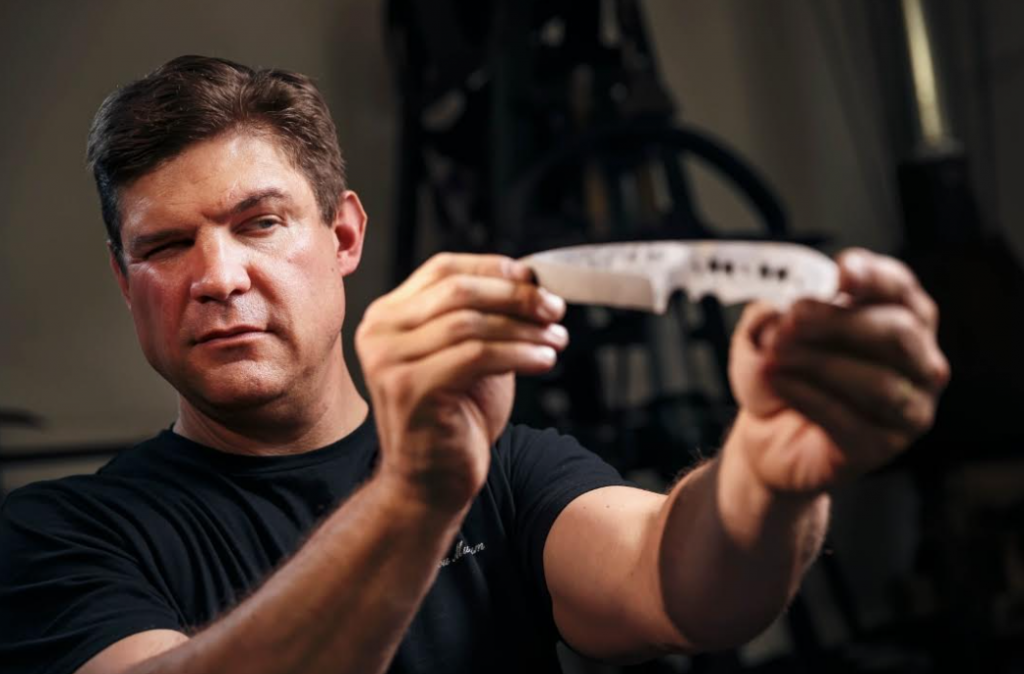
This week’s interview takes us to Nova Scotia, Canada and the new home of Murray Carter. A 17th generation Yoshimoto bladesmith and ABS Master Bladesmith. I first found him through his sharpening tutorials online, and shortly thereafter I found his knives. He has shared often his knowledge and his story, if you want to do a deeper dive, he has several books for you to choose from. It was a pleasure and an honor to speak with him and share part of his story with you.
You have mentioned you have a lot of love for Japan, and that it found its start with martial arts, do you find there are any overlaps between martial arts and knife making?
I think there is definitely an overlap. The national identity of the Japanese, their approach to learning, their approach to doing, their approach to their work, etc. In one word dedication, is a good way to describe it. You can say North American society is a bit fickle, and I feel Japanese society is more dedicated. In North America someone may want to try something, but if they don’t like it, they will move on to something else. In Japan dedication is seen as a virtue on its own.
Do you think that relates to their strong attachment to tradition?
I think you could definitely make that connection, they certainly value tradition highly.
So how old were you when you started making knives?
I went to Japan when I was eighteen, and encountered the bladesmith right away, then I came back to North America after eight months in Japan, when I was back in Canada I enrolled in university and completed an academic year. I did a whole Japanese language course in Vancouver, BC before returning to Japan in the fall. I made my first knife after I returned, so I was twenty by then.
Is that when your apprenticeship began?
Right.
What take-aways do you have from that time?
Well, just for clarity. I think a lot of people imagine it was something like in the Karate Kid. Asking someone to take you under their wing and then doing anything and everything they ask of you. Mine was a bit different, because it started from a friendship, during our friendship I was told I could come by whenever I wanted and ask anything. It started it off more as a hobby, and I think they thought I would eventually lose interest and move on. But as time went on my interest became more serious, and much more dedicated.
Where you surprised, when they ended up asking you to take over the workshop?
Not really, I had spent so much time there, over six years into our relationship, it was clear I was invested and reliable. I was quite dedicated, so it ended up being almost a foregone conclusion, a formality, because I had already been doing it.
Was it daunting, taking on something that had so much history?
I guess I was lucky, being twenty-six, I felt I could take on the world. I felt the privilege, but I didn’t feel the awesome responsibility that it was. But I have also changed my thoughts on that. I don’t put so much weight anymore on lineage and tradition.
What was the first knife that you made?
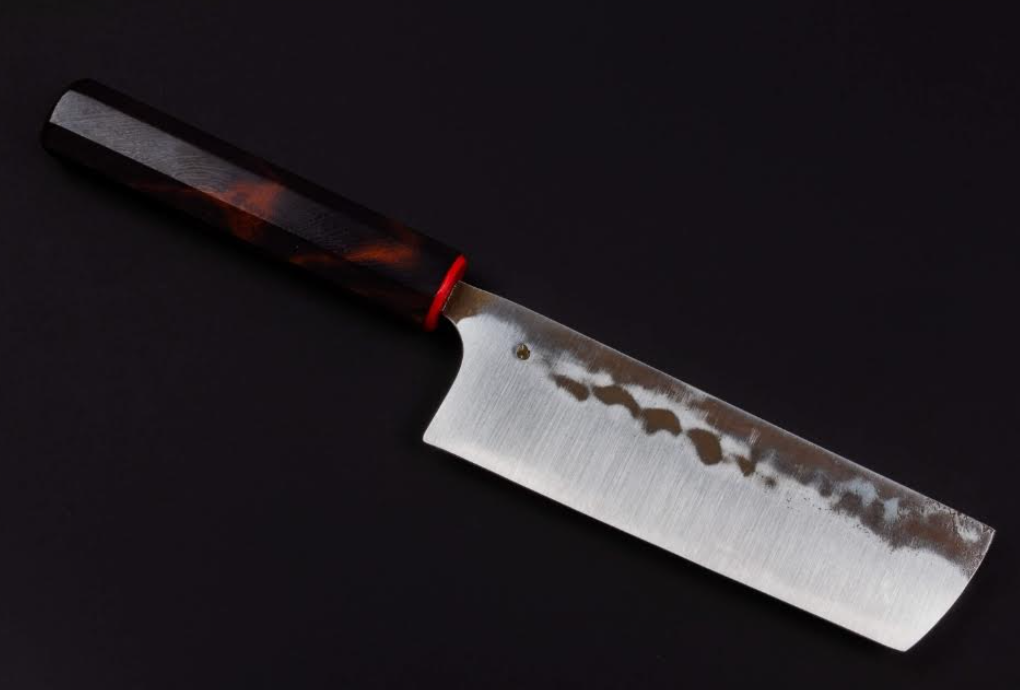
The first, or one of them, was a simple forged blade, with a brass soldered bolster. That was the first forged knife. The first knife I made was not forged but was cut from stainless stock.
I think that there are many makers that work primarily in stock removal.
Yes, that is true, stock removal is certainly a viable method for being a knife maker, especially given all of the high-end premade steels that are available.
Do you have a favorite knife that you made?
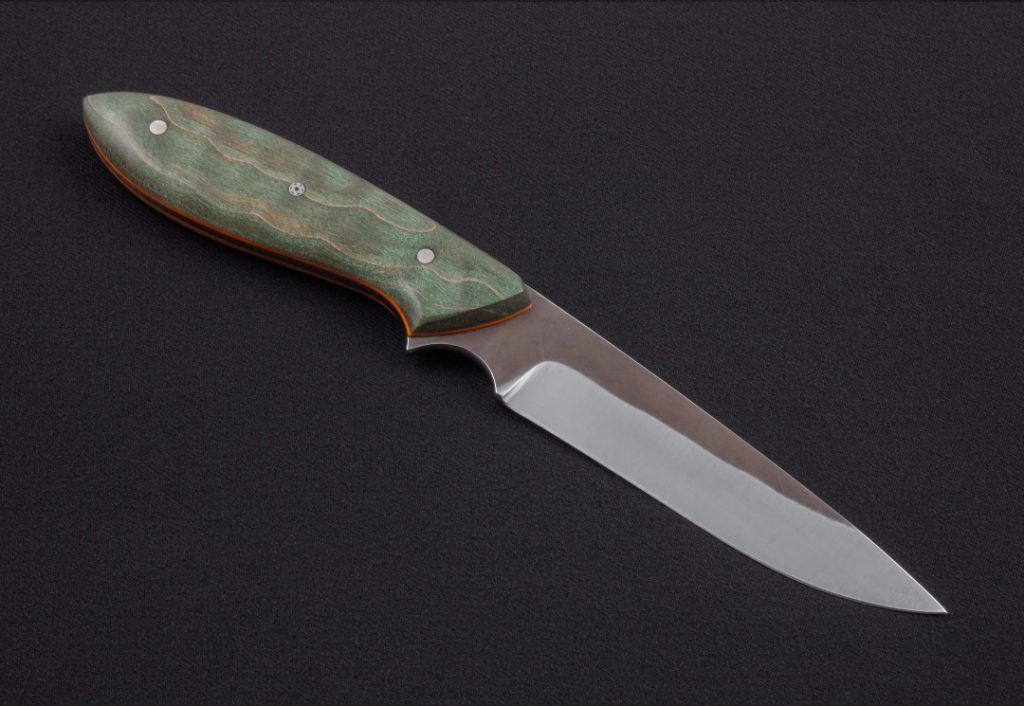
Well, I have my perfect model neck knife, and for the kitchen I have the perfect model kitchen knife. So, in terms of pattern, those would be my favorites in their respective genres. I pretty much enjoy making all of my knives, and when one turns out really nice and pretty, that will be my favorite knife of the day.
That makes sense, perfect for each specific task.
Exactly, there is no perfect knife because there are so many varied tasks, but when you pull out a blade and it does exactly what you thought it would in a minimal amount of time, then that is perfect. So perhaps while a perfect knife doesn’t exist, a perfect knife experience is possible.
What do you think is the most important aspect of a well-made knife?
I believe that it is metallurgy, many say geometry, and I can understand why they say that. Because you could have a perfectly heat-treated block of the best metal, but without geometry you can’t cut with it. But the reason I say metallurgy is that to me good geometry is a given, it needs to be shaped like a knife. So how you work that metal is the most critical.
What inspires you to keep going?
It is interesting thing. I probably have made about 32,000 knives, and there have been times when even though I have always enjoyed knife making, the running of the business and the managing of the different tasks, things that were broken, different bills, and managing a team of individuals can wear you down. Now that I work alone, I am clearing out all of my old files and such, and it has really let me reflect on all the water that has went under the bridge so to speak. And now that I work alone there is a peace and a tranquility with it. I recently moved to Canada from Idaho, to be a care giver for my folks. I was in talks of selling my business. There was a buyer, who was very interested in buying the Carter brand, we were very close to an agreement. But then at the very end, they were too busy to take on the brand with their other commitments, so even though I didn’t complete the sale, in my mind and in my heart, I had gone through the process of letting it go. So now that I am still the owner of Carter Cutlery something happened, the way my mind and my heart approached the business changed and now it’s like I let it go and got it back and it is just a really special feeling.
Kind of like a rebirth?
Yes, I have no debt, no employees, no responsibilities. I can connect more with my customers in a way I had not been able to before, allowing me to be much more personal.
What are your biggest struggles?
As a knife maker, really not too many. My biggest struggles have been more personal, like with my marriage, dealing with employees, and when I was younger, I did become a bit of a spender.
Do you find it easier to create when things go well or when things are difficult? Is it a challenge to separate the business from the personal?
I think you can separate them, but it isn’t easy, and I think for some people they just can’t.
Are there any particular makers’ work you follow?
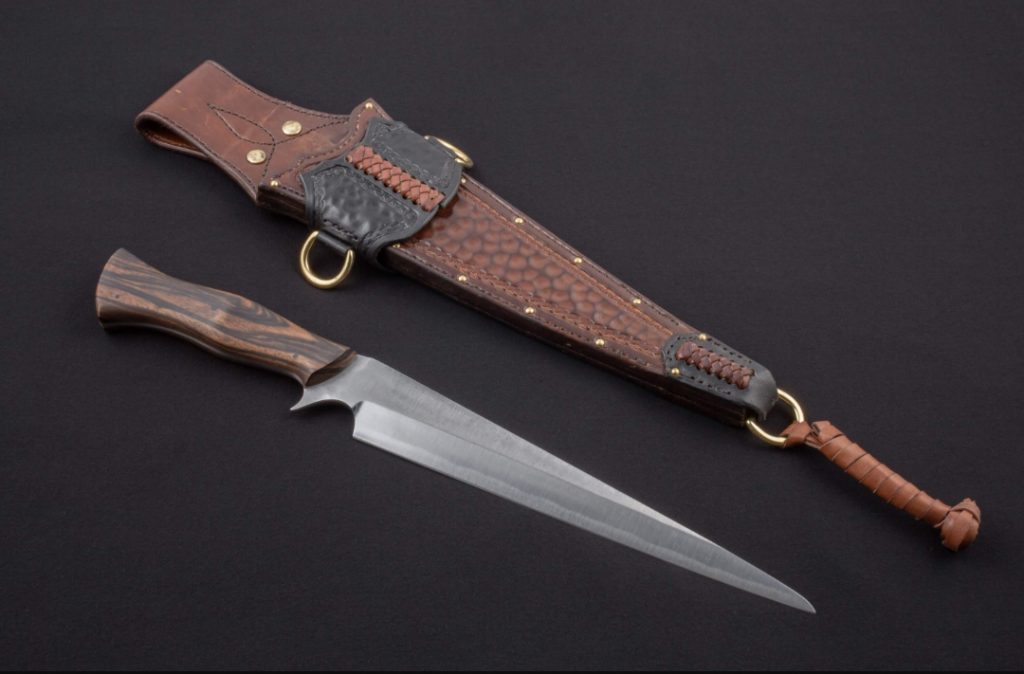
Not really, I am not online. However, when I get to a blade show, I do like to see what other makers are doing. I was really impressed at the vitality I saw at the last blade show. Some of the swords and daggers were outstanding.
Knife making is really a composite of so many skills, is there one that you think is the most fundamental?
Learning how to see with your eyes. I call it micro-observation. Being able to accurately identify small details and how they relate to the project is so critical.
How do you think the knife making world has changed since you started?
Well for one thing, there is a lot more sophistication with folding knives, which is not my realm. I was making a joke at Blade Show, that I had on my table the same four knives that I have been selling for thirty-five years. They are a little more refined, but essentially, they are very similar. While things do change, especially with the technology, ultimately a well forged carbon steel blade is hard to beat. From a usability and sharpen-ability standpoint.
From your standpoint, with all of your experience, do you have any advice for new makers?
I wrote a book called “How to Make Money Making Knives” which has a lot of my advice in it. I recommend finding out early on if you are an Artist, an Artisan, or a Craftsman. If they think they are a Artist but they are not, or if they think they are an Artisan, but they are not, they will have the wrong ideas about how to use their time, money, and resources. Basically, a Craftsman, is someone who works with their hands, they take pride in what they do but at the end of the day they want their knife making to be the means to the end to support their life. An Artist on the other hand, their mind is consumed by their projects, they can become so engrossed that they can lose sight of the consequences of the uses of their time. They are not usually financially driven, the project is the be all end all, until they can complete it. And an Artist usually needs someone, a benefactor, to support them. An Artisan is someone in between, they push the boundaries of what they do, people will look at what they do and see it as a work of art, but the Artisan is aware that they could have done more, but with the added time it would no longer be profitable. So, they are aware of the costs of time and materials but still have an artistic flair. Sometimes an Artisan will tackle an artistic project, but only when they can afford to do so.
I have seen some makers, that I would call Artists, putting out production knives, how do you think that fits in?
Well, yes, that does happen, but I think that it is bad business. I think an Artist making a production knife can have a detrimental effect on their reputation, and it probably isn’t even that efficient, because production is not their area of expertise.
Murray, I really appreciate you sharing your thoughts on all of these different topics, outside of knife making what interests do you have?
I really only have one passion anymore. I just do my best to serve the Lord and await the return of Jesus. That’s the most important thing, everything else is just temporary. I used to fly. I have four dogs. I have also enjoyed reading religious history. From the early church to the Anabaptists, which lead to the Hutterites, Mennonites, and the Amish. I am Mennonite so I find it fascinating. But ultimately my biggest focus is on living right, that’s the most important thing.
Any upcoming news or projects you’d like to share?
I am trying to encourage people to leave the internet, to engage with their customers directly. It is a leap of faith, but getting off social media has been positive for me. I was told it would have a negative impact on my business. And it was true, at least initially, but now everyday I am getting calls, I am interacting meaningfully with my customers and they share that experience with others. I am as busy as I ever wanted to be, and it has been very freeing removing social media.
To keep up to date with Murray Carter he will still occasionally post on his website https://www.cartercutlery.com/ and his Instagram https://www.instagram.com/cartercutlery/ but as mentioned in the article if you would like to get your hands on one of his knives your best bet would be to reach out to him directly at murray@cartercutlery.com.
Leave a Reply