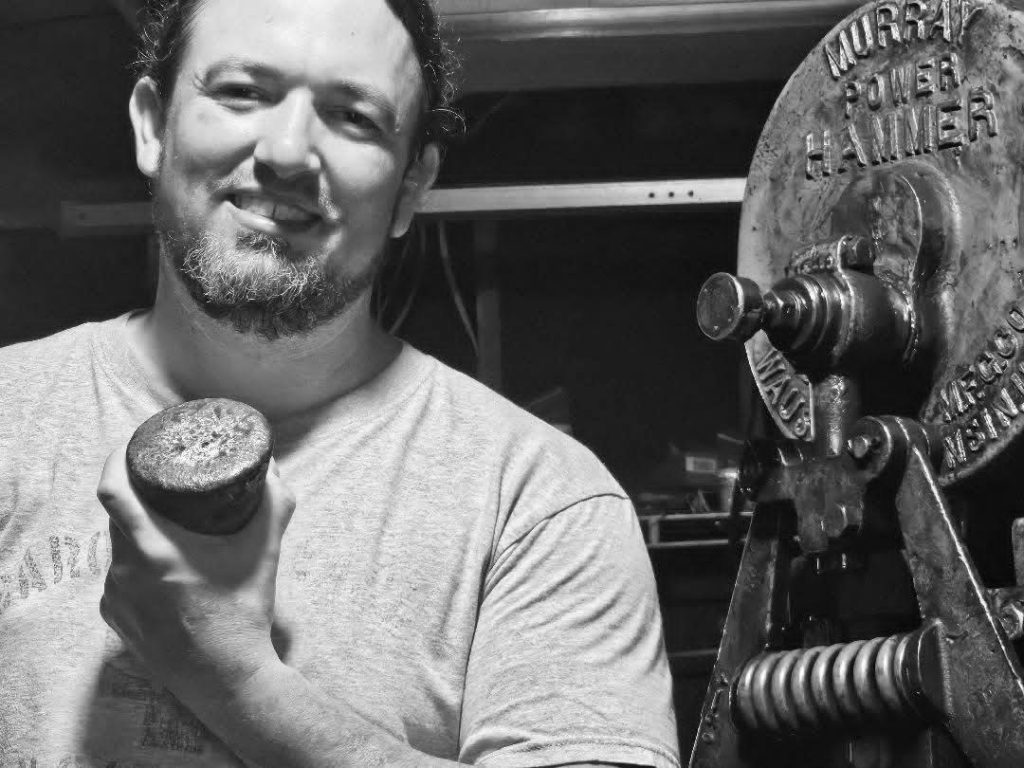
This week’s interview takes us to the shop of Daniel Cauble, a maker who not only makes some absolutely stunning knives but is also on a personal journey to unlock metallurgical secrets of the past. I am so excited to share his story with you.
To start off, please tell us a little about yourself.
Hello, I am a 38 year-old Bladesmith and Ironsmelter that does this part time while juggling a family business outside of cutlery and my wife and kids. I could also say I am a self-taught western togishi for some of my blades as well, as I’ve been collecting and using Japanese natural stones for over 10 years. I’ve been bladesmithing since 2012 and ironsmelting since 2013. I love these hobbies as my free time endeavors when I can and haven’t made them my actual job. I feel this balance allows me to be as creative as possible while avoiding burnout.
What sparked your interest in knives?
My interest in knives and forging in general started in 2012 when an episode of PBS Nova aired “Secrets of the Viking Sword” with blademsmith and ironsmelter, Ric Furrer. It went into some of the history of crucible steel, its use in antiquity and the modern Renaissance of the creation of this steel. That episode sparked my interest and from there I allowed all of my other interests to run amok, which includes Japanese swords and iron smelting.
I kept forging ahead because it was rather enjoyable to get into the craft and learn something so old and so new to me. I also became surrounded by really skilled bladesmiths and ironsmelters such as Jesus Hernandez, Mark Green, and Ric Furrer. I kept creating goals in my learning by creating more and more tools I still use in my shop to this day, and eventually I entered the realms of knives because of Japanese kitchen knives. This, coupled with my desire to learn steel creation through smelting like at the Shimane Tatara in Japan brought me closer and closer to the Japanese side of forging knives. In 2013-2014 Maxim uploaded the famous Kiyosho Kato video and from that point forward I became interested in sanmai and the procurement of Japanese natural stones in order to polish my knives to gain a kasumi polish.
What inspired you to do this and how did you learn?
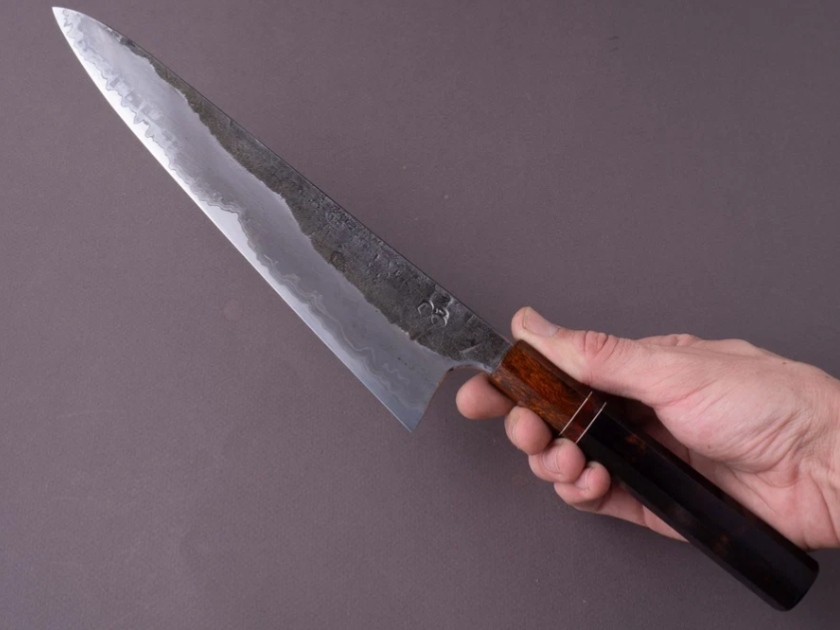
What inspired me to do this and how I learned was seeing great artisans such as Kato, and Hernandez create sharp geometry and well-polished steel, coupled together to make sharp works of art. Seeing people do this with their bare hands spoke to me that, with enough practice and patience, I too can do the same.
When did you start making knives?
I started making knives in towards 2013-2014. Again, I began my endeavors learning to forge competently before I ever entered knives.
What did you make your first knife with?
My first knife was made from an old Black Diamond file. It even had a hamon.
Do you have a favorite knife you made, tell me about it?
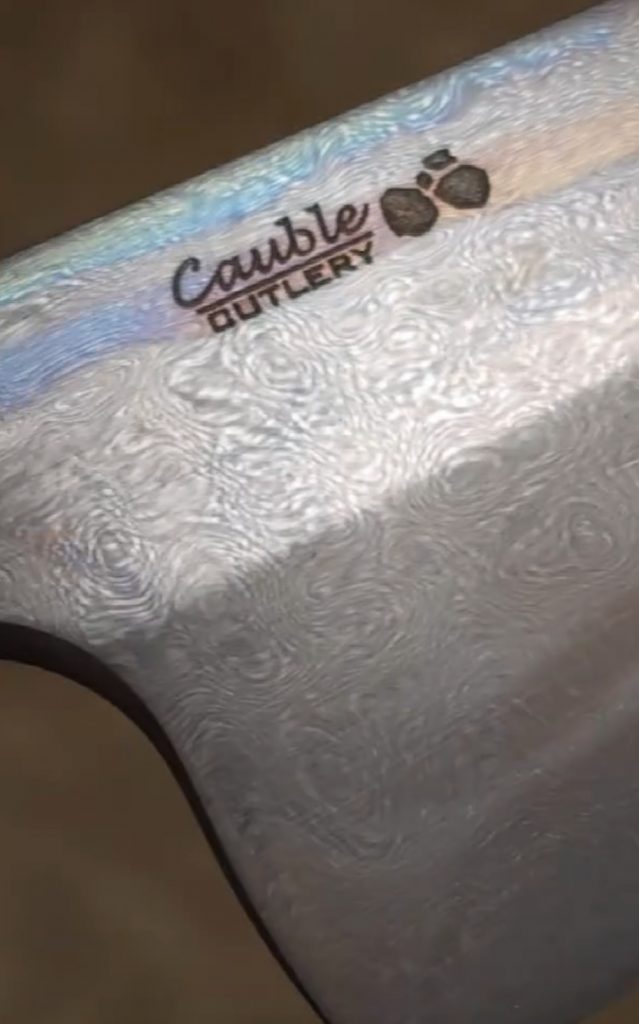
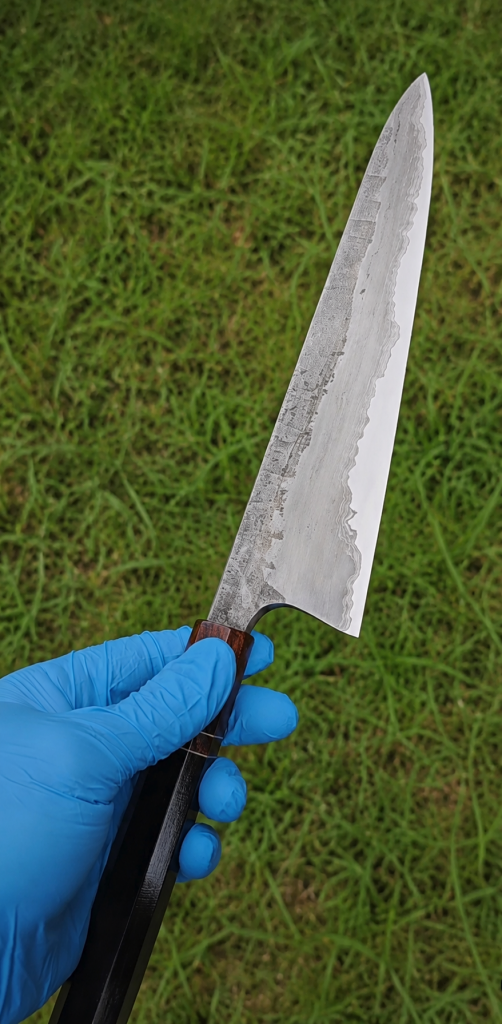
My favorite knife was made at the end of 2024. It contains the best banding I’ve ever pulled out of wootz before and signaled a change in the way I created the steel. I’m still tweaking and testing the limits of my new understanding, but that knife was the first time since I’ve began my wootz making endeavors that I really felt like I exceeded examples found in antiquity. It was a really surreal moment. Many, many years of hard work and mixed success and failure finally lead me to that point.
What is the most important aspect of a well-made knife?
The most important aspect of a well made knife is always going to be the geometry. Well thought out geometry for the task the knife was meant for can make any high carbon steel shine above the rest. Even badly heat treated steel can cut well with proper geometry.
What keeps you going?
Wootz creation and stone procurement keep me going. Wootz being what is perceived as Mount Everest of steel making is always a challenge for me. There’s always room to improve. Jnats are also a big reason why I keep making knives. I absolutely love collecting Japanese natural stones and often fund those endeavors with knife sales.
Biggest struggle?
Biggest struggle is always the point of sale. I’m my biggest critic and am always critical of my work and this often extends to my feelings about how others feel about my work. Since this is much of an artform, what others perceive of my work is often the most stressful part for me. When you place a price on a piece of work that was in my hands for a month, it’s at that moment when my mind wonders if it was all for not or that person’s prized possession. A lot of pressure for me.
What kinds of knives do you make?
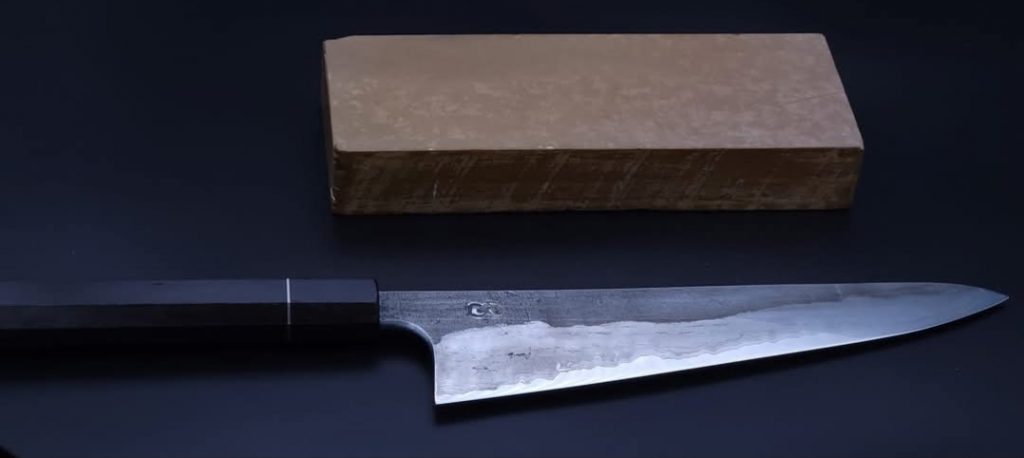
I focus mainly on kitchen knives made from homemade steels such as wootz, sometimes bloomery or oroshigane, and also sanmai. Sanmai allows me to use my stones after all.
How did your background affect your approach to knives?
Since I am used to making steel from scratch, I feel most everything I do is done the same way, aside from growing the tree that goes into my handles. Everything I make is one off and made from the ground up by me. I approach everything with “What desire to I have to make something?” Aside from buying fun things with sales, this is for shear enjoyment and self-satisfaction.
Who helped you early on?
Early on I was helped by forging forums and knife forums such as iforgeiron and Don Foggs Bladesmithsforum. After that is when I met my good friend Mark Green, who taught me iron smelting and pushed me to learn forge welding.
Who are your influences?
My influences are Kiyoshi Kato, Yoshindo Yoshihara, Jesus Hernandez, and Niko Heinaman.
What other knife makers out there impress you these days? Do you take inspiration from anyone else in the field?
Niko inspires me to keep pushing with Wootz. Mark Green always inspires my smelting ability and hard work. Milan often inspires me to keep making sanmai these days as well.
Any specific breakthroughs or revelations in your knife making journey?
When I finally figured out how to get a baseline watered pattern in wootz, I was blown away.
What is the perfect knife?
The perfect knife to me is something that looks and feels impressive without unnecessary embellishments that detract from the blade itself. I gravitate towards earth tones and natural materials when adhering furniture to my blades. Once it passes some of that arm’s length appraisal, I expect this perfect knife to have thoughtful geometry for the task. Everything like planned and nailed heat treat is expected baseline.
How do you approach knife testing?
Knife testing is often performed on rejected knives that failed for something towards the finishing stages. However, general testing like edge deflection and how the knife performs cutting the food they are intended for is performed on every knife. Along with sharpness tests after hand sharpening on stones.
How do you develop a design, select a steel, and fine-tune a heat treatment?
Despite being and avid hand illustrator and occasional painter in my youth, that mindset never really hit me when I approach knife shapes. I typically do not forge and grind a knife based on a drawing. I have pretty good muscle memory when it comes to gyuto shapes. I figure out how wide at the heel I want the knife, how long I want it and a general thickness. I write down the general starting weights I need from starting out with a billet and can pretty much get what I want at this point based on weight to begin with. Of course, I do try to maintain some consistency, I’ve been able to do so with simple means.
As far as the way I select grades of steel and heat treat is concerned, I adhere to more of an engineering approach. Sometimes I use very specific mill steels like Hitachi white or blue steels, or sometimes clean western steels like 26c3, or 1.2519, but I usually always stick with carbon steels for ultimate edge geometry and performance. I tend to take these steels to the max hardness and temper back a bit but still leave them incredibly hard to take advantage of edge stability and sharpness. I can take these steels to incredibly thin geometries. I heat treat everything I make in atmospheric gas kilns. I find this to be the best and easiest way to consistently reach my potential. Electric kilns have too many limitations for me.
What drew you towards wootz steel?
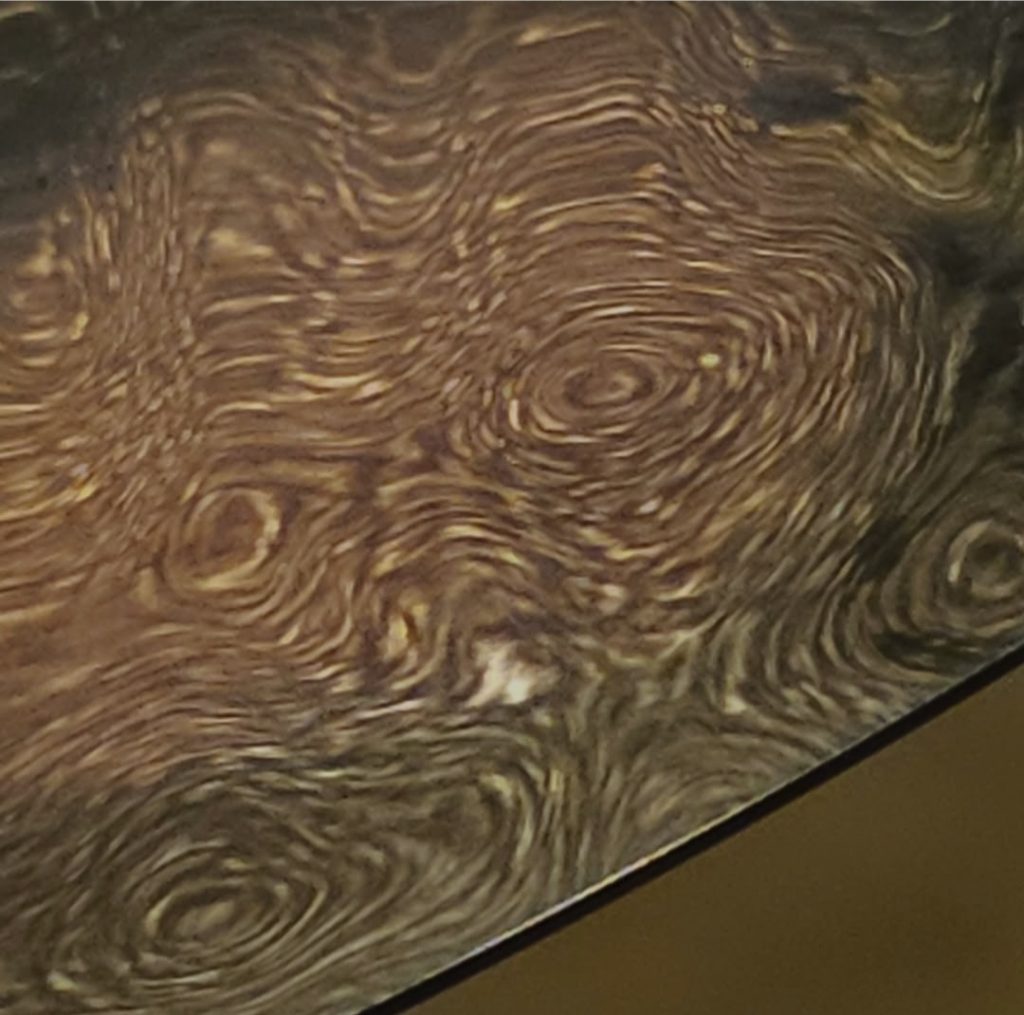
I love Wootz steel firstly because it was what got me into forging and knife making. I happened to catch “Secrets of the Viking Sword” on PBS Nova in October 2012. It was an introduction for me on Wootz steel and the mysteries surrounding it through history. It remained an infatuation after several years of forging and creating steel with other methods like smelting and oroshigane. Then in 2017, I decided to finally embark on the endeavor to unlock the mysteries of the steel and its unique watered patterns when forged correctly. There weren’t any how-tos or tutorials or AI to assist me in this. I had the entire smelting community available, but it was a mystery for everyone else as well. There were others who toiled with the steel and only 1 person in the world to have cracked the Secrets, but he wasn’t divulging anything. After roughly 8 years of heavily researching, dozens and dozens of ingots made, dozens of billets drawn out and dozens of blades made, I’ve come closer than most others working on this in the world. The payoff with the intense patterns has been forever rewarding. The satisfaction of producing museum level patterning keeps me coming back. The steel itself compliments the types of steels I use for kitchen cutlery. Simple carbon steels with high hardness. My current Wootz is among the purest knife steels in existence. I use very clean materials going into the crucible, and do not use any alloying carbide forming elements in my chemistries either. The entire pattern is made up of micron scale spheroidized cementite. Clouds of them. These concentrations of iron carbide are what forms the patterning, surrounded by martensite. The results after so many years of work have changed my overall focus these days. I went from polishing sanmai and hopping over to wootz and vice versa to almost exclusively focusing on Wootz. It’s so addictive for me. I love it.
How has the knife world changed since you started?
The knife world has changed a lot since I started. First, it was all about forums to discuss things with people from around the world. Now it’s all so much more personal with the creation of our current social media. The ability to advertise ourselves has greatly increased as well. Customer base has increased some due to awareness of this craft and culture. I would say it has changed overall for the better.
What’s up next for you? Any exciting new projects to tell us about?
This past year has seen some of the slowest output I’ve ever had, short of injuries. I am forced to focus on business and life outside of knives, so I’ve had to temper some expectations, but my plans moving forward are to continue to work with Wootz and possibly finally going through with the installation of my Nazel 4b power hammer to work Wootz with. An exciting piece of equipment that I’ve had in storage for years. I think I will finally see some of my earlier dreams come true with that finally getting done. I hope to make exciting content for all of you guys in result.
To keep up to date on what Daniel is working on follow him on Instagram https://www.instagram.com/caublestonecutlery/
Leave a Reply