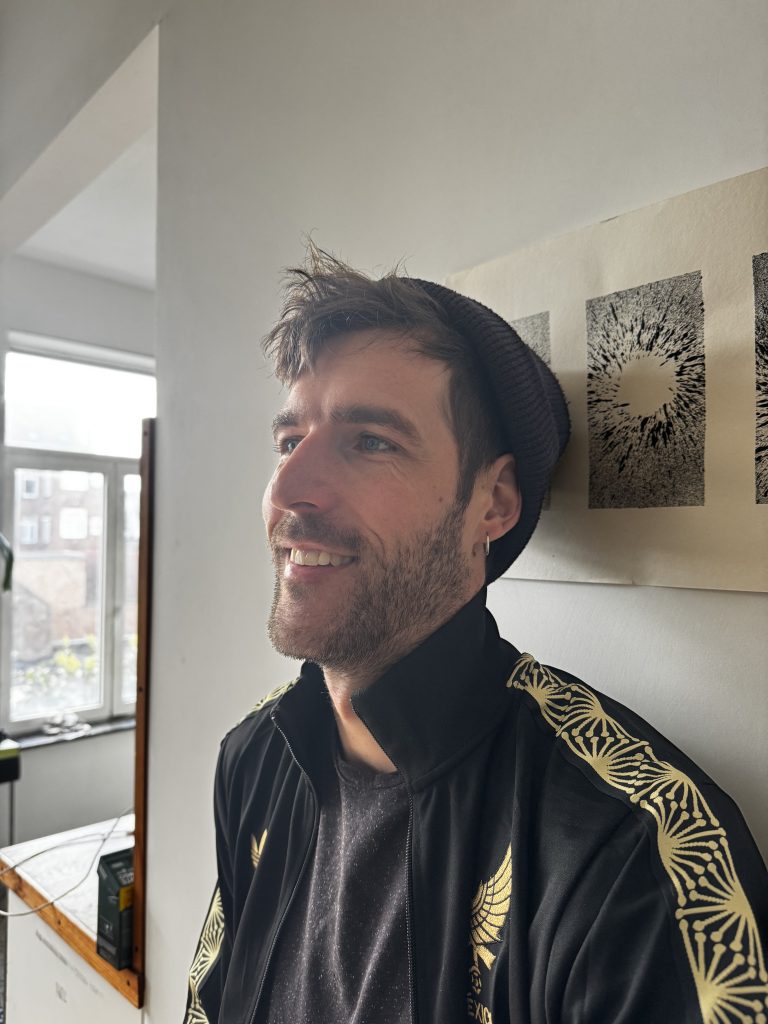
This week’s interview takes us the workshop of Guirec Couteaux. His passion is evident, his clean organic style is inspiring, and I have greatly enjoyed learning more about him. I am very excited to share his story with you, as I loved reading his thoughts nearly as much as looking at his work.
To start off, please tell us a little about yourself.
Hi, I’m Guirec Peron. I’m a bladesmith originally from Grenoble, in the French Alps. I’ve been forging knives for about six years now, and I recently moved to Belgium.
What sparked your interest in knives?
I grew up in the mountains. As a kid I was fascinated by history and spent a lot of time outdoors. I was always building cabins, climbing trees, and reenacting scenes from my favorite movies.
My neighbor had a large woodworking workshop, and I used to go there to customize wooden swords and build all kinds of things.
One day his son brought a small forge he had made himself, and we started putting bits of steel into it. His father cut wood for heating, so there were always small pieces lying around. We would collect them, feed the forge, and try to hammer steel on a piece of railroad track.
At that time it was just a game—making arrowheads or crude swords out of mild steel.
But since those days I’ve never stopped being fascinated by hot steel. In our world, steel is a kind of reference material: something strong, reliable, something you move and use to cut other things. Discovering that, with a simple forge on the ground, a hammer, and a few pieces of wood, you could actually move it and shape it the way you wanted—that was incredible.
And it still feels that way today.
Over the years I kept forging from time to time and trying to make knives. It became a way to find quiet moments where relaxation meets concentration. Crafting has a special quality: you feel outside the world, yet completely inside it at the same time. You are connected to the material and to your environment.
It may sound romantic, but for me it is very real.
What inspired you to pursue this path, and how did you learn?
I studied history and sociology, and after that I worked as a tree climber for several years. Eventually, for various reasons, I stopped, and started thinking about what I really wanted to do next.
I told myself that I needed to try pursuing knifemaking seriously with a professional to see whether it could become my profession.
By chance, my cousin’s boyfriend was a childhood friend of Milan Gravier. I contacted him, and he generously invited me to spend two weeks with him in his workshop and at his home.
During that time I discovered not only the craft itself, but also the daily life of a bladesmith.
To be honest, at the end of those two weeks I felt both fascinated and uncertain.
On one hand, I completely fell in love with the craft. I remember very clearly the day he forged a sakimaru. I was mesmerized—it looked like a katana. The atmosphere of the forge, the power hammer, the colors of the hot steel, the textures of the handle woods, the precision of the gestures and the tools… everything was incredible.
It felt like returning to childhood, but this time with adult tools.
There was also something very elemental about it: fire, water, steel, wood. The main ingredients are simple. Of course we use many other tools and techniques today, but the essence of the craft remains the same.
I’m still extremely grateful to Milan for welcoming me and sharing his knowledge with me.
On the other hand, I also discovered how demanding the craft really is. Making a precise, finished knife is far more difficult than it appears. A knife is such a simple object, yet achieving it properly requires enormous care and skill. And a single mistake can destroy days of work.
I also saw how difficult it can be to make a living from it, and how much pressure there is to both produce and constantly improve.
So I hesitated for a short time. But eventually I decided to commit and start forging knives seriously.
Since then I’ve visited Milan several times to continue learning. Even today he still teaches me a lot.
Beyond that, I’ve learned through books, online research, and discussions with other bladesmiths.
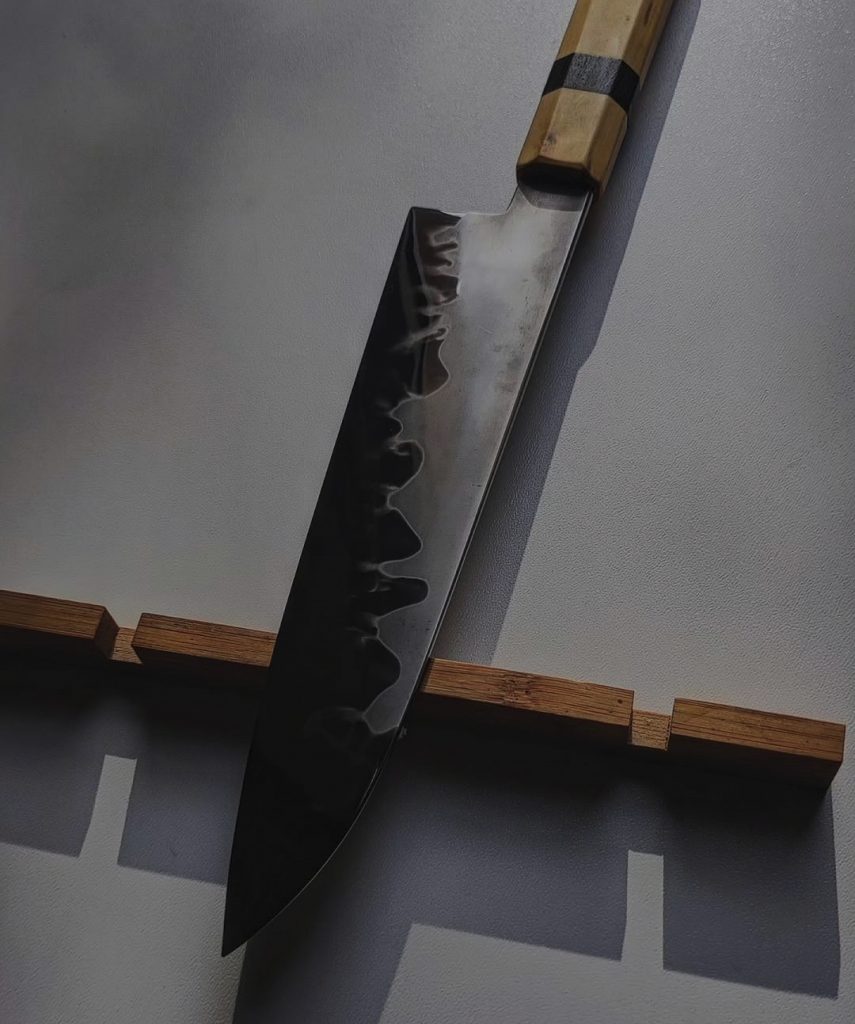
My inspiration first came from Japanese kitchen knives. Later, when I started making honyakis and using nugui for polishing, I became more interested in Japanese sword polishing. That’s where I discovered the pure beauty of that tradition.
What did you make your first knife with?
The first knife I made—if we can call it a knife—was made from mild steel. We quenched it in water, but we had no idea about temperatures or the role of carbon in steel, so I doubt it became very hard.
My first real knife was made from XC75. It was a small petty knife, and it is still cutting today.
Do you have a favorite knife you’ve made?
Yes. My favorite is a sakimaru, which is still my favorite type of knife to make.
It’s a 315 mm mizu-honyaki made from 135Cr3 steel. Because of the difference in contraction between the quenched and unquenched parts of the blade (under the clay), the blade curves upward during quenching. As a maker you can influence how much curve you want.
On this blade the curve came out exactly the way I hoped. The hamon was also a surprise—I don’t think I’ve achieved a better one since. It was very simple, but extremely pure and clear.
Water quenching is very risky, especially with honyaki blades. So when everything works exactly as you imagined, you feel like the happiest man on earth.
For the grind I took inspiration from some tanto blades made by Pavel Bolf. The shinogi line stops earlier than on traditional sakimaru grinds.
The handle is very simple: burnt oak with a small brass inlay.
I like simplicity. But simplicity is often the hardest thing to achieve well. When it works, you are left with only the essentials: a blade, a piece of wood, and nothing more.
For me this is especially true with honyaki blades, where the steel itself becomes the main expression.
What is the most important aspect of a well-made knife?
In the end, it always comes back to cutting performance.
A knife must slice well and release food properly. It needs the right balance between slicing and pushing through ingredients. You should feel a little resistance, but the cut should still feel effortless.
What kinds of knives do you make?
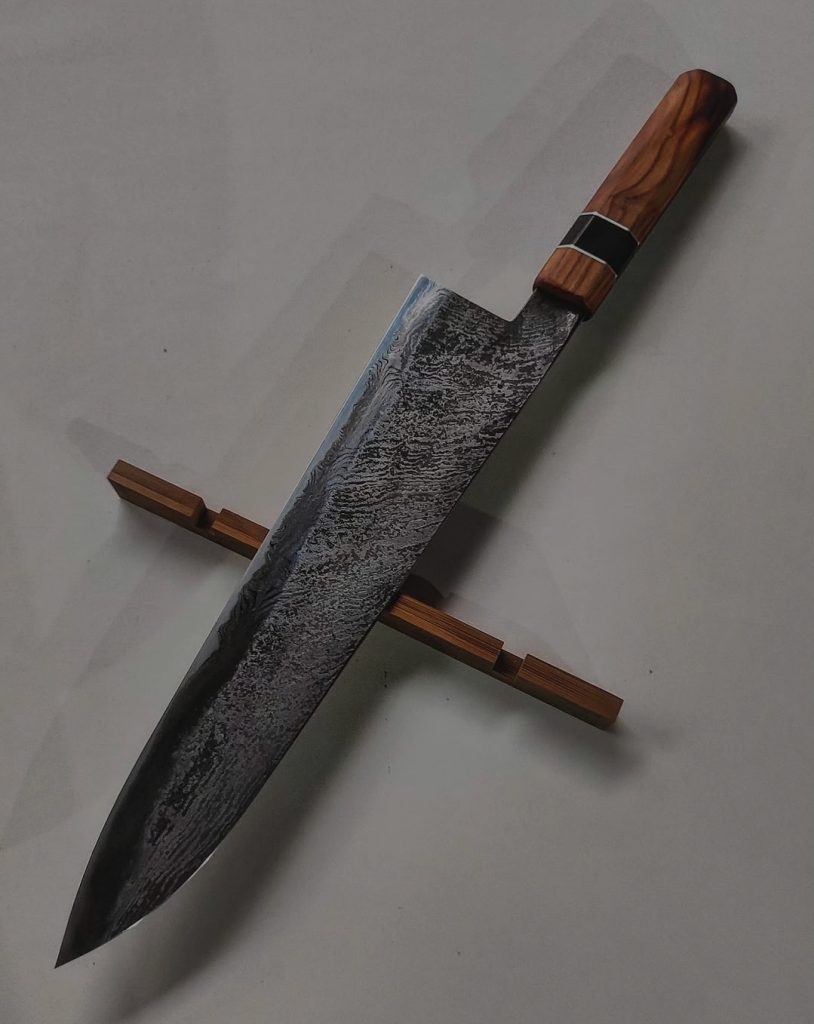
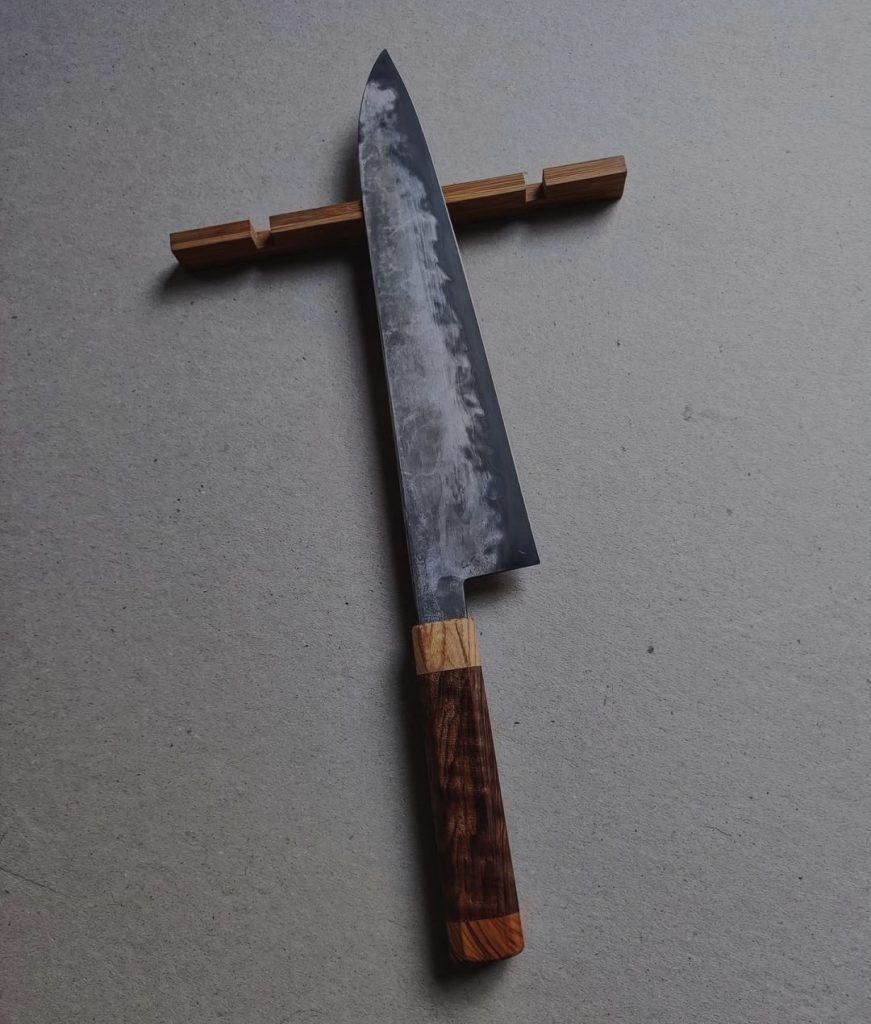
I mainly work with two techniques: san-mai using wrought iron as cladding, and honyaki blades.
Most of my knives are gyutos and slicers. I try to position my work somewhere between the heavier workhorse style—like those of Yanick or Milan—and the extremely thin laser-style knives.
Personally I don’t like knives that are too heavy, but I also don’t enjoy lasers that feel too fragile or weightless.
Since I prefer forging with a hammer rather than relying heavily on belt grinders, my knives naturally lean toward the workhorse side. I simply try to keep them balanced.
How do you develop a design, select a steel, and fine-tune a heat treatment?
When it comes to design, I mostly start by observing the shapes made by other makers. I reproduce them, test them, and see how they feel in use. Step by step I begin to understand what I like and then try to push things further in my own direction.
Mistakes are also a very important part of the process. Like everyone, I learn a lot from them. Looking carefully at a mistake can sometimes reveal new possibilities.
For example, someone once told me about using a pin hammer to tighten the hole for the tang in a steel rivet. You drill the hole slightly larger than the tang and then use the hammer to compress the metal so it fits perfectly. It’s a very good technique. But it also creates another problem: if you want the rivet to look clean, you have to grind away the hammer marks afterward.
But what if you decide to go in the opposite direction and emphasize those marks instead of removing them? If you strike the rivet more intentionally, it creates a small texture on the surface. Suddenly the rivet becomes a tactile detail that you can feel with your fingers.
Many times when you make a mistake, if you explore it deeply enough, you can find a new technique hidden inside it.
In that sense, knifemaking is always about precision, but also about allowing something to escape your control. That’s where beauty negotiates with efficiency. When it works, it’s a real pleasure. You never know exactly what the final result will be. When everything goes well, it feels a little like guiding the steel toward a destination—and once you arrive, you let it express itself.
You are controlling something that still manages to surprise you every day.
As for steel, I mainly work with 135Cr3, C130, and C105. It takes a very long time to truly understand a steel. For now I am still learning them. I prefer to focus on a few steels and understand them deeply rather than working with many without really mastering them.
I use 135Cr3 as the core steel for my san-mai blades and for my oil-quenched honyaki. It is an excellent steel—very pleasant to forge and grind—but it also has a tendency to quench very easily.
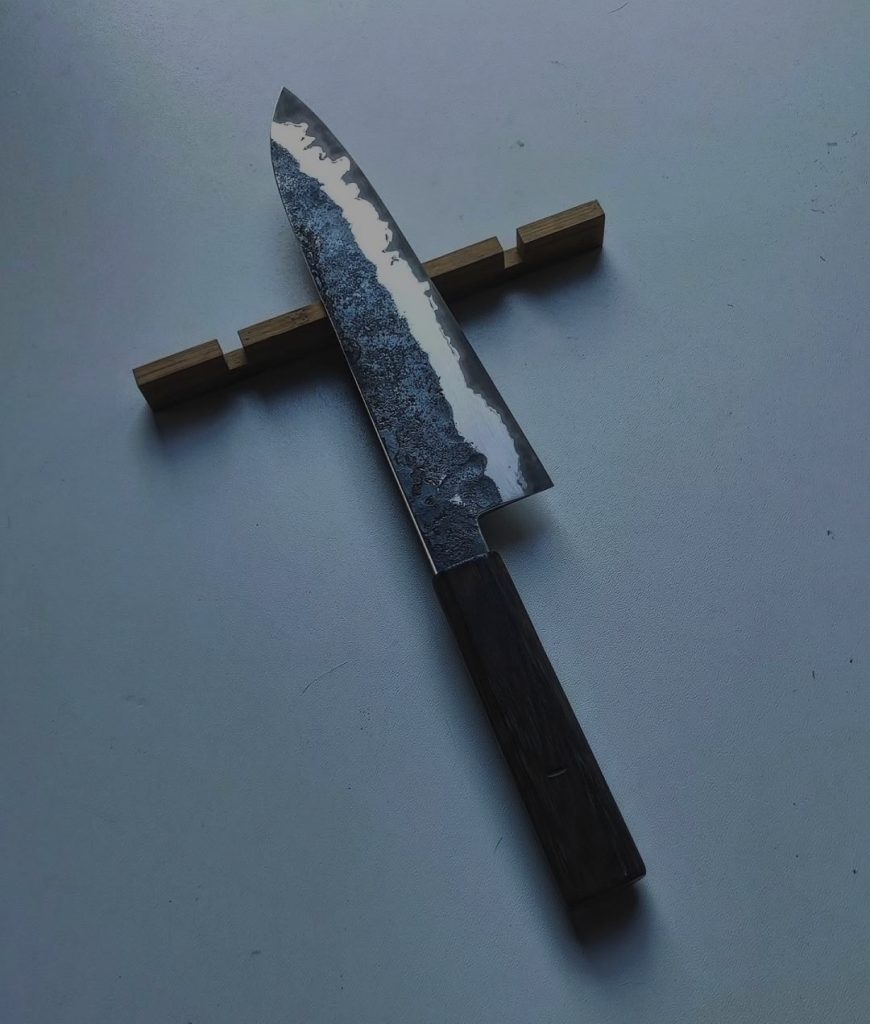
For my mizu-honyaki, which are quenched in water, I prefer C130 or C105. They are more difficult steels to work with, but because they do not harden as aggressively as 135Cr3, they often produce more interesting hamon activity.
Water quenching is a very specific and demanding process. I first became interested in it because of its simplicity and effectiveness: just water, no toxic fumes, and a very fast quench.
But if you want to use it successfully, you need to adapt your entire process. Your forging, heat control, and heat treatments all have to be very precise. For example, when quenching in water I tend to use slightly lower temperatures, because the transformation in the steel happens so violently and quickly that overheating can easily cause the blade to warp or even break.
In the end, heat treatment is always closely connected to the forging process and to the type of knife you want to make. When making a mizu-honyaki, for instance, you have to carefully control the thickness of the blade so that the hamon follows the boundary created by the clay. And depending on how the blade was forged, you may adjust the quench temperature slightly to reach the right balance.
What keeps you going?
Beauty.
What is your biggest struggle?
Consistency.
Life is never stable, so you constantly have to adapt. In knifemaking you never stop learning and experimenting.
But at the same time you must be careful that evolution does not destroy the qualities you have already achieved. You need to progress without losing your identity.
What is the perfect knife?
This is a difficult question.
Many of us are chasing that idea. It can keep you awake at night.
Technically, a perfect knife would have the perfect balance between slicing ability and resistance through food. But for me there is also something more.
A perfect knife is one where cutting performance connects you to the beauty of the blade. When you use the tool and enjoy using it, you start to find it beautiful.
Beauty should come through use—never the other way around.
How has the knife world changed since you started?
This is a huge topic.
Many young people are entering knifemaking because they want work that feels meaningful. They bring new values and different ways of working. The younger generation tends to collaborate more and share knowledge more openly.
It’s also great to see more and more women entering the field, which has traditionally been very male-dominated.
At the same time, knifemaking—like many crafts—is increasingly shaped by social media. Today you are not only selling knives. You are also selling an atmosphere, a story, even a version of yourself.
Makers feel pressure to constantly produce images and videos of their work. This creates new opportunities, but it can also make the profession more precarious, especially for beginners who immediately compete with very experienced makers online.
In some ways we all participate in this system. Sometimes we benefit from it, sometimes not. But overall it creates a constant acceleration.
What’s next for you?
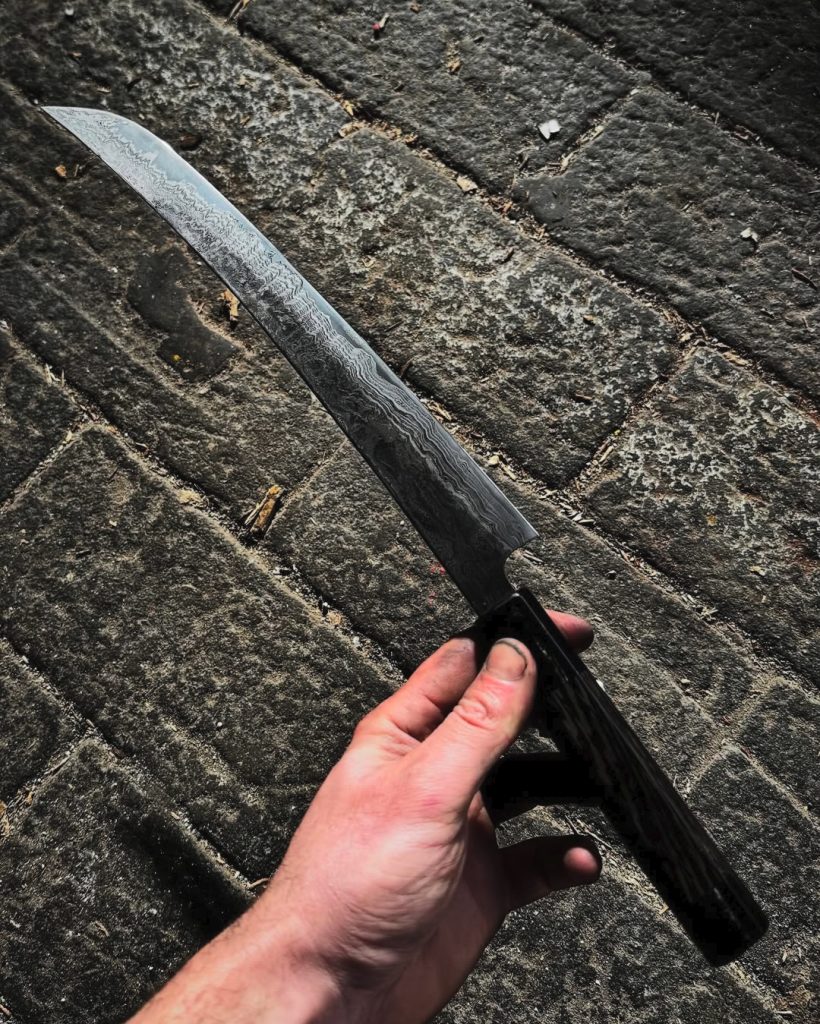
My next goal is to combine Damascus steel with selective quenching.
To achieve this I’ll need to experiment with different steel combinations and Damascus patterns, and explore how they interact with hamon formation.
I’m not yet sure whether I will focus on Damascus cladding, a Damascus core, or perhaps both.
But that’s part of the process: experimenting, failing, and discovering new possibilities.
To keep up to date with what Guirec as going on visit his website https://guirecperoncouteli.wixsite.com/ and follow him on Instagram https://www.instagram.com/guirecouteaux/ as of the writing of this interview he is currently on a break, but there is no doubt your wait will be rewarded.
Leave a Reply