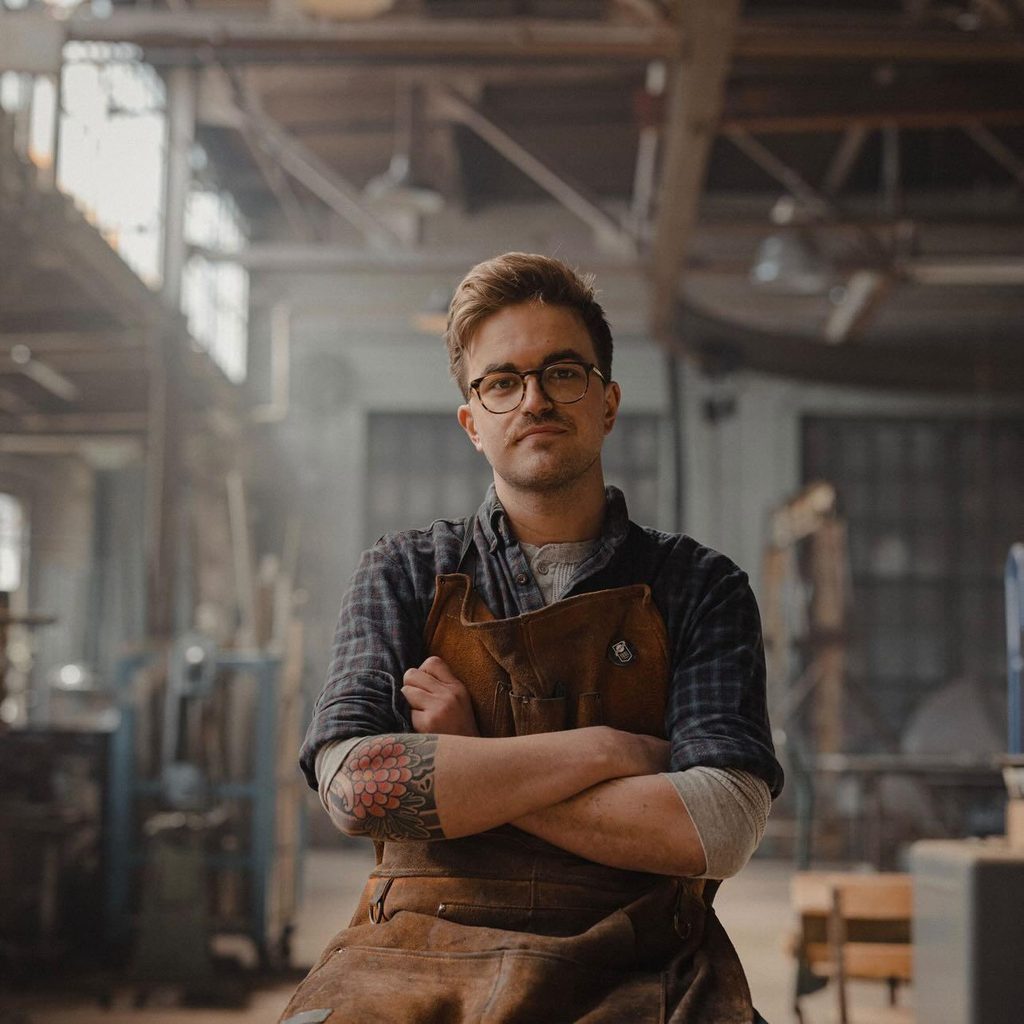
This week’s interview takes to the workshop of a maker who largely lets his work speak for itself. He has nods to classic design, but he adds plenty of his own elements to create distinctive kitchen tools that are carry his singular style. I am very happy to be able to share his story with you.
To start off, please tell us a little about yourself.
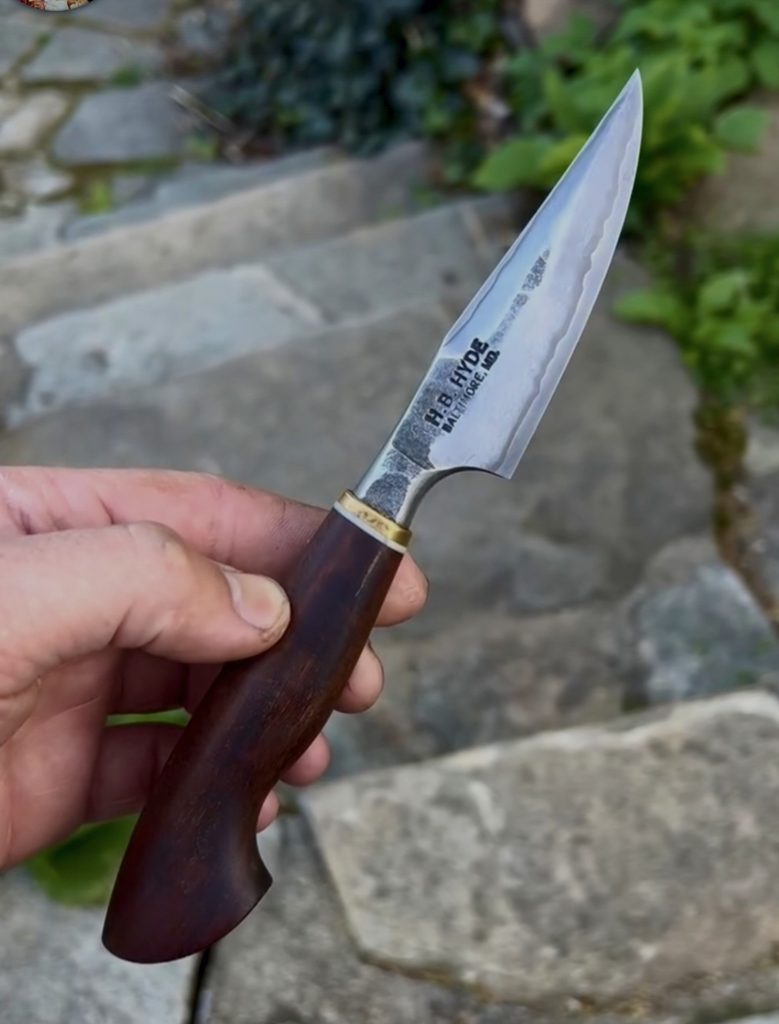
My name is Henry Hyde, middle name is Blackburn, so H.B. Hyde. I am from Maryland, currently working in Baltimore City. I primarily make kitchen knives, but I also make hunting/belt knives and other non-knife kitchen accessories.
What sparked your interest in knives?
I gained a love for cooking early but not the skill until college. When my roommate started getting into learning to cook, I learned with him. I quickly fell in love with cooking. I started working in kitchens in the afternoons after class. I kept cooking after I graduated because I loved the camaraderie and the excitement of cooking professionally. The longer I cooked, the better I understood what the knife in my hand should do, how it should feel like an extension of my hand. I had collected a respectable collection of knives, including a forged gyuto by Matsubara. Coworkers of mine needed their knives sharpened, and I had gotten familiar with sharpening, so I became the kitchen sharpener. This increased attachment to the knives sparked an idea in me that if I could sharpen them, I could probably make them.
What inspired you to do this and how did you learn?
Kitchen life is hard. I started realizing that I couldn’t see myself as a career cook/chef. I needed to pivot, but my experience was in cooking, and I loved working with my hands. I reached out to a few local knife makers around Charleston, South Carolina, where I lived during and after college. A few days later, I got in touch with Quintin Middleton. He invited me to his workshop, and we made a knife together based on my design. At the end of the day, he asked me if I wanted to be his apprentice! I obviously said yes, and I spend the rest of the afternoon staring at a paring knife that Quintin and I had made. The fact that it was nothing but a piece of steel and wood that morning, by evening it was a tool I could have for the rest of my life…I was hooked and then some. I started by helping Quintin in his shop on his production knives, sanding and polishing handles mostly. I had some experience with power tools but this was levels beyond my ability. I attended the American Bladesmithing Society’s Introduction class and learned to forge blades under Master Smiths. I began making knives of my own, and Quintin would critique them and tell me how to fix any mistakes. My apprenticeship lasted a year, as I moved to Baltimore in 2019, but I still consider him a mentor and a friend. When I moved to Baltimore, I met Nick Ireys, a local architectural and fine art blacksmith, he took me under his wing and has been helping me develop my bladesmithing and blacksmithing.
When did you start making knives?
I started with Quintin in early 2018.
What did you make your first knife with?
1095 single bevel paring knife, ebony and curly maple handle.
Do you have a favorite knife you made, tell me about it?
My favorite is always getting updated, as my work improves and develops. Usually it’s how the whole thing fits together over it being made of fancy materials, but sometimes it’s the fancy ones.
Currently, I have to say that my favorite is a hunting knife I made for myself for deer hunting season. Mostly because I don’t keep knives around and use them very often, and it’s just a nice piece that has been working really well. It is a clip point hunter forged from Hitachi Blue #1 with a whitetail antler and olive wood handle.
What is the most important aspect of a well-made knife?
Heat Treatment and temper. If it don’t stay hard, it ain’t worth a anything.
What keeps you going?
Can’t imagine myself doing any other job. I’m a terrible employee, so it’s probably best I make it work somehow.
Biggest struggle?
Admin stuff kills me. All the side work of running a business is the hardest part.
What kinds of knives do you make?
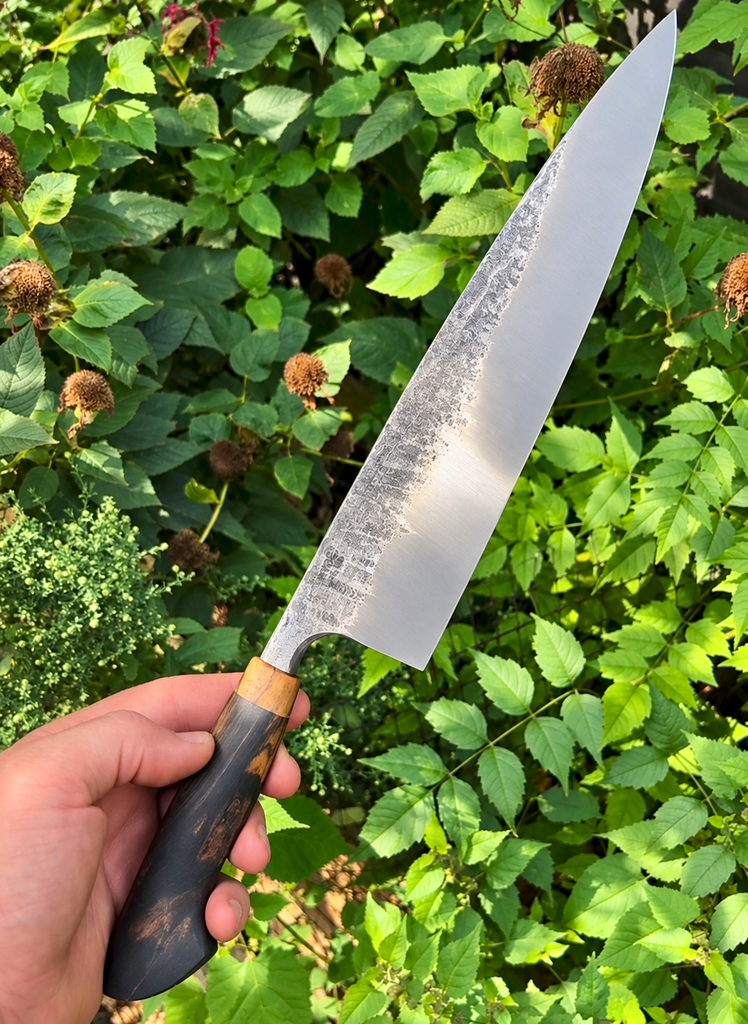
Mostly culinary, a little bit of outdoors. Occasionally, I’ll do a dagger, spear, or some other historical recreation.
How did your background affect your approach to knives?
Cooking professionally gets you used to using knives for hours on end, I could tell if a knife was good if I didn’t think about it while using it.
Who helped you early on?
I had a lot of support from my friends and family, even from the beginning. Of course, I got questions like, “Where are you trying to go with that?” But I have always had a lot of people supporting me through this.
Who are your influences/inspirations?
Dmitri Popov, Tomas Rucker, Geoff Feder, Tony LaSeur, Josh Prince, Tomislav Sokač, Curtis Haaland, Dan Prendergast, Dylan Ambrosini, John Doyle to name a few knifemakers
I like watching other artists and craftspeople work, seeing how other people solve problems and create their work inspires me. I think that being a professional artist is more about keeping a fire lit inside of you to continue making pieces, rather than the work itself. Developing, but ultimately continuing your craft is the only way to get better.
How do you think that inspiration (those inspirations) translates into your work?
I have always thought, as my mentor Quintin told me, that the work is often only as good as you’re feeling that day. There is a definite mojo to knife making, along with many other forms of expression/art/craft. Once you feel the mojo for what you’re working on go, you should move on to something else, or just stop for the day entirely. This has led me to making a wide array of products, as I get bored doing one thing. I think I take more the mindset and outlook of other makers over shapes for knives, popular handle materials, etc, but I have definitely done the latter as well.
Any specific breakthroughs or revelations in your knife making journey?
Probably none of my own, but here are a few:
The customer mostly does not see many of the things that the maker will see/obsess about. Make a product that is as good as you can reasonably make it, but don’t lose sleep over work not being perfect.
The worst part of any task/job is a lot less bad when you don’t let yourself think it’s the worst. I got this from Nick Anger in a class, I used to hate hate hate handsanding, I would whine and moan through the whole process and say how hard it was, which made it worse. Nick said something to the effect of, its gotta be done, but if you cut out the negativity associated with it, it’s really not that bad. Applicable to non-knife related things as well!
Grinding knives is a lot like dancing with a partner. Being relaxed and loose will help things come out nicer. Got this from Quintin, he would blast music and shout at me to get into it while I was learning to grind knives.
What is the perfect knife?
Doesn’t exist, more of an idea to strive for, but each task and user has a different knife that’s best for them. I just try to do my best that I can at the current moment, and hope that each iteration is slightly better. With the amount of knives I make in a year, I try to balance making the knife look and perform the way I’d like it to with the efficiency of producing it.
How do you approach a new concept and that concept’s implementation?
I like to draw things out, I don’t get things too measured or exact, but I like to have an idea of what I’m going for. Then I will forge a few test pieces, and get them cleaned up on the grinder, and see if I need to start again, or if I can continue/make more. I like to have 3-5 of anything completed before I get to making a lot of them, and test them at home/give them as testers. From there, we can make any tweaks and then set up a larger production schedule and flow to make things as efficient as possible. I hate getting stuck on stages, so I like to have things set so it’s less likely.
How do you approach knife testing?
Take it home, if it feels good in the hand and I don’t have to think about the knife while I’m using it, it’s successful. Most of my edges are too thin for major torture testing, and I have a few years experience with the steels I’ve been using. I don’t test knives as much as I’d like to, but I also don’t often feel the need to. I know my knives are ground thin, because that’s the way I like em.
How do you develop a design, select a steel, and fine-tune a heat treatment?
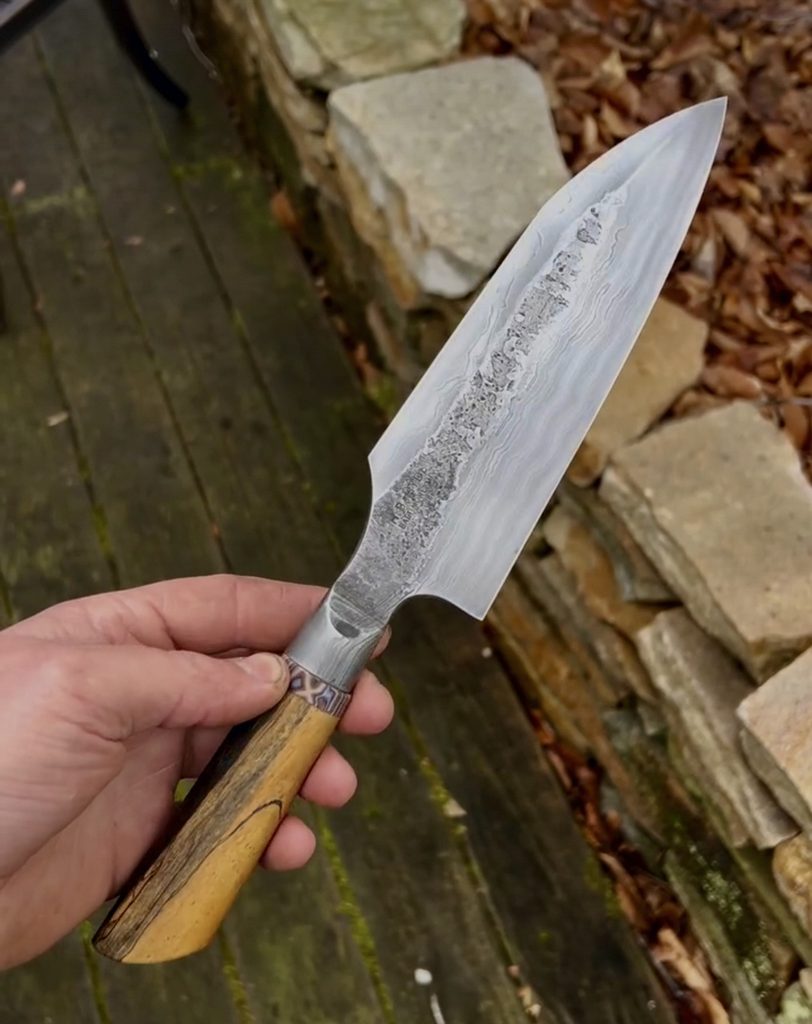
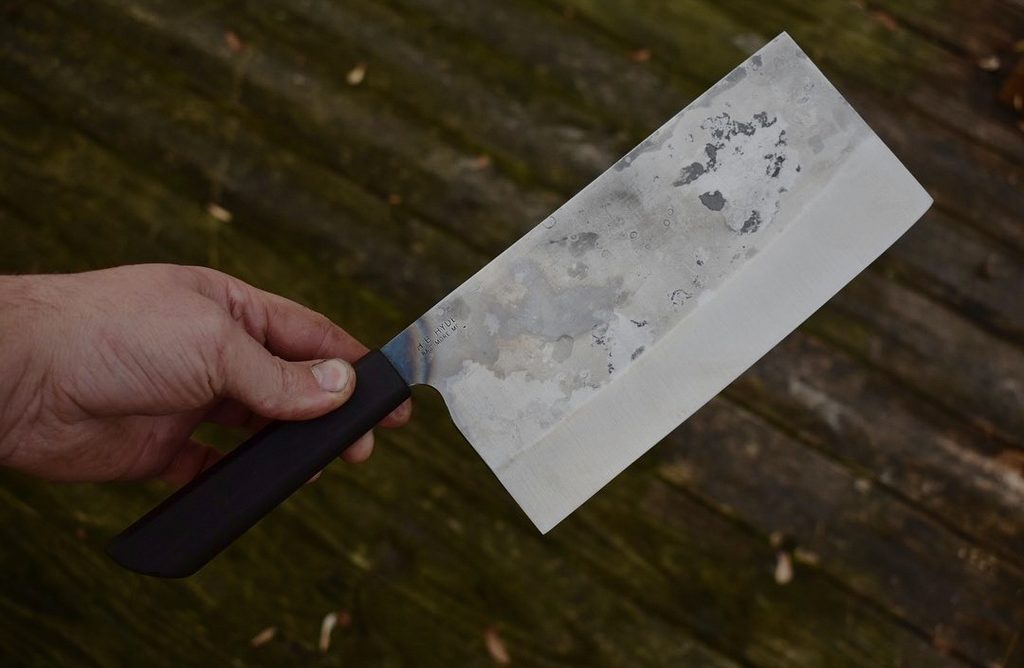
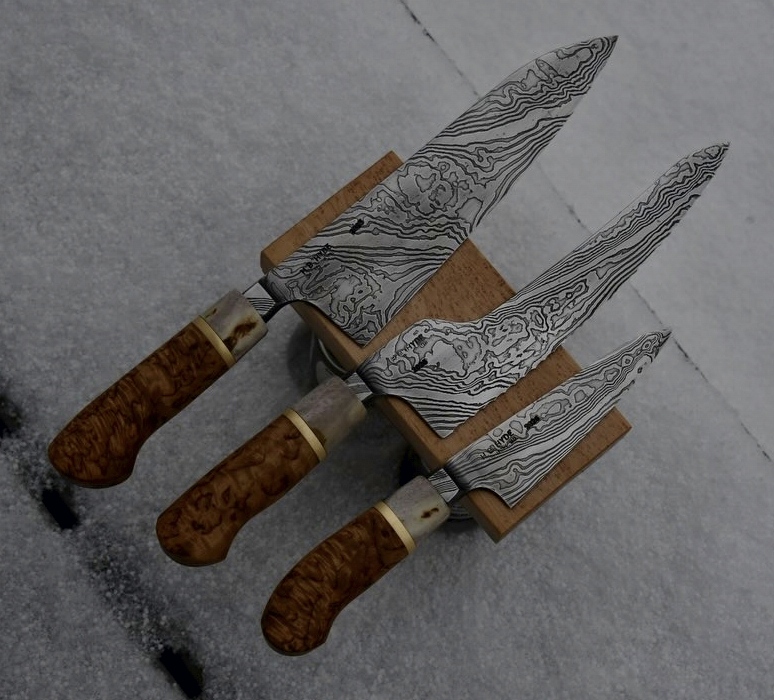
I don’t really. I really only use one genre of carbon steel, it all hardens around the same temperature. All my general use kitchen knives get tempered at 400F degrees. If they’re a hard use knife, a little hotter, if they’re something that needs to stay sharper, a little cooler. I don’t have any premade designs, unless someone wants a set of matching knives, which isn’t often. Most of my customers are cool with me making all different stuff, which I love. Almost every knife I make is shaped largely off of how it comes out of the forging process. I like to let the steel have a say in how it is shaped. I think this gives my pieces a more natural and organic look that flows.
How has the knife world changed since you started?
Instagram sucks now, a lot less community on those kinds of platforms. Knifemaking is a lot more mainstream, while it is still rare to find people doing it as a full-time job. I got into it in a moment where the excitement around Forged in Fire was increasing, and the craft was getting a lot more attention. Since Covid ended, there has been less new knife makers, from what I’ve seen. It’s definitely harder to get eyes on your work nowadays, but there is still interest in handmade knives. In person shows have ticked up around me, and classes are everywhere, which I think is a great thing to see.
What’s up next for you? Any exciting new projects to tell us about?
I have two huge craft shows in the spring, the American Craft Council show in Baltimore, and the Smithsonian Craft Show in DC. I’m trying to get my tabling set up super professional to do a lot more in person marketing and selling, as Instagram is not my favorite medium for sales. I am always looking to get into more stores, but the tariffs imposed by the US makes it hard to sell overseas right now, so trying to expand domestically as much as possible for the moment. I think this year, I’m going to do my best to have 100 knives going into each craft show I have, then just get right into producing for the holidays.
To keep up with Henry is working on head over to his website https://hydehandmadeknives.com/ and give him a follow on Instagram https://www.instagram.com/hyde.handmade/
Leave a Reply