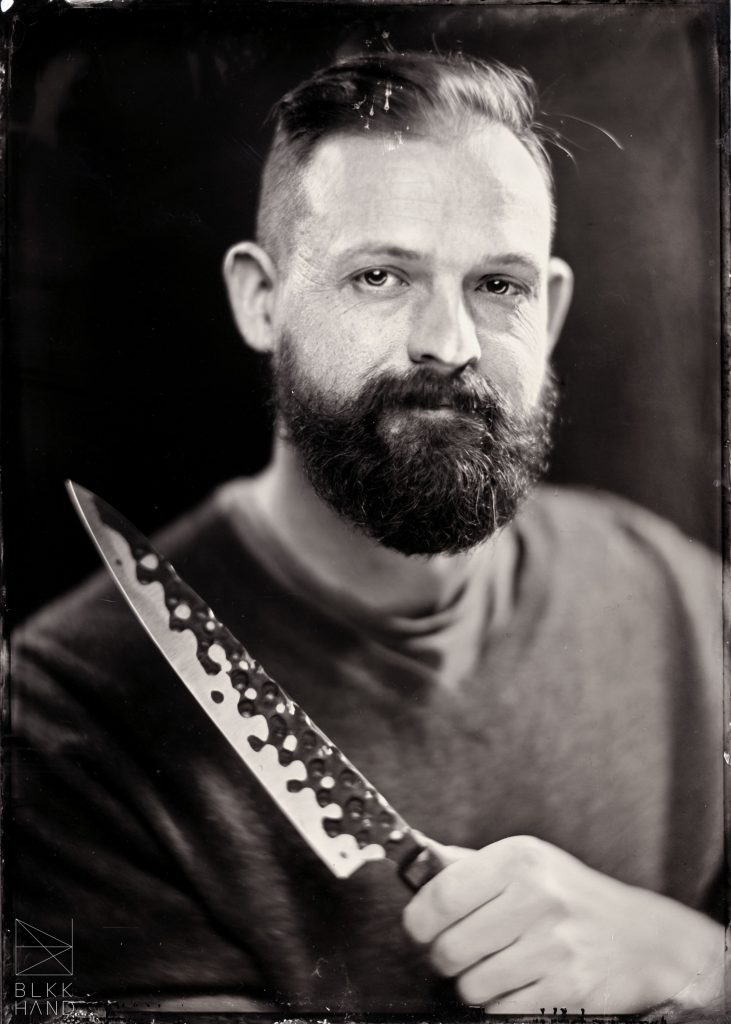
photo credit BLKK HAND photography
This week’s interview takes us to the workshop of a maker I have been following since I first started getting into Western knifemakers. His designs which straddle the banks of tradition and art have always grabbed my attention. I was thrilled when he agreed to share his story, and my personal favorite element of any interview is the how someone came to start making knives. There’s something so interesting about how people coming from so many different directions and find their way to this craft, Isaiah’s story is no exception, and I couldn’t be more pleased to be able to share it.
To start off, please tell us a little about yourself.
My name is Isaiah Schroeder, I’m 47 years old and I’m a bladesmith in Madison, WI. I’m married to Rebecca Rettenmund and we have a greyhound named Zoiks and a cat named Sukoshi.
What sparked your interest in knives?
Before I got into making knives I was a furniture maker working mostly in wood, I was working for a successful studio furniture maker(Richard Judd) and also making my own pieces in an effort to build out my portfolio. One day, Mark and Sue from ChefKnivesToGo.com (an online Japanese chef knife retailer) came into the shop where I worked asking for somebody to make handles for some of the Japanese knives they were importing. My boss wasn’t interested so I took it on and it turned out there were a lot of people who wanted custom handles. So, I did that for a while as a side-gig, and I got interested in the craftsmanship involved with knifemaking as I was learning more about knives. As a furniture craftsman I’ve always admired well made, aesthetically pleasing, and finely tuned tools and I began to see that knives could be in that category also.
What inspired you to do this and how did you learn?
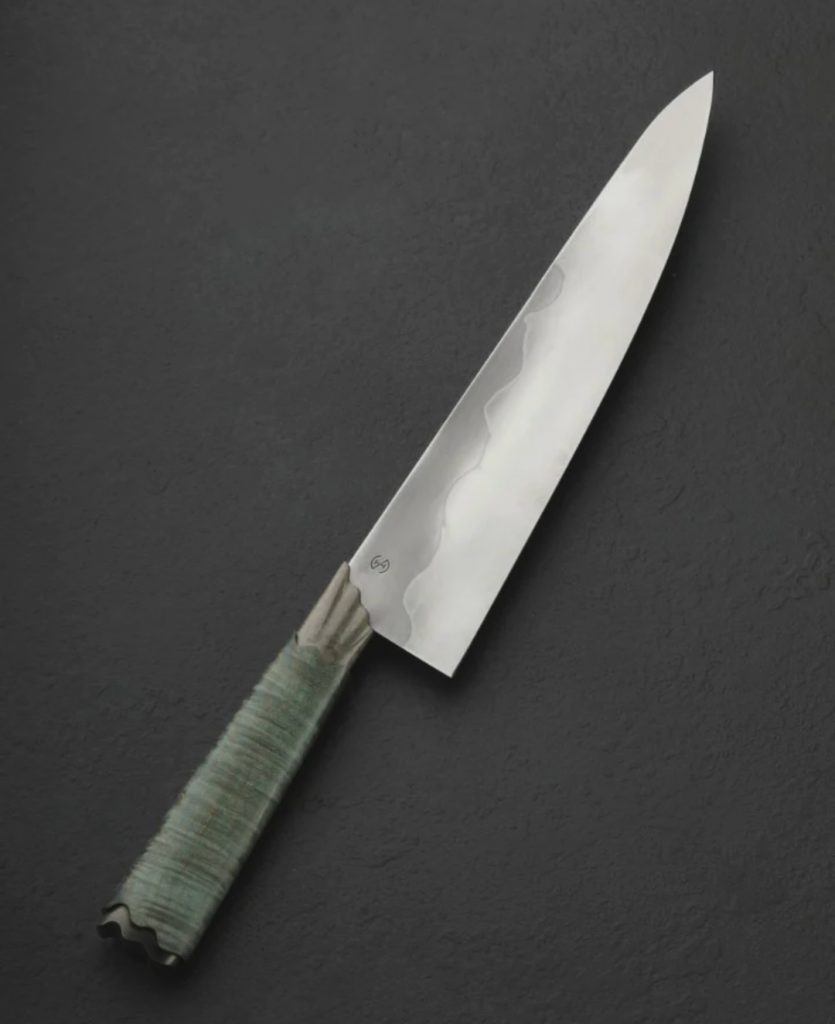
What I really love about making knives is all the different disciplines you can bring into it. I’ve learned about metallurgy, forging, casting, welding, machining, lots of jewelry techniques like mokume gane and lost resin 3d printed casting. I could keep going, the list is very long. I love learning new things and then applying them to my work, adding tools to my toolbox.
I also like making beautiful things that are functional, in that way knives are similar to furniture. They’re things you spend a lot of time around and having nice versions of them can really enhance your daily experience of using them.
I’ve learned so much from just the internet, in the early days bladesmithing forums were a treasure of knowledge. Though reliable heat treating information was hard to come by. YouTube and Instagram have been really amazing also, I love watching people doing their work and seeing their shop setups, you can learn so much just from that.
I have also taken a few classes here and there, but I tend to learn best on my own.

photo credit Eating Tools
When did you start making knives?
I made my first knife in a blacksmithing class that used to be offered at my local technical school(MATC), that was I think around 2010. I made my first knife for sale in 2015, it was a santoku in 1095 with a wavy hamon.
What did you make your first knife with?
That first one was actually a damascus blade that I made with old bandsaw blades and metal strapping tape and I used a coal forge. I’m pretty sure I burned out most of whatever carbon was in that stuff because that steel definitely didn’t harden, but I was still so excited to reveal that damascus with the etching!
Do you have a favorite knife you made, tell me about it?
I think it’s easy to look at past work and feel like it’s obsolete in terms of your own abilities, if you’re always improving as a craftsman. But I like to think about what I learned from this or that piece and certain projects stand out to me as milestones in that regard. Making my first successful stainless damascus was a big one for me and I still love the knife that I made from that billet, it was a low layer twist and I used blackwood and silver for the handle.
What is the most important aspect of a well-made knife?
Performance is the most important but not the only important thing. Performance is tied to a lot of other aspects of a knife also, the steel choice, heat treatment, geometry of the blade, shape of the handle, choice of handle materials, and the weight and balance of the knife all play a part in how well the knife does it’s task. And I think part of a well-made knife’s task is to make you happy to be using it, that involves aesthetics and originality and the sometimes the story of its making as well.
What kinds of knives do you make?
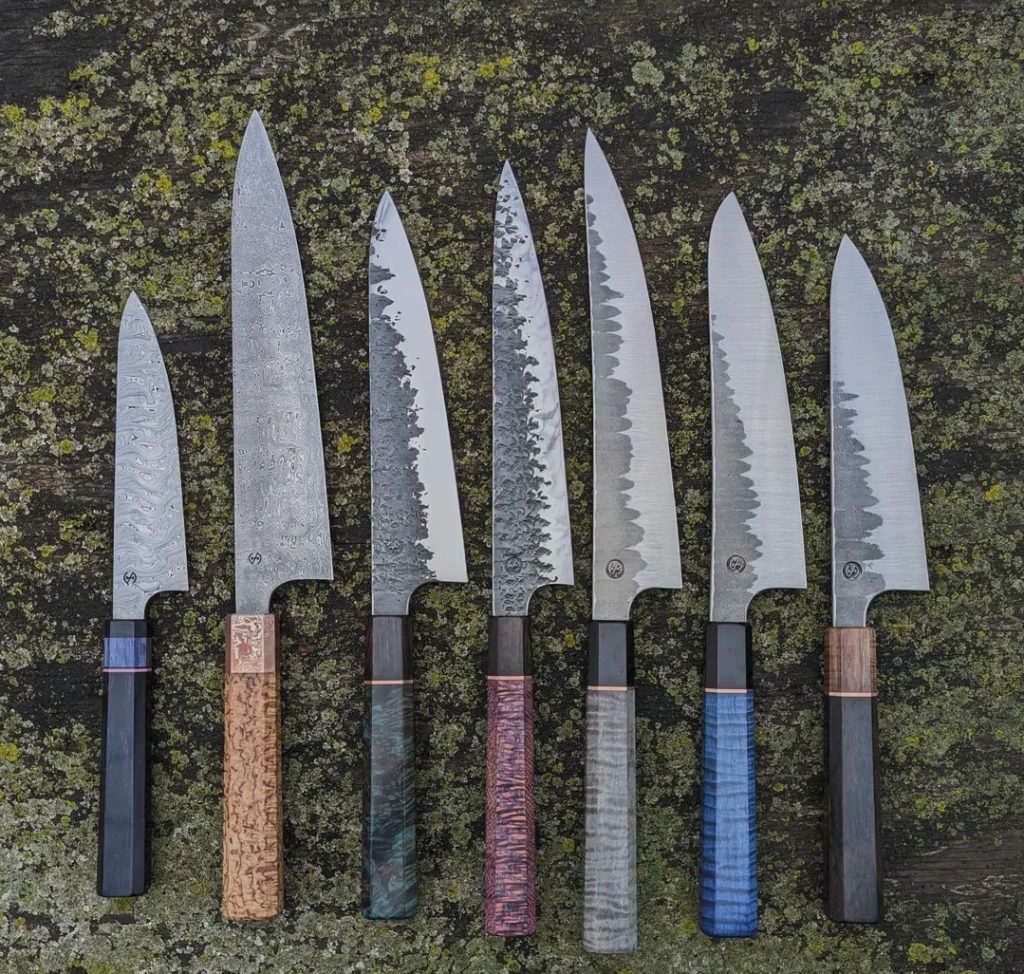
I focus on making knives for the kitchen. They are the most common knives in the world, nearly everyone on the planet owns at least one kitchen knife. I like that they get used, I like the idea that someone will look forward to picking up my knife and cooking a meal with it.
Who are your influences/inspirations?
Some of my early knife making inspirations are: Anders Hogstrom, Michael West, Adam Ritchie, Mardi Meshejian, Serge Panchenko, and Andrew Meers. There are plenty of other makers who’s work I admire but these were some of the people I found early on that really were doing something different and interesting to me.
Some of my furniture making inspirations are: Wendell Castle, Silas Kopf, Bob Trotman, Gary Knox Bennet, and James Krenov.
How do you approach a new concept and that concept’s implementation?
I usually will begin with a drawing session and a cup of coffee. Sometimes I have some ideas already that I want to work out on paper and sometimes I don’t have anything until I sit down and start drawing. Some of my more complex ideas get 3d modeled so I can derive patterns and 3d printed prototypes from them. Often, I do adjust things as I’m making the actual piece also. Although a physical 3d prototype gets very close, things can be different with the actual material, and I want to be open to adjusting to that.
Any favorite steels?
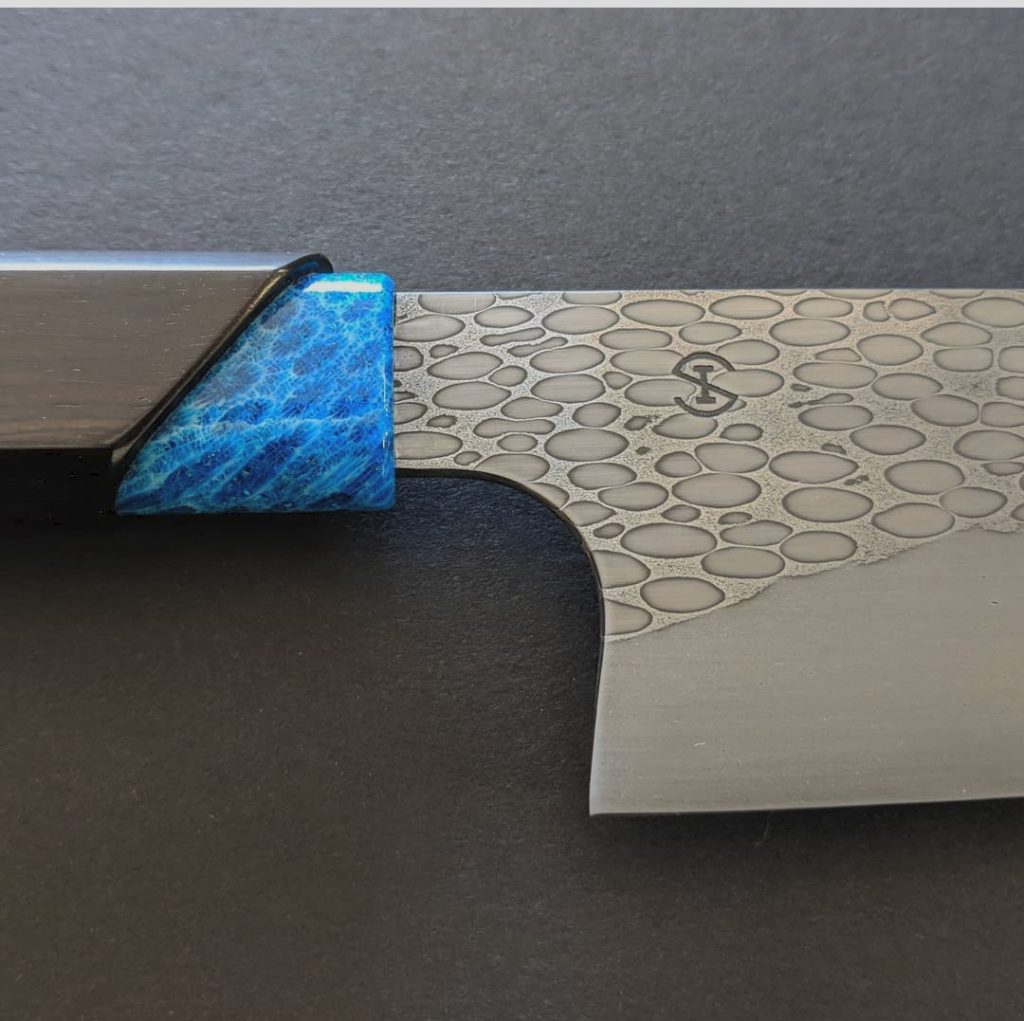
I’ve been moving more towards stainless steels in general. I’ve seen a few of my carbon damascus knives that have been used a lot and you can barely see the pattern on them sometimes. I like to do big, bold patterns, and that does help with that. But with stainless damascus it always looks like new. I love looking at Larrin Thomas’s data that he shares of his wear resistance testing of various steels. I prioritize wear resistance for kitchen knives and S90V is the king according to his chart, so I’ve been using that quite a bit for monosteel knives.
What’s up next for you? Any exciting new projects to tell us about?
I recently opened a retail space in the same building as my shop. I’ll be selling my own knives and offering sharpening as a service. www.severforever.com is the website for the store if you’re interested.
As most knife makers know, Instagram has been pretty problematic recently as a way to reach customers. It’s become unreliable and with a physical retail space I’m hoping I won’t have to rely on it as much. I’m also looking forward to meeting my customers face to face, which I never get to do when I only sell online.
To keep up to date with Isaiah is working on head over to his website https://www.schroederknifeworks.com/ and follow him on Instagram https://www.instagram.com/schroederknifeworks/
2 responses to “Isaiah Schroeder Knifeworks”
-
Thanks for including me in your interview series Phillip, I like reading these and it’s an honor to be on this list!
-
So glad to have you be a part of it.
-


Leave a Reply