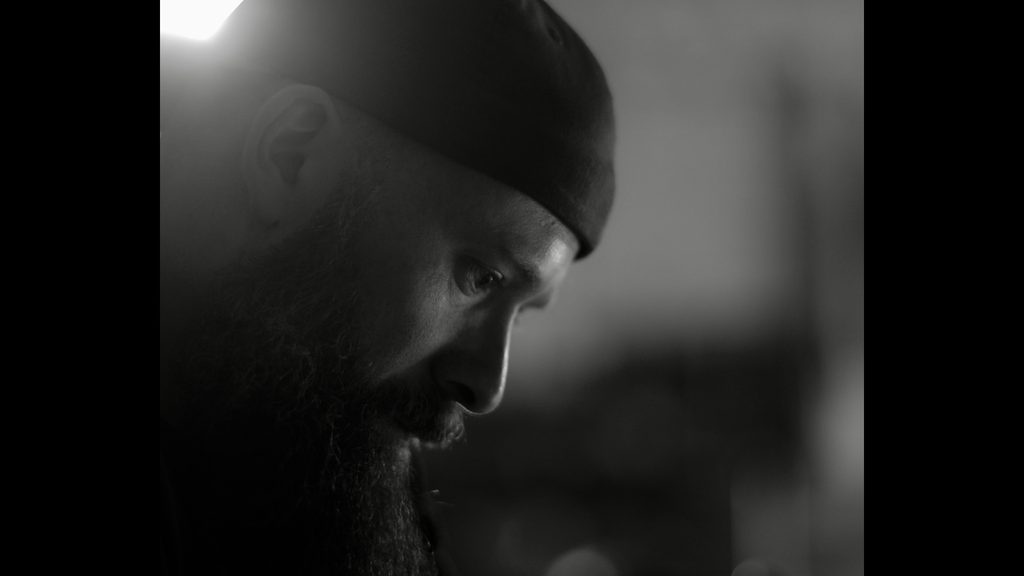
This week’s interview brings us to a maker that has a catalog of work that is as varied as his imagination. When I think about the world of functional art, one of the aspects that intrigues me is the extent a tool can be pushed artistically before it no longer is useful. When I think of the work of Zack Jonas, I love the fact that all of the art is built on a solid foundation. It makes what he creates that much more amazing to know that not only does it look incredible, but it still is a credible tool.
To start off, please tell us a little about yourself.
I grew up about 20 miles north of Boston, Massachusetts. I developed a strong interest in art early on, think I started taking lessons when I was about 4, and instruction continued steadily up through college and beyond. I gravitated toward drawing early and filled sketchbook after sketchbook as a kid. My drawings often included things like swords and dragons, likely inspired by the books and movies I consumed. I studied philosophy in college because I have always enjoyed thinking. I would say one of the strongest features of my personality is my curiosity. I love finding out how things work, and learning new ideas.
What sparked your interest in knives?
I have loved knives for as long as I can remember, so there was no initial spark that I can point to. I have simply always been drawn to them. Any given knife can of course just be a tool, a matter of pure utility, but “the knife” in its most essential nature is an object of power in a way that I think speaks to us in a very natural way.
What inspired you to do this and how did you learn? When did you start making knives?
I think it’s fair to say that my curiosity led me into knife making. I started casually collecting knives when I was about 20 (nothing fancy), and that eventually led me to discover the website of a custom knife purveyor. I remember the moment the lightbulb went off and I thought to myself, hang on a minute, ‘custom’ means people are actually making these things; I have to learn about this!”
So I just started looking and asking around. Eventually I found a connection to Paul Cooper, who was apprenticed to a knife maker named JD Smith. I reached out to Paul and he suggested signing up for JD’s Intro to Knifemaking class at the Massachusetts College of Art and Design (MassArt) in Boston. I signed up immediately and arrived with no idea of what to expect. I fell in love. I ended up taking that class back-to-back eight times. It got me access to MassArt’s well equipped studio and JD’s skillful instruction. Once I had the basics down, I traveled around the country and learned from several other master knife makers, eventually settling back down to begin my own practice full time. I also became formally apprenticed to JD Smith under the auspices of a Traditional Arts Apprenticeship grant from the Massachusetts Cultural Council.
What did you make your first knife with?
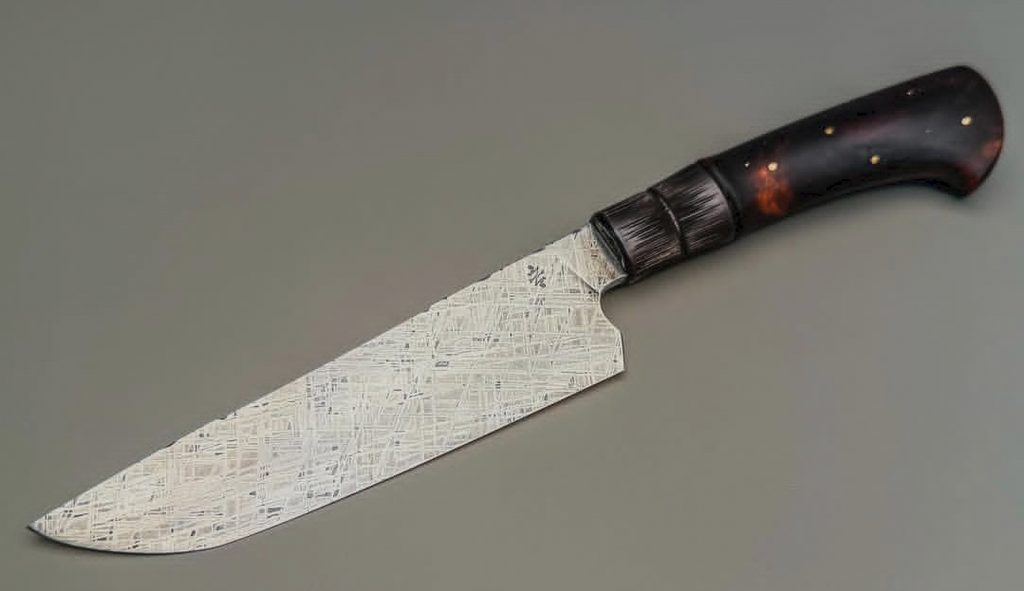
My first finished knife was a simple damascus knife with a swept, clip point. It was an all-steel piece with a fileworked tang and a vicious little edge. I still have it! I will never forget the moment when, after I heat treated it, I brought it to JD to see if I had done it properly. By way of an answer–and entirely without warning–he drove it into the sheet metal lid of a toolbox. I was sure it would break, but instead it punctured the lid. Several times! And upon inspection, we saw that it had taken no damage whatsoever. “Good job,” JD said.
Do you have a favorite knife you made, tell me about it?
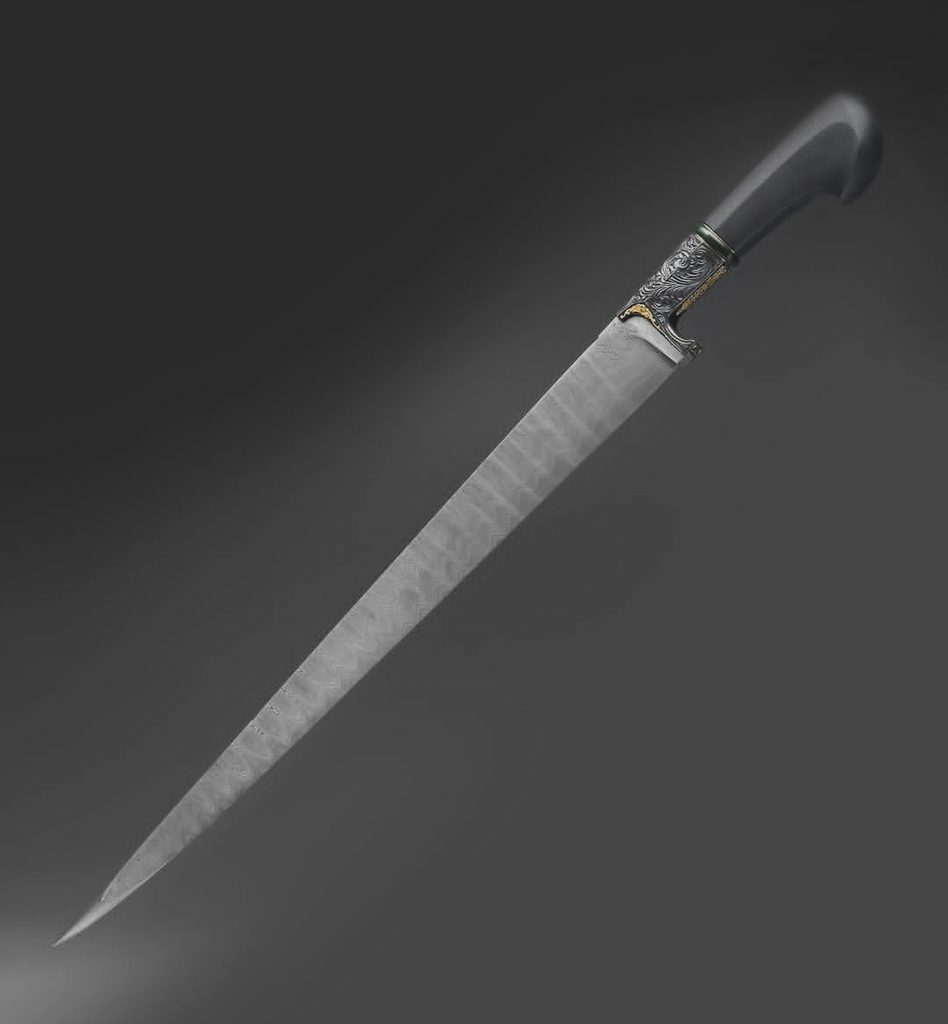
I think my favorite piece so far is one that I completed for the Art Knife Invitational show in 2025. It is a 24″ piece, landing it somewhere between a large knife and a small sword. In terms of typology, it has DNA from the kard, the pesh-kabz, the choora, the rugger…and from me. The 18″ blade is made of 1000-layer ladder damascus, tapering to a wicked reinforced point. The grip is sleek African blackwood, with spacers in nephrite jade and 18 karat gold. The bolster is 1045 steel, with very extensive sculpting, engraving, inlay, and overlay by Tyler Sofie of Wanderer Metalworks, featuring accents in 18 and 24 karat gold. The piece blends subtlety, tension, and stark simplicity of form with rich and decadent detail. I’m really happy with it.
What is the most important aspect of a well-made knife?
There are so many critical factors that go into any well-made knife, but if I had to choose just one, it would have to be heat treatment. Without a heat treatment that provides the appropriate performance characteristics, a knife is not a knife. Unless the piece is purely decorative, the heat treatment is what provides it with so much of its power.
What keeps you going?
I just love making knives. It feels strange to say it, but it’s just something I deeply enjoy. Part of my philosophy of life is that if we could all make the people around us just a little bit happier, we’d all be a whole lot happier. Knife making is one of the ways I can do that. Am I curing cancer? No. But it is meaningful when someone comes up to me at a show and says, “I bought a chef knife from you five years ago, and I smile every time I cut something.” Between that and just the immediate personal satisfaction I get from solving some new challenge or learning a new skill? It just feels good. It’s hard work. It’s tedious, difficult, dangerous, tiring, dirty, and just generally fairly punishing, but it is also extremely satisfying.
Biggest struggle?
Early on in my career, it was difficult to know where to price my work. Today, my biggest struggle is probably that there are more projects I’d like to do than there is time to do them in!
What kinds of knives do you make?
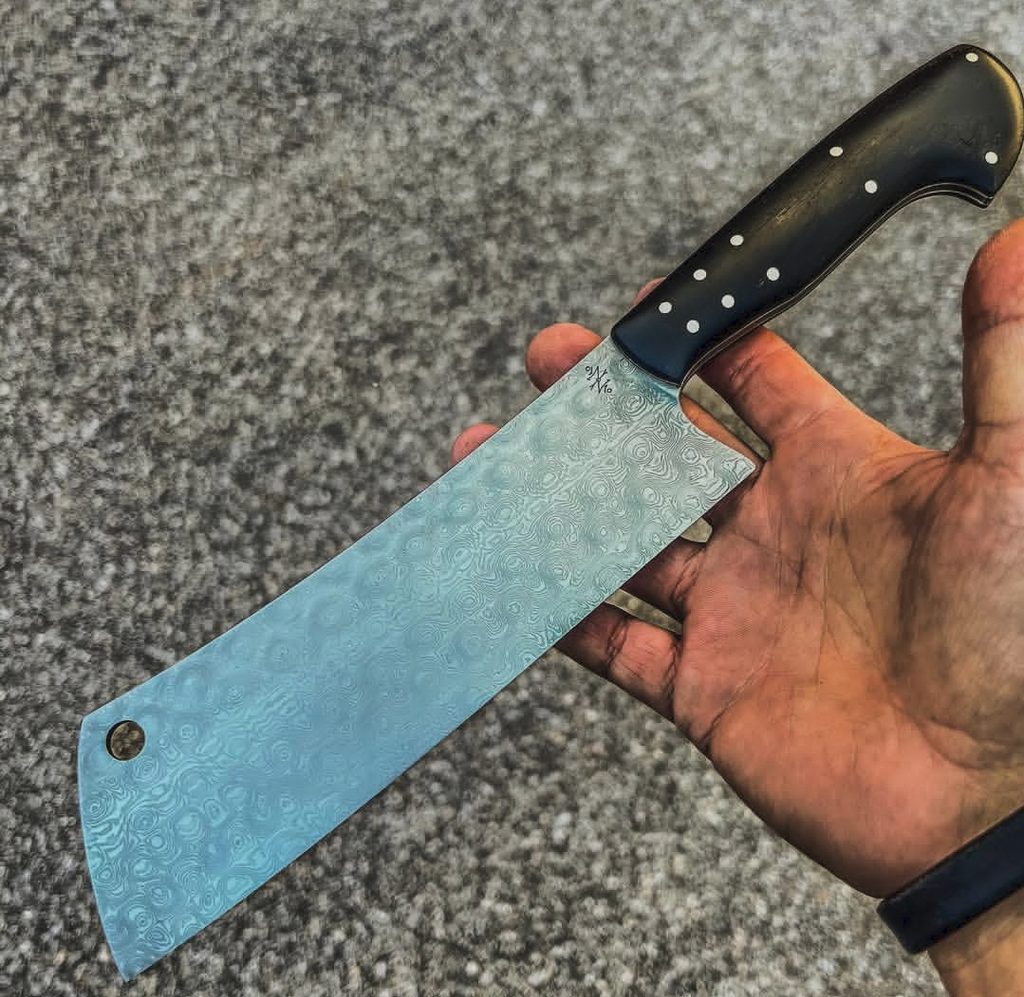
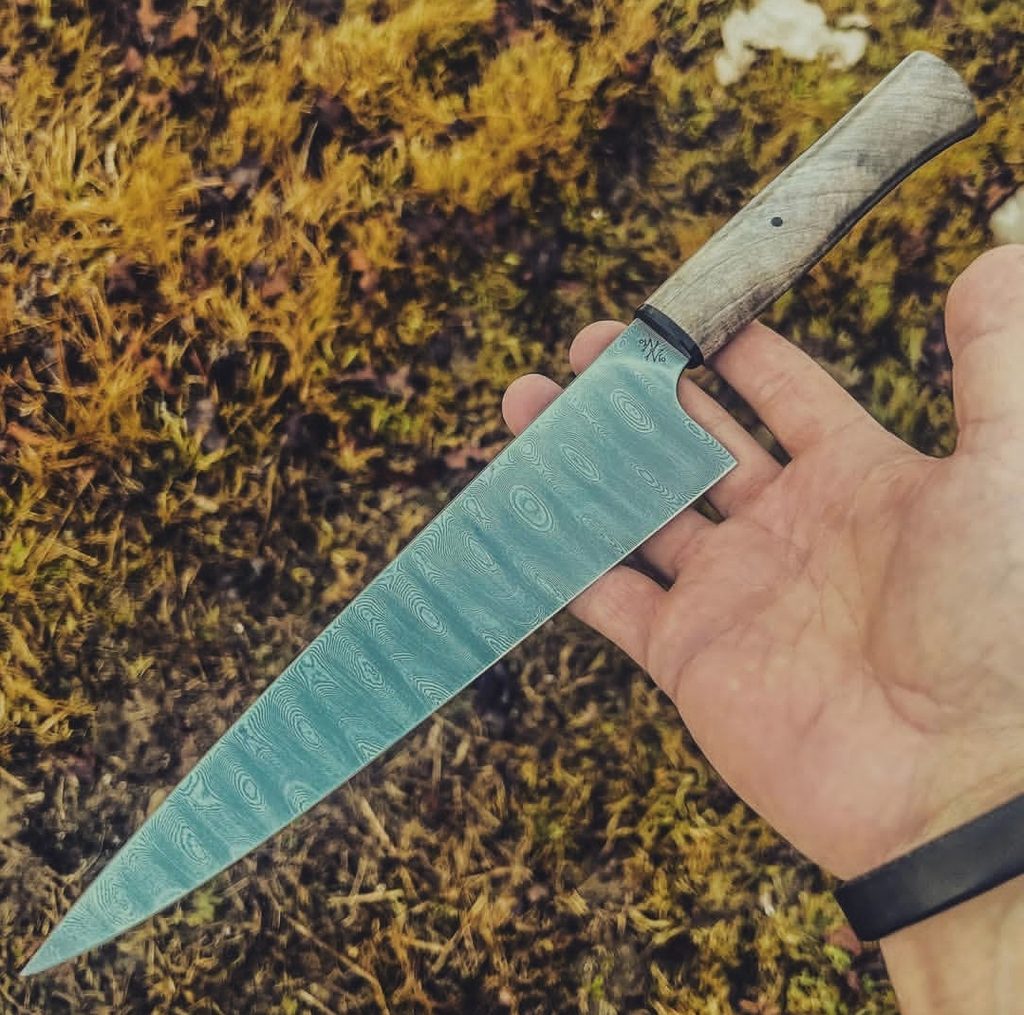
I can’t really think of any categories of knife I don’t make. I tend to do a lot of chef knives and a lot of hunting knives, but I do plenty of everything else too.
How did your background affect your approach to knives?
It’s hard to answer this one because I don’t know how my approach might differ if I’d had a different background. But I think my general education and my ability to figure things out are a huge help. Time management is also a major factor, and that happens to be something I’m very good at.
Who helped you early on?
Paul Cooper, JD Smith, John White, Dan Petersen, Michael Bell, Ford Hallam, Peter Johnsson. I also learned a lot of what I know about machining from a local friend, Dan Piotte.
Who are your influences/inspirations?
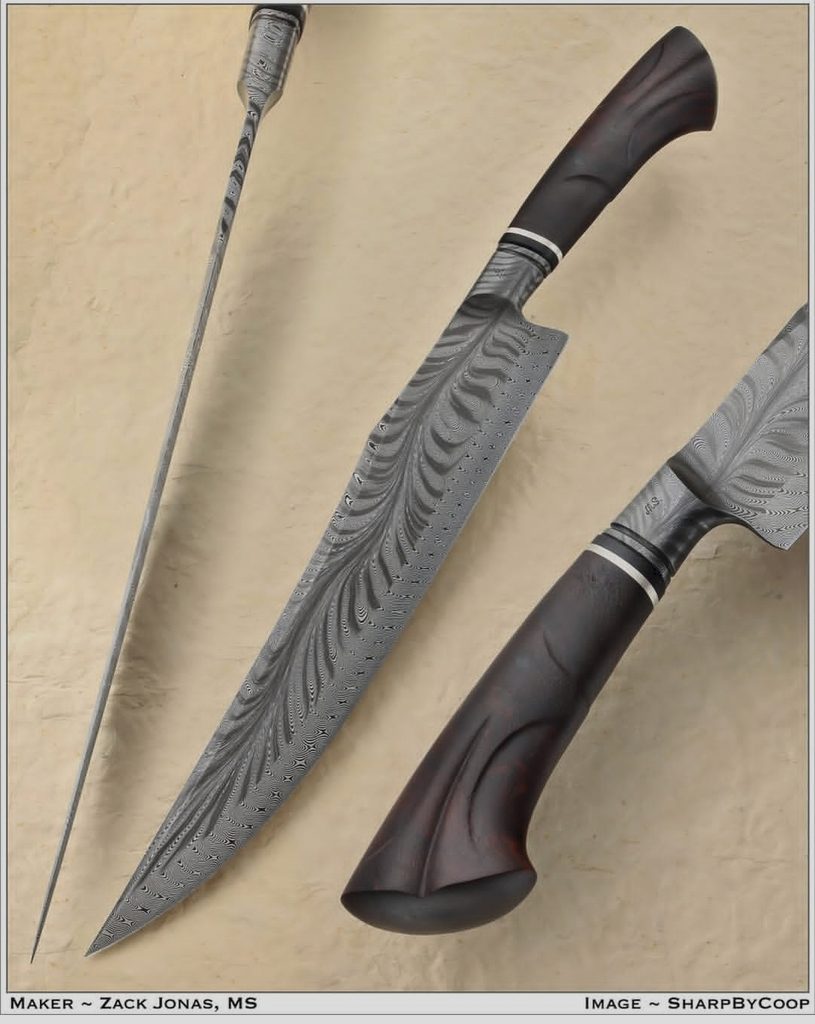
My influences are many. I would say in terms of bladesmiths, my two biggest influences would have to be JD Smith and Peter Johnsson, but there are also so many good makers out there these days that I end up feeling inspired by work pretty regularly.
How do you think those inspirations translates into your work?
The work that I do is my own, but it is absolutely infused with influence from all around me. I have had people tell me that they can see JD in my blades, and I know that I work to incorporate some of Peter’s ideas into my designs–not his style, but his ideas about things translated into my own.
Any specific breakthroughs or revelations in your knife making journey?
I’ve had far too many breakthroughs to list them, and I continue to have them regularly. That’s one of the things that I love about bladesmithing; there’s always something new to figure out. Just recently, linerlock folding knives have “clicked” for me in a way that they previously hadn’t, and I’m excited to explore them!
What is the perfect knife?
I don’t know that I think there is such a thing as the perfect knife.
How do you approach a new concept and that concept’s implementation?
I learn best with visual input. When I encounter a new concept or technique the easiest path is to first see someone else do it. Then I can repeat it and see what goes right and what goes wrong. Having seen it done, I’ll be able to contextualize my errors and adjust my technique accordingly. As far as implementation goes, I approach new concepts through experimentation. Take liner locks for example: once they “clicked,” I drew up a new design from scratch and then started making parts. Based on my new understanding I expected it to function well, but I wasn’t positive until I had the thing put together and could feel it in my hand and see the action. If it had not worked it would have been disappointing, but it also would have been useful; I would have learned from the failure points.
How do you approach knife testing?
I don’t think there is any one approach to cover “knife testing” broadly stated. To be sure, the performance testing for ABS JS and MS represent good benchmarks for many knives, but they are not especially relevant to, say, how a chef’s knife will actually run in a kitchen, or how a folder will ride in a pocket. So wherever possible, I test the knife by…testing it! For example, a few years back, I made a champagne sabre. Once I had it essentially finish ground and the handle roughed in, I went out and bought a case of the cheapest prosecco I could find!
How do you develop a design, select a steel, and fine-tune a heat treatment?
My design workflow almost always begins with just pencil and paper. The edge is usually the thing I sketch first, and then the rest of the knife resolves around it. The lines are brushy and gestural at first, and then once I strike upon a general form that feels right, I go in with finer lines and tune it until it “arrives.” These days, I often go from pencil into a digital workflow, tracing my pencil sketch in something like Adobe Illustrator. From there I can make fine, precise adjustments using the built in tools. The other huge advantage with a digital workflow is that I can copy/paste in instants–if I want to try some variation, I don’t have to trace the whole thing from scratch, so it takes literally seconds rather than minutes or hours.
Steel is easy. I might catch some heat for this, but…1084 and 15n20 will do just about everything you could ever ask most knives to do. Early in my career, John White told me I should pick a couple of steels and master them, and I think that is sound advice. There are definitely some exceptions. Stainless is an obvious one. Or if I’m making something that will deal with more impact, like a machete or an axe, I might use something else. But for the most part, good old 1084 and 15n20 is the right answer for me.
How has the knife world changed since you started?
The knife world is almost unrecognizable from when I started. Twenty years ago, information was hard to come by. When I started seeking a way into the craft it took me time to find local makers, and information was siloed into a few forums. These were geared more to people who knew enough about the craft to ask intelligent questions, rather than total beginners like myself. The ABS ran just about the only classes one could find (though I myself found my way into JD’s class). Today, information–both good and bad–abounds on YouTube and elsewhere, and there are skilled makers offering good instruction all over the place.
What’s up next for you? Any exciting new projects to tell us about?
I joined Art Knife Invitational in 2025, which offered me a potential market for some of my most intricate, creatively fulfilling work. I won’t be able to attend this year, but I look forward to returning in 2027.
To keep up with what Zack is working on head over to his website https://jonasblade.com/ and follow him on Instagram https://www.instagram.com/jonas_blade/
Leave a Reply