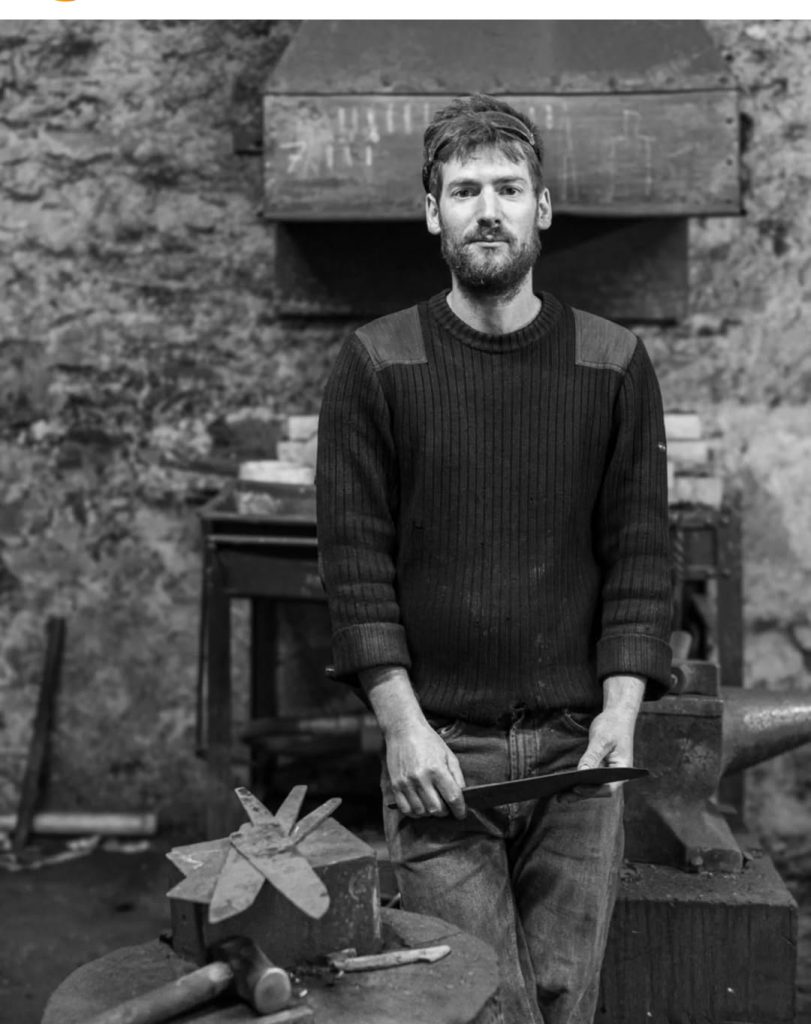
This week’s interview brings us to the heart of Le Marteau et l’Enclume – in English the Hammer and the Anvil, this is the workshop of Milan Gravier. His work is timeless, and as you’ll see that is intentional. His work truly is all about connection. My love for knives stemmed from the love of the connections built with food, and it will be no surprise that his approach speaks to me. I am very excited to share his story.
To start off, please tell us a little about yourself.
I am a blacksmith and knife maker from Saint-Martin-Laguépie in Southwestern France.
What sparked your interest in knives?
It happened surprisingly actually. When I was a kid, I did not have much interest for those objects. For example, my mum was a great cook but honestly, she was working with dull blades mostly and so I learned to cook without sharp knives.
When I was studying, I was not really into working with my hands either, I was trying to be journalist and finally studied philosophy. After that I changed direction and decided I wanted to learn how to work with my hands with the intellectual idea of going back to basics and being more autonomous in my life for my needs. So, I decided I should start with learning how to grow food. And that was the time I learned about knives. In France, around the 2010’s there was a little fashion about « survivalism » : some people learning to live in the forest with basic necessities and no fancy tools, just a simple knife. I was quite curious about that and even though I had no experience with survivalism or even just sleeping in the forest, I just start looking at things on internet and started looking at knives. Just out of curiosity at that point.
During my research I came across a handmade knife made by Eric Plazen (quite famous french knifemaker, passed in 2015). I saw that knives could be beautiful, mindful, made from tradition and knowledge from an artisan.
In the little farm I was living at that time, I started learning to sharpen knives and tools. I also started to try forging.
I finally went to learn from a knifemaker close to my farm for about 4 months and learned all the basics. My interest continued to grow.
I finally quit the farm for different reasons, but one of them was some frustration; we were making some of the most beautiful vegetables and meat but we had no time to really cook and make great dishes with them. And it got to the point I was losing meaning of why I was doing it. But that experience lead me toward kitchen knives. This object was the perfect tool to resolve my frustration. Having a great tool gives you more time to cook as you’re more efficient, but even more a great tool just gives you joy to cut and cook and keeps you motivated to transform all that hard work to make vegetables into beautiful meals for family
and friends.
The last thing that totally pushed me in the craft. I quit the farm and went back to my mother’s home. I thought I wouldn’t stay long but then I met a local blacksmith. As an artist he was making sculpture. Wen I met him he was making his own charcoal and was starting to work with bloom iron and steel. I followed him for about a year. We made steel together, we forged crazy things, huge pieces of iron, we were discussing about the craft all day and into the night. He really pushed me deep into the craft and
because of him I am still in it, haha!
What inspired you to do this and how did you learn?
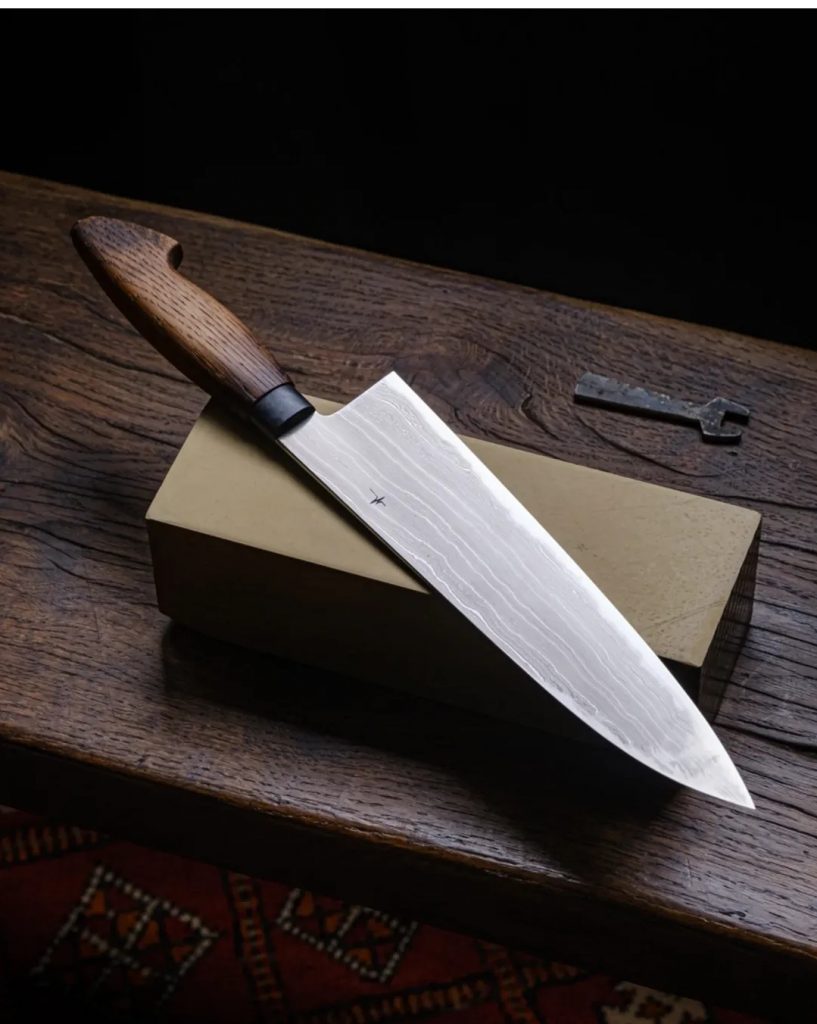
My main inspiration to making knives was that the final object and the process are very appealing to me. About the process, first there was the fire : it’s incredible to be able to transform and make some chemical process with that simple tool. You can weld, you can stretch and shape a flat piece of steel into a complex geometry blade, you can create kurouchi, you can harden steel. Second were the stones : the precision they give really opened my mind about surfaces, geometry, how a bevel should work, how I can improve my forging. And it also brings me the joy to use Japanese natural stones : real stones from the mountains, picked and selected because they are some of the best items in the world to polish and reveal steel and iron structure.
And a kitchen knife is really an interesting and complete object. First there are many of them, depending on the task and cultures and you can already travel quite a bit just by discovering all the types of kitchen knives that exists. Second, it’s a simple tool and everyone can share the same experience with it and you can talk about that tool in any country, any family. Third, it’s made to cook and feed : it is linked to a process that brings joy while you’re cooking and after when you’re serving and feeding people. It’s so simple and necessary. It’s talking about the simplest thing but also one of the most important.
I learned through the years with different makers that were willing to share their knowledge. We have to realize that in France, like in most western countries, there were knives makers all around
and then for a period of time they were gone. Knowledge vanished quite a bit. And we had to try and recover the knowledge about that craft these last 30/40 years. So, it’s very important for makers to continue to share and pass their knowledge to other makers and future makers.
Each maker has their own way of doing things, so it has been very interesting to learn a wide range of how to approach this craft.
When did you start making knives?
I start making knives quite early, kitchen knives and camp knives in about 2010. To be honest, the first ones were not very good. I was not a very talented blacksmith or knifemaker at first.
My main asset is perseverance and patience, and it is because of my hard work, repetition and passion that I slowly got better
and better.
What did you make your first knife with?
My first knives were made with recycled spring steel from cars 0,4 to 0,5 % carbon, lots of manganese and silicium. Honestly good steel for machetes, not amazing for kitchen knives though. Then I worked a LOT with 0,7 % carbon, XC70. It’s quite a good steel, quite tough, good edges but not long lasting. I then start working C130 and 135Cr3. It was difficult in the beginning but then I realized how much more they give compared to the 0,7 % carbon.
Do you have a favorite knife you made, tell me about it?
I have lot of favorites. I look at my previous work, and I see all the things I should have done better. But I also see some milestones, some knives that made my craft change quite a bit.
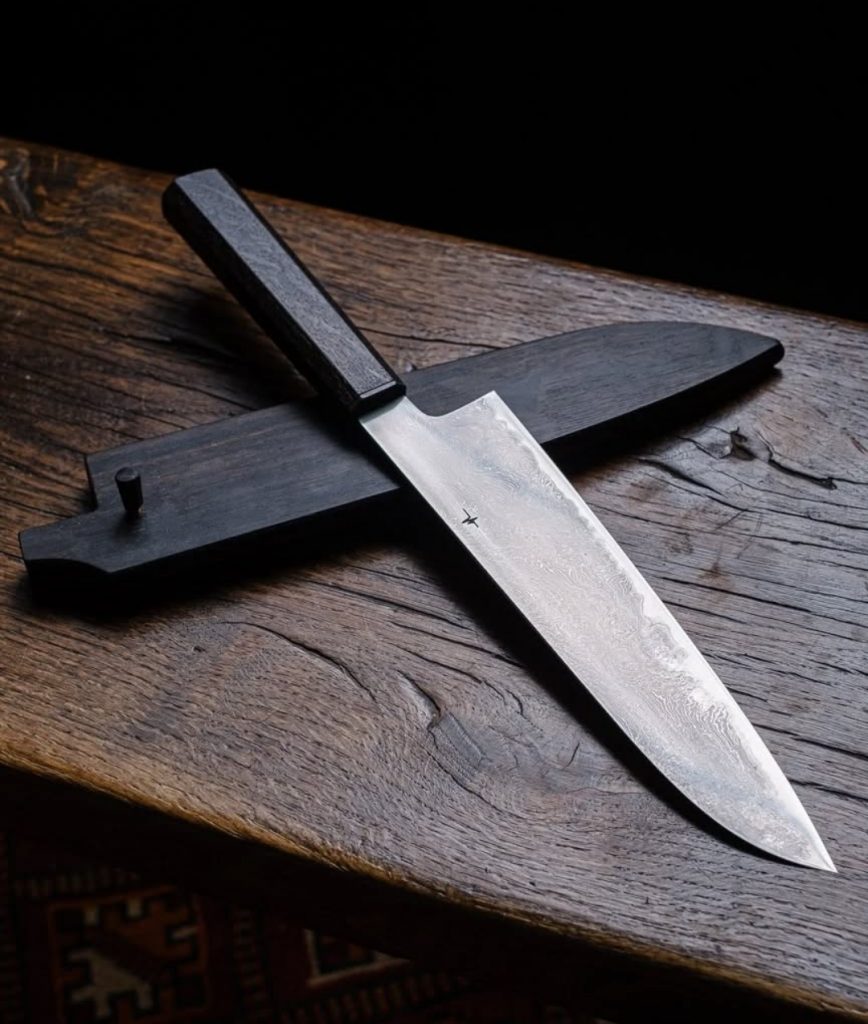
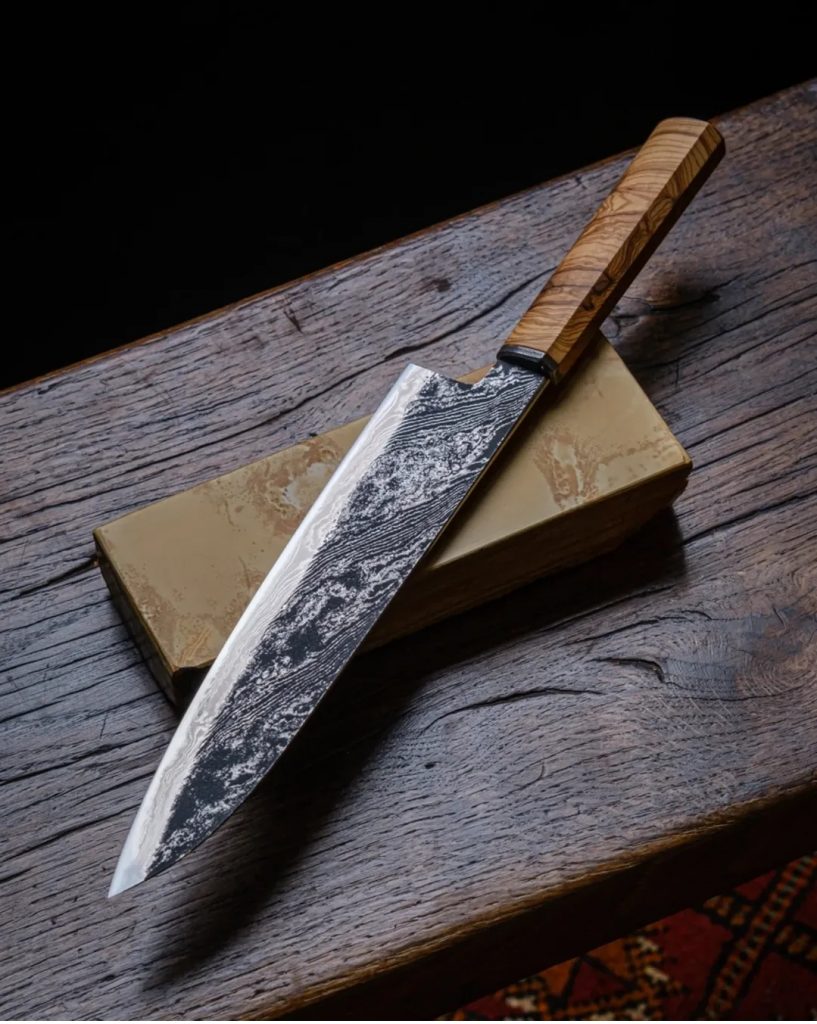
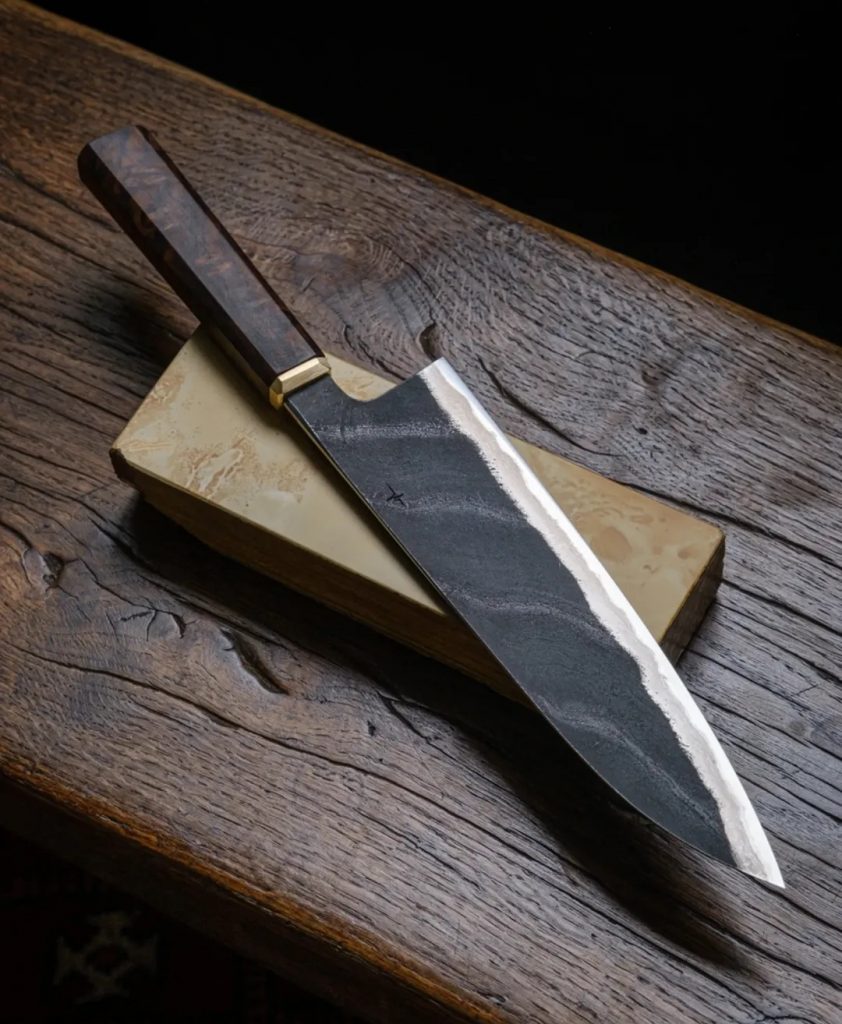
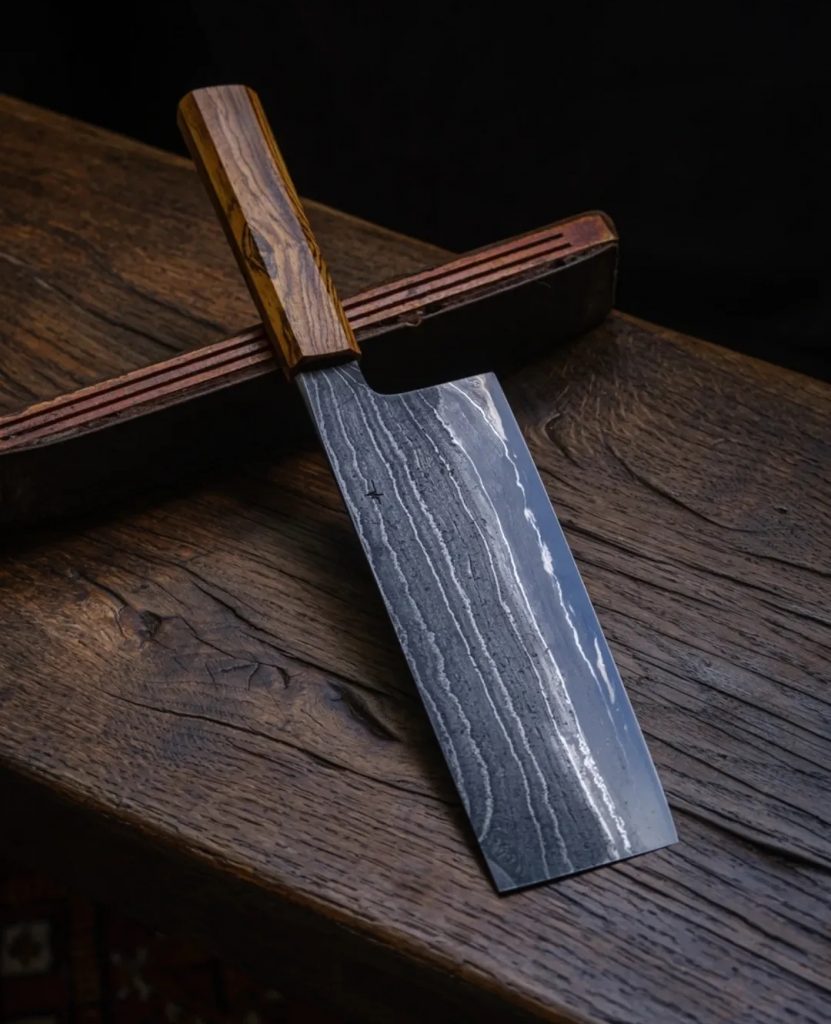
One knife that is quite special to me is a damascus clad Gyuto « marble noir » before I picked that name, it is one the first ones. It had a crazy amount of detail in the damascus kurouchi, maybe more than I have created since. The look of that damascus
in the kurouchi and in the polished bevels is beautiful and to me it’s a special one.
What is the most important aspect of a well-made knife?
To me, it must connect people to things. Connect to the food, connect the people for whom you cook, and connect to you, your feelings, your sensations, your memories. It needs to perform, to cut well. But I try to go beyond that and for example to make them cut a certain way, a sensitive way. I am not too much into lasers
because while they would cut very well in lot of food, they will not connect to things very well. To me the best knife needs to cut effortlessly, but still giving you the sensation that it cuts,
that it touches the food, separates it. To ensure this, I work a lot on geometry and sharpening. But I also work a lot on aesthetic, the shapes, the visual balance, the balance, the colors, the patterns, the link between blade and handle. When an object feels complete, where handle and blade are connected, where shape of the blade just feel right and balanced, not too narrow, not too wide, not too much tip, it really can open people to a connection with things and feelings through that knife.
What keeps you going?
I think that would be the challenge to make a knife with the purpose I have in mind, the new idea, the little thing I want to improve to finally touch an object that will have everything, and of course never achieving that, I keep working on it again and again. I
also love the way that the craft helps me meet a lot of people from around the world, different than me, with different ideas than me and still meeting to share and sometimes work together.
Biggest struggle?
I would say, body damage. It’s like sports a bit. You can harm your body, you can be hurt by machines. It’s ok, I try to work in good conditions, being careful with my body and my eyes and
ears, and lungs. But the job is what it is, you can do your best, it will work on your body. I am 37 and still ok. I hope I’ll do 30 years more. But you do need to be careful.
Oh and another struggle is the process : sometimes you make a beautiful knife, perfect kurouchi, great geometry, lovely damascus, sweet handle. And you think, ok this is a new
level, everything should continue to be as good or better. But that’s not the case : some days are better than others, some knives are closer to your ideas whereas others are not.
Some days you succeed with a technique, and the next day it’s not working as well anymore. That can be frustrating. You need to stay humble, do your best, solve issues, sometime there will be failures. And when it fails, you have to try to learn from it. And just start again.
What kinds of knives do you make?
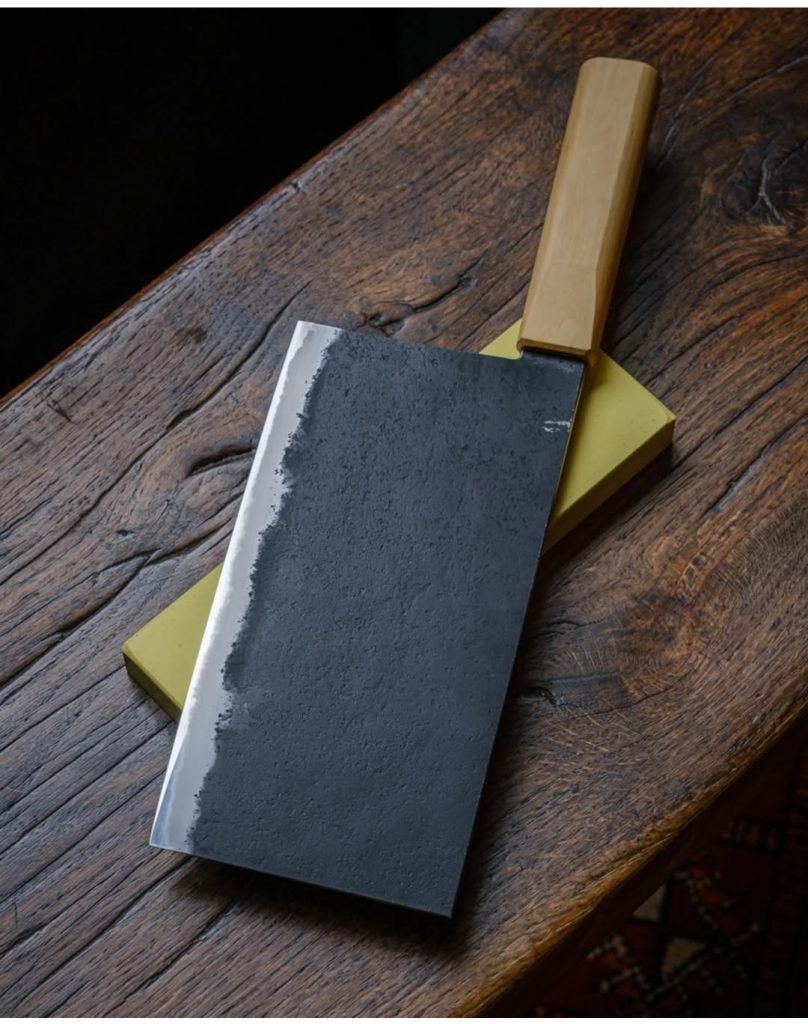
I am concentrated on kitchen knives. Mostly high-end ones. High end because I use techniques that make reproduction and large quantity not possible. It takes times, it takes skills. Always working on something unique, always adapting my work and gestures to the new knife I am working on. It’s tiring sometimes! But you can learn so much about yourself and the materials and methods.
My main idea about my craft and why I do it is to make knives in a way that every part of it needs me, needs my skills, needs my repetitions, my experience, my knowledge. It’s a bit like martial art to me (I did not do much martial arts to be honest, so it’s just a fantasy, I did maybe 1 year of aikido), you repeat and learn your topic until it feels natural, it feels you, it feels like you’re just breathing. And when I succeed to work this way it’s really
overwhelming me : it feels like how I imagine a dancer feels. And that’s the kind of knives I want to make if possible : something about how one human can live his job fully, practicing and learning
so the final object is unique and meaningful. Some kind of giving life to the concept of a kitchen knife : it’s not new, it’s not old, it’s not inventive but it’s not an average object either.
It’s there, unique, speaking about mankind’s history, feeding ourselves, learning to use fire and using it’s power, learning to refine the lines of the object so that’s it : it’s a kitchen
knife, one of the most used tools by humans.
How did your background affect your approach to knives?
I think philosophy, economic, social studies, they helped me try to think the metaphysics of my job : it just means that I try to work my knives with techniques and learn my craft and try to better understand steel and wood. But above or around that I try to
think about why I am doing things this way, why I am doing knives with this tool and what does that mean to work it this way instead of another one etc.
So things are meaningful to me : the object is about its purpose but not only, its about who, when, where it was made, with what, etc. Understanding why you work in such way, and is it really matching expectations. This makes my work meaningful to me at least and I think it translates into the knives I make.
Who helped you early on?
Lots of blacksmith and knifemakers and sharpeners. French guys at first for sure : Bertrand Pons who was a sharpener in Bordeaux, Bernard Artaud was old factory sharpener in Thiers, Arnaud Elisabeth the sculptor I followed for a year. And of course so many people in the knife community, many many makers, sometimes just sharing a little trick, sometimes really teaching me their way so I could find mine. Sometimes even people I did not meet
like Eric Plazen, as I followed a lot of the discussions he had in online forums. When I start making knives full time 6 years ago, I learned from Yanick Puig for a while and was helped by Bryan Raquin sometimes. And another early teacher would be Murray
Carter : I looked at all his videos on YouTube and bought one of his books and it was a way to learn the Japanese way of making knives as I hadn’t been able to get direct teaching from a Japanese maker.
And now with Instagram I can learn and share with many people too, so for example, Naader from Canada helped me so much about stone polishing and improving lot of details in my knives.
These days, I am still helped by makers, workmates : Guirec who learned the basics with me and we share now our experiences. Silvain Dixneuf from France with who I share a lot discussing problems and solutions. Antoine (Adonys) with whom I discuss many topics even outside knifemaking. Well, so many people honestly. Customers who send feedback and motivation everyday.
Who are your influences?
In our business I feel it’s not easy to speak about influences. It’s not always well welcomed. I am a maker who has been influenced by many people. I might be not creative enough maybe or maybe that’s just the way I see my craft and the ways ideas are shared,
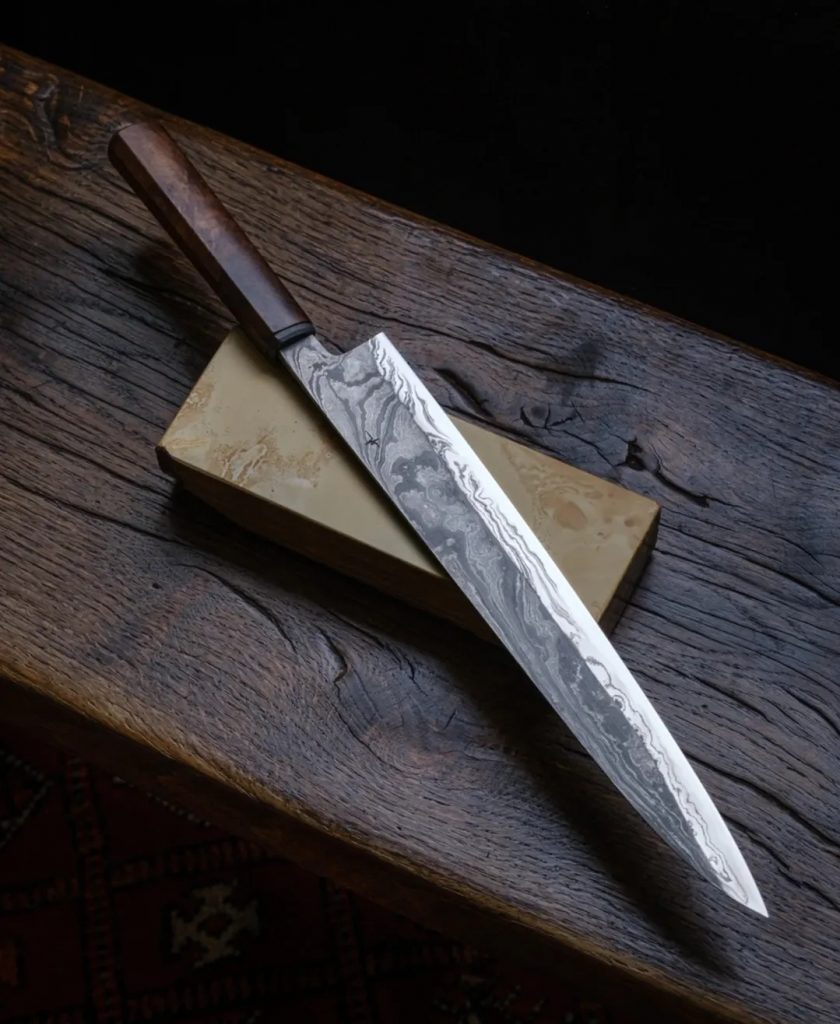
developed and achieved. From the begining, I would name Brian Raquin who was making his meaningful kitchen knives when I started blacksmithing. His style influenced a lot of French makers. Another one would be Takeda. When I started, not many Japanese makersbwere famous in France and Takeda was symbol of great knifemaker from Japan. I learned later that his way was quite personal and not actually that traditional. Yanick Puig for sure as I learn and share with him for a period and his way of seeing and making knives of course inspired me. He was the first to show me that stone polishing was possible for example and I really kept from our meeting that design idea of forged blade with forged surface left on top and low stone polished bevels.
I discovered other makers like Kato and Hinoura later and they also influenced me quite a bit.
And even today, I am inspired by others work, in cutlery and other crafts. Today, influences are just more spread out. I try to learn from filmmakers, music players, artists. I don’t have like very specific ones that influenced me. It’s more how those people could learn to me how I could see that act of create an object.
How do you think that inspiration translates into your work?
In term of design, Brian, Takeda and Yanick surely gave me that idea of build the knife with a forged geometry left rough from the forging as much as possible and then stone polished bevels from precision and beauty.
From Kato, I learn the simplicity of the design. From Hinoura, that you can reveal damascus in a third way : not by etching, not by polishing but by heating and playing with black oxide formation.
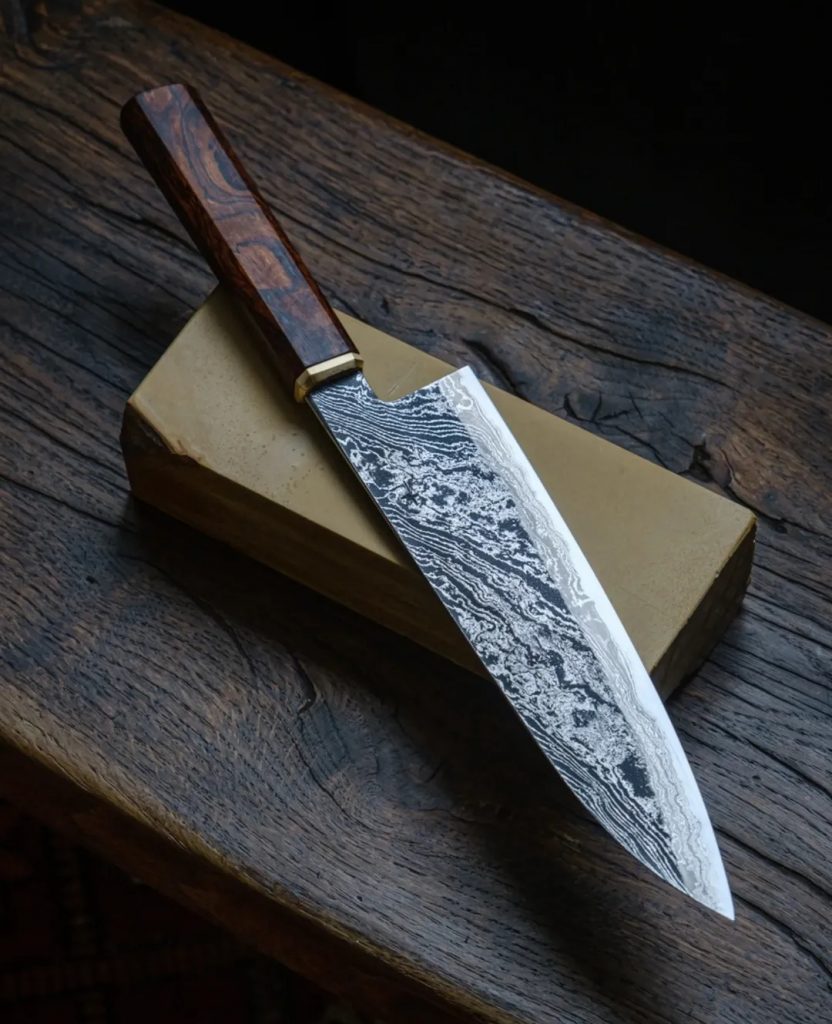
From artists in other craft : I try to give some background or depth to the objects I am making by the way I work, the material I use, the way I show them, picture them. I also try to tell a story : playing with matching the figures of wood and damascus for example, it
tells a lot. It tells how much those materials are surprisingly close to each other. It tells how we humans love playing and just giving that attention to match handle and blade will make people smile.
What other knife makers out there impress you these days? Do you take inspiration from anyone else in the field?
These days… I am sure there is some inspiration but it’s maybe more diluted and I get ideas and influences from lot of people, not only knives makers. The knifemakers I am impressed those days ? I think of Alexander Bazes, but I am not sure he is still making
knives. I think also about Joel Black for his lovely hamon work.
Any specific breakthroughs or revelations in your knife making journey?
Stone work totally changed the way I see my knives. From forging to finishing, this technique changed everything and everything is made for finally using this technique. But the Kurouchi technique and all the failures I had in the process of learning it made me able
to make Marble noir and damascus kurouchi. This technique also changed a lot the way I see my knives, the way I see the material and my understanding.
What is the perfect knife?
The perfect knife is the perfect looking knife that will perform perfectly and that was made with a perfect process where no difficulties happened, only perfect control of each step one
after the other.
How do you approach knife testing?
I generally test my blades through the process of making the knife. While you straighten, you grind, sharpen, you can already have a lot of information about the quality of the blade. And I generally like to test cutting an onion while I am making foundation work on the bevels. It’s a vegetable that ask quite a good geometry to be cut very well and comfortably so it gives a lot of info about a blade.
How do you develop a design, select a steel, and fine-tune a heat treatment?
Bit by bit, year after year. I like to improve step by step as I feel even if I make the perfect plan and drawing on paper. I prefer to just not draw and plan too much but stay curious, stay critical and try new things.
About design, I am working on my blades profile each time after another. And I like not to use template but just my eyes. Every blade will be unique, but every blade will be following the best idea I have of a kitchen knife when I was making it. And hopefully, I don’t change my mind too often.
For selecting steel, I like to work 135Cr3 : it’s a great steel that can be harden well, sharp and tough enough and easy to sharpen.
For fine-tuning? I would say the biggest improvements were done by other makers years ago and feel, oh ok my blades are really not as hard as this. Maybe I should try to get them harder : and just find solution : quench in water, less tempering. But a great
heat treatment is really about many factors and fine tuning is about quenching, tempering, but also forging, cold forging, choosing the right clad, choosing the right geometry, grinding
with a cooling system, etc.
What do you like about 135Cr3 steel?
What I really like is how much performance you can get from a steel that is not so difficult to produce, not so difficult to weld, forge, grind, polish and sharpen.
Also tungsten steels are interesting to me, but that ratio is just not as good in my opinion. You get better edge retention, but you pay in that it is not that easy to weld, forge, grind, polish and sharpen. Every maker/user may choose their own compromises, but I much prefer the way 135Cr3 steel is working for the type of blade I make.
How do you approach a new concept and that concept’s implementation?
Honestly, I feel most of the time that I don’t make anything new. I am just trying to be curious about my craft and already so many things to repeat and learn. Marble noir ? It’s
new to me but Hinoura was doing that since the 80’s and lot of tool makers in Japan were doing that type of finish on kanna for maybe centuries I don’t know. So, I don’t invent, I just try to work correctly and repeat what makers do for centuries.
In another way, some new concepts sometimes happen, but it’s just new to me, not new to the craft really. And the way I work it will be just working at improving step by step my current work and sometimes by surprise touching something a bit new. An error or a mistake let me see a finish I did not think about before. Trying a different technique will show me some new compromise, some new choices I need to make. It’s really like a researcher. You work on something, try different possibilities, mess with things and discover a new patch bringing you to more possibilities and more chances to fail or succeed.
How has the knife world changed since you started?
One of the main change was the business : it was quite locally focused, and I was selling at French knife shows for the first 10 years. But it’s now worldwide and using a lot of social media. It changes the way you connect with people, and it changes the people you’re connected with. Honestly, I would be happy to have a little better balance toward local market sometimes, but… I am so happy with the network with Instagram and all the great
people I am meeting there. And I am selling my knives. It was not that easy before I set my account on Instagram. And that security of being able to sell my knives, having money to make my living while I am doing the job I love, living in a nice countryside close to my friends and family, well I can only be thankful about that.
What’s up next for you? Any exciting new projects to tell us about?
My next project would be to starting making bloom steel. I have just started… well…no bloomery done yet, but I am reading, looking and finding some iron ores, preparing… So maybe in a year if I am not too lazy, I should start that more and more.
It’s a path that totally resonates with me and my work it’s another step about learning about steel and material. You learn about where you live, about the geology. You learn about the chemical process that transform iron ore to steel. And you can maybe make a knife that is about all that – being a blacksmith somewhere.
To keep up with what he is working on head over to his website https://www.marteauetenclume.com/ and follow him on Instagram https://www.instagram.com/milangraviercoutelier/
Leave a Reply