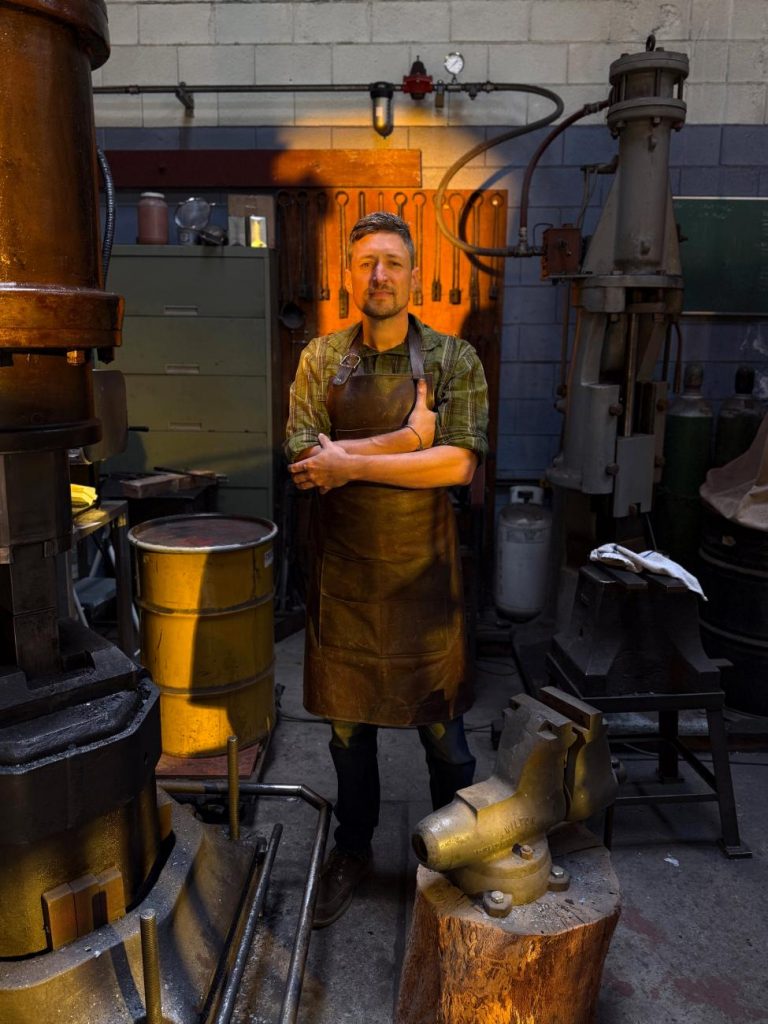
photo credit @brandonhmoore
This week’s interview takes us around the world and explores the many sources of inspiration that fuel this maker’s drive to create. I am so happy to share with you the story of Nick Anderson, the person behind Nanda Knives. He makes some exceptionally beautiful work, and was a pleasure speaking with him.
So, tell us a bit about your background?
Well for some time I have been in Northern California; however, I spent a number of years before that in Thailand. Which is actually where I got my start making knives, in Chiang Mai in northern Thailand. Before that I lived in Santa Cruz, I wasn’t making knives but was doing sculpture and glass blowing, I did a bit of bronze casting and jewelry work as well.
How did you learn knife making?
Really early on it was the internet, but then while I was still in Thailand, I met Che Americano, he had been making knives, at that point, for around 10 years already. He was, like many other Thai makers, very familiar with ABS method of knife making so that was big help to me. Learning proper fit up, clean plunge lines, hand finished. He was a really a good mentor and accelerated my making quite a bit.
Tell me about your first knife.
My very first knife? Well, let me preface it with the fact that I was in Thailand at the time and getting my hands on the right tools and materials was a challenge. So, before I could even make my first knife I had to build my grinder, forge, and heat treat oven. Even getting material was hard, so I started with band saw blade material, and I forged a thin carving knife. I almost don’t consider that my first one, because from the beginning the material was terrible. For my next knife I was able to track down some 01 steel, and that was a forged texture hunting knife with rosewood scales, it was nice, I made a brass bolster, and a leather sheath definitely I spent a lot more time on it. I even put a bird wing on the sheath. It came out cool.
You mentioned glass blowing earlier, is that where the glass handles come in?
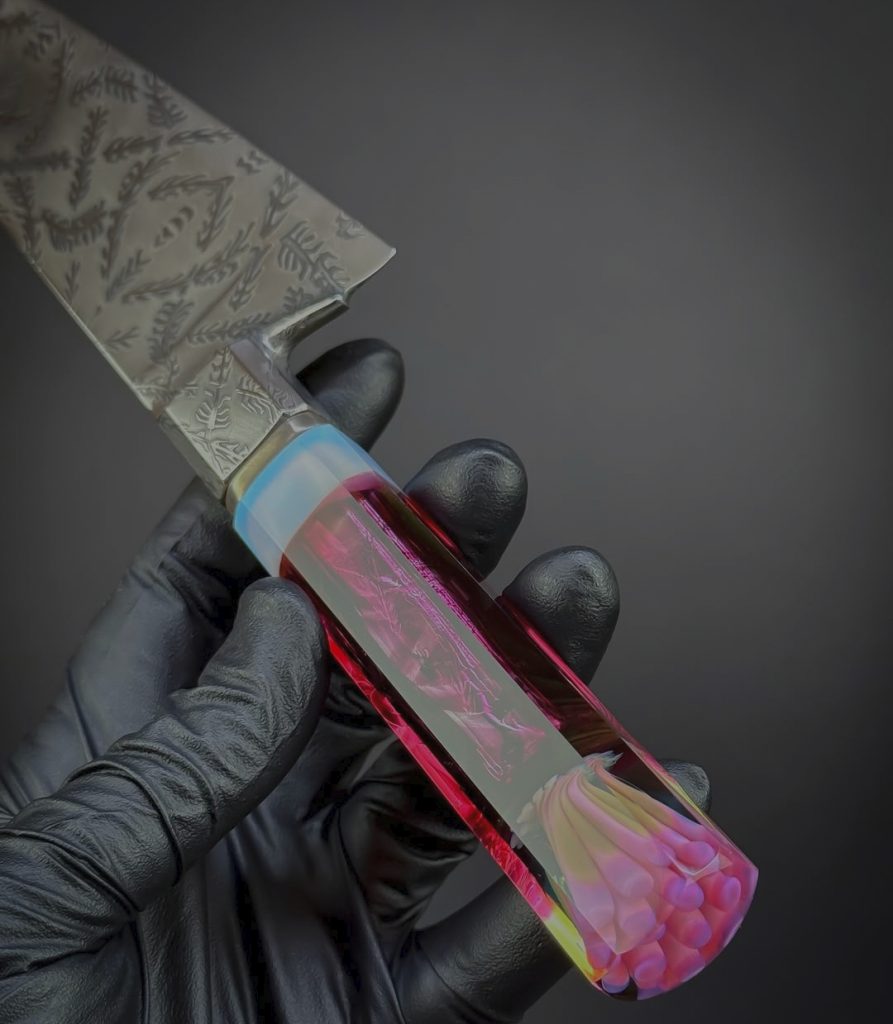
Yeah, for sure, glass blowing for a long time was my job and my main creative outlet. I was still doing glass blowing when I went to Thailand. I actually have another glass handle piece in the works.
I can’t wait to see it. I know I loved the first one I saw that you had made. So, it seems like most of your careers have had an artistic element to them?
That’s true, I came into knife making from an artistic perspective, but function was super important to me, I really love cooking, so it really was always a combination of the two. While in the beginning I did do the occasional hunters and bowies, which was a great way to learn about guards, and geometry, very quickly my focus became culinary knives.
Do you have a favorite knife you’ve made?
I would have to say it is probably one of the two Arboreal line knives, either the carbon fiber or the glass handle. They are special to me. I also love a well executed s-grind, they just work so nice.
What do you consider the most important aspect to a well-made knife?
I think geometry is so important, you can’t get around that.
What have you been working on lately?
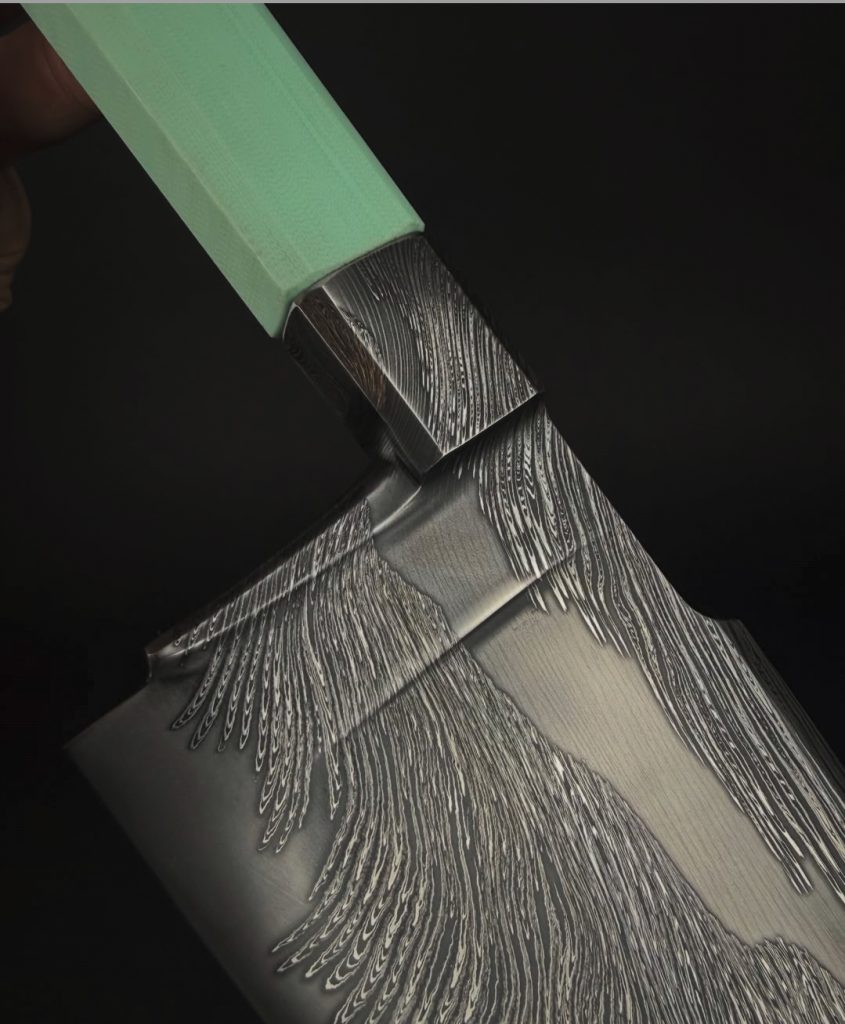
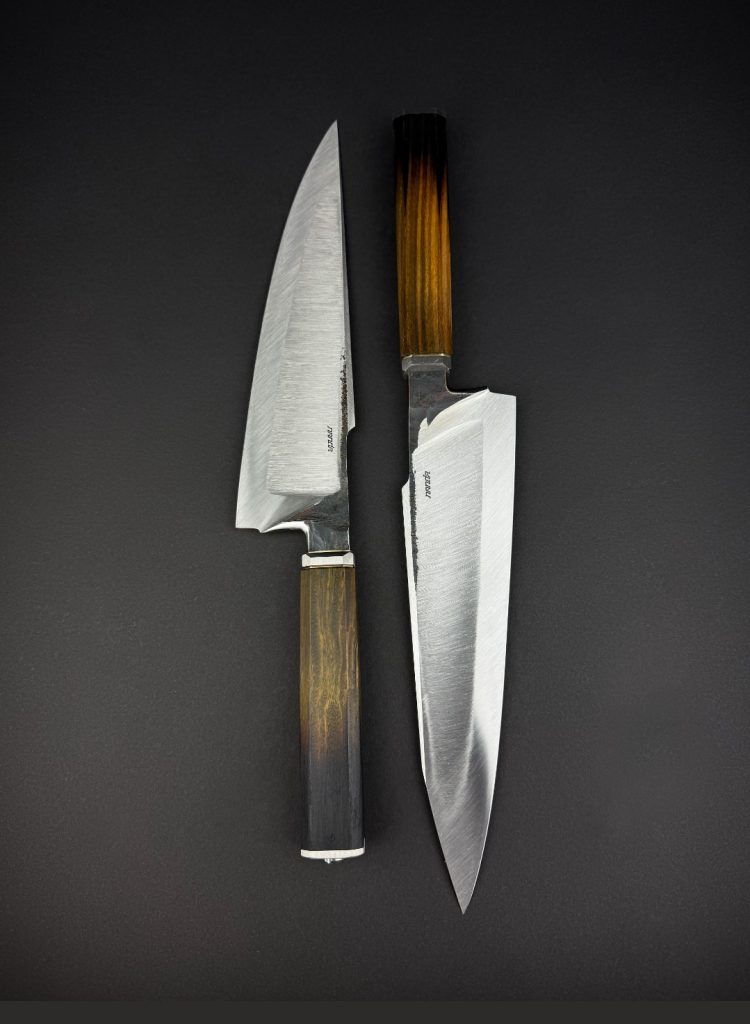
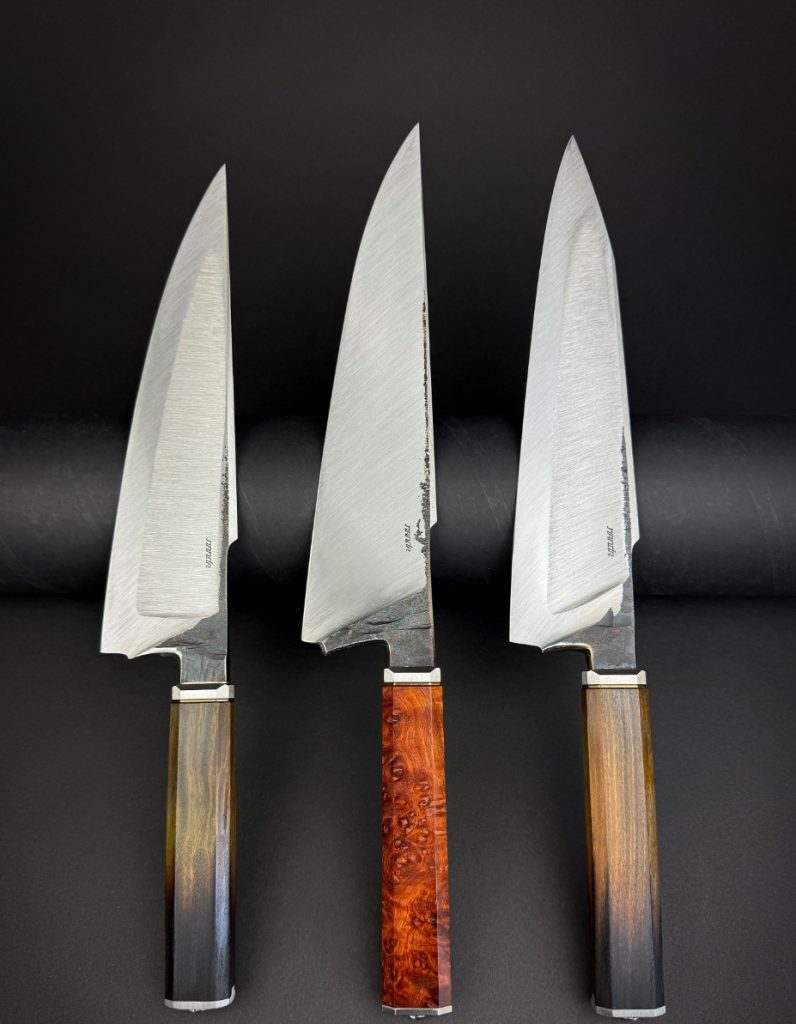
I have been pretty focused on my Elemental line.
I had wanted to make a line of stainless, because I wanted to give people a premium product but in a format that they wouldn’t be afraid to use.
It took a long time to get to the Elemental line, to get to something that is a bit easier to make, but is still unique, still looks awesome, and gives me the flexibility to create almost any blade as long as it fits the parameters for the handle, then I don’t feel like I am stuck making 100 of the same gyuto, I can still express my creativity. I don’t like doing the same thing over and over, so I spent a lot of time working out the flow that would give me the ability to streamline and make the process more efficient without removing the creative elements that keep me going.
Sure, they would still fall into a premium knife category, but they are much less than my other work, and even though they are less expensive they still can get quality workmanship and nice handle materials. I am even exploring down the line doing an even simpler version.
How do you balance simplifying your product, but still keeping them true to you?
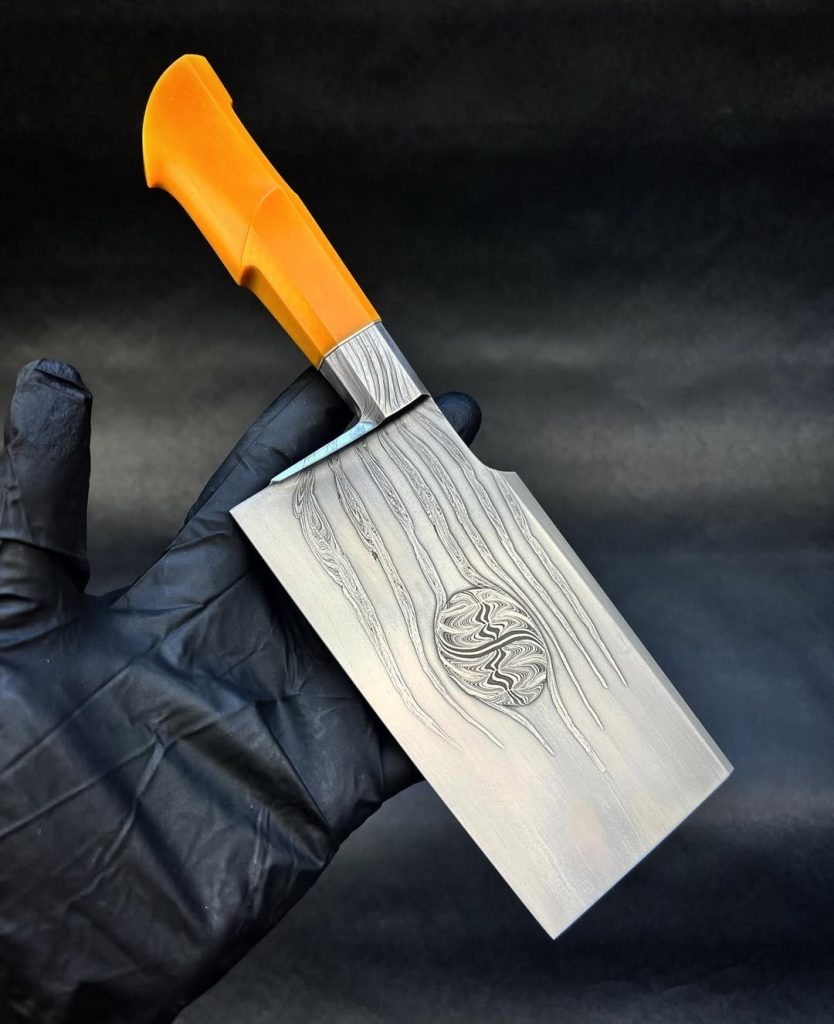
I think at some point you might have to put them under a different moniker, because you don’t want to lower the value of the brand. But it definitely is a balance, I probably only make two full complex damascus blades a month, and I’d like to see more people get a chance to use my blades.
I think every maker should make some knives that take less time, sure the complex damascus are the most fun and fulfilling to create, but when you feature something that is a little bit easier to produce, then you can always have some product on hand. I really hate it when I have nothing available in stock, it is a weird feeling.
I do like when a customer asks for something specific that is similar to what I make, because then I have a clear reference to what they want. Sometimes though when it is completely different than my typical work, it becomes a challenge to deliver on their expectations as it isn’t always clear to me what they are going for, so that can be frustrating, because I want them to be happy with their custom.
When it comes to custom orders, do prefer when the concept is wide open, or do you like it when a customer says I want you to make this specific knife?
When you do it the other way, you have to spend a lot more time checking to make sure that the customer is happy at each step of the process, which makes the piece take longer, and sometimes they are not happy at the end result. As opposed to where they say I want one like this one you made but with a few modifications.
I also have spent quite a longtime making knives and cooking, so I have a pretty solid understanding of what works and what doesn’t so even when I experiment with some new, I generally have an idea of how effective it will be.
What is your biggest inspiration to continue making knives?
Well, I have explored a lot of mediums, and I have found that knife making is the medium that I want to stay in, it’s perfect for me, I love art, I love cooking, and this really pulls them both together. And keeps me interested. I love to keep learning there really are endless things to learn. All of which keeps it fresh. Being able to actively use this work is really great.
What would you say is your biggest struggle?
Probably, I would say it is switching gears. When you are a single person operation, you have to handle the making, the marketing, the moving of the tools. Marketing is really hard, I will get involved in a project, and then I will fall off of Instagram posting. It’s really hard to keep up with all of it. I try to focus the most on making pieces, because I find I sell whatever I make even when I am absent from Instagram, so I know it only makes sense to keep making as much as possible. But at the same time, I hate falling off the map on Instagram or not sending a newsletter for months at a time. I need to update my website, and I know how to do it, it is just all about bandwidth, you know?
I would like to get an employee at some point, this last year, I got a new power hammer, and a CNC, and now I want to hold tight, and just make knives.
I just want to get more consistent with the marketing side.
So, mind mapping for the new year, I don’t want to but any new equipment for the shop, use what I have and optimize the art and business. I never want to lose either the business or the art.
Are there any specific influences or inspirations out there, other makers?
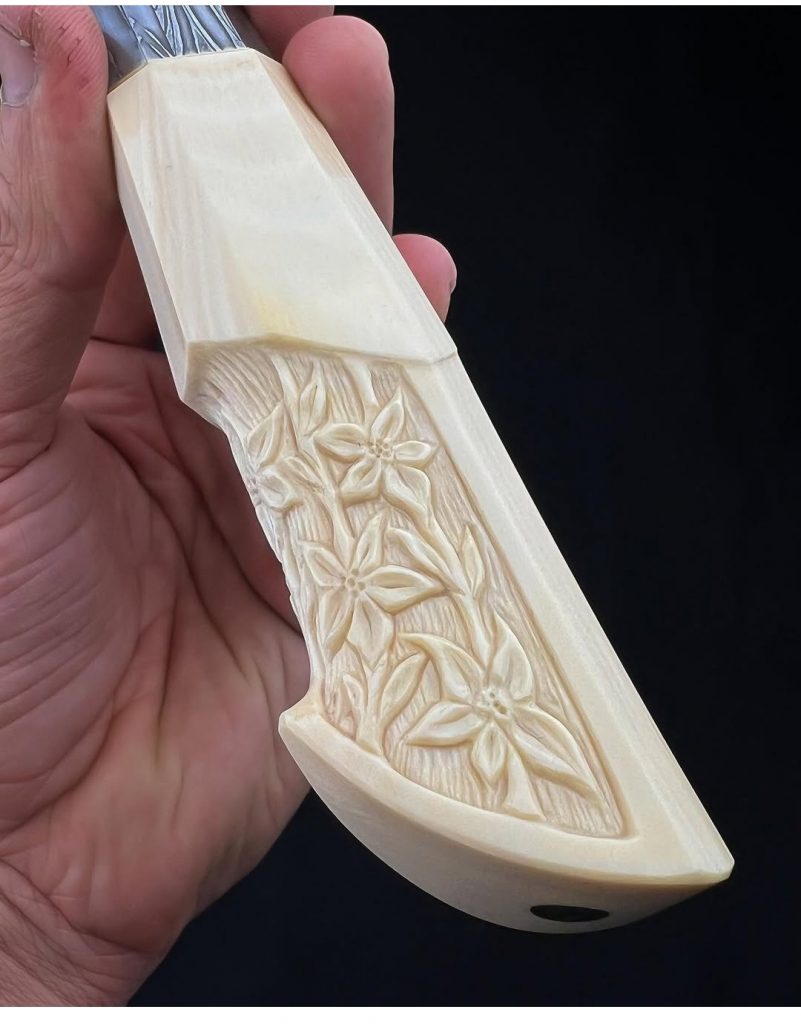
Oh yeah, so many, Straub, Mareko Maumasi, I really love what Jordan Lamothe does, the koftgari he does is amazing, and Zack Jonas has been doing some amazing things especially some pieces he collaborated with an engraver on just awesome. And I certainly can’t forget about Ben Kamon. But I also get inspiration from non-knife makers, glass blowers. Murdoc Glass, carving guys, Chris Ser jewelry.
How do you think those influences translate into your work?
It is just cool to see what people are doing, it’s so fun. Amazing things, I just really motivates me to try to do new and cool things myself. This year, especially, I have the shop upgraded, so I want to just focus on new things.
When you do come up with a new concept, how do you go about making it?
Well, I sketch knives all the time, not even so much for a new concept, but purely to sketch knives. I don’t really like to sketch something and then try to forge something to match. I prefer it to be more organic. I like to come up with the design as I am forging it, by far that is my favorite way. Different patterns require different approaches, so after I do a test etch, I can see where I need to adjust to get where I want. But ultimately, I would say I like to let the forging dictate the direction. There have certainly been some pieces that required me to sketch it out and work to match the sketch, but it is not an approach I enjoy as much.
What do you like about AEB-L?
It is such a cool steel. It forges really nice, you can get it easily, you can grind it easy, the edges hold up so well. It is one of the toughest commonly available stainless steels. It performs so well. I use my knives a lot, and I am constantly amazed at how resilient a thin edge can be with AEB-L. I would much rather have a knife that requires a little more frequent sharpening but will not chip easily, than the opposite.
How has the knife world changed since you started?
Well, there are definitely a lot more makers, which is fun. It is such a rad community. I love it. We did have a period of a few years where everything sold super easily. I could just post an in-progress photo, and someone would claim it, it was crazy. It dropped quite a bit after that. Recently it has gotten a bit better, but not as good as it was a few years back. I still sell what I make, but I think in general you do have to try harder. Instagram has made it so complex, you have to put so much into it, and it is getting harder and harder to get visibility.
Any specific breakthroughs in your knife making journey?
I know for years I really wanted to make damascus but I didn’t have the tooling to really make that happen. I remember when I got into my first shop with a power hammer, Jim Austins shop, just how much of a game changer that was. Once I got my own shop, and I could set up areas for specific processes, it really sweet. I was also say being able to see makers that I had chatted with when I was overseas, being part of the US community was great. I mean I did absolutely love living in Thailand, some of the best times of my life, but it was a lot harder to get connected to the knife making community. I think the US has such an excited knife making community. Sharing techniques, and knowledge. Also, with all the exciting work that is going on, you just keep pushing yourself to keep advancing. The glass making community, did not have the same level of openness, of course there are exceptions on both sides, but in general this is the most open artistic community I have been a part of.
Any exciting projects coming up you’d like to talk about?
I am excited to do more glass handled work. My collab with Salem Straub I am really looking forward to putting together. I will be doing ABS testing this year with Maureko Maumasi and Gabe Fletcher, so that is something I am going to be working on. And the elemental line, I am going to be focusing on getting as many of those into people’s hands as I can.
To keep up to date with what Nick is working on check out his website https://www.nandaknives.com/ and follow him on Instagram https://www.instagram.com/nandaknives/
Leave a Reply