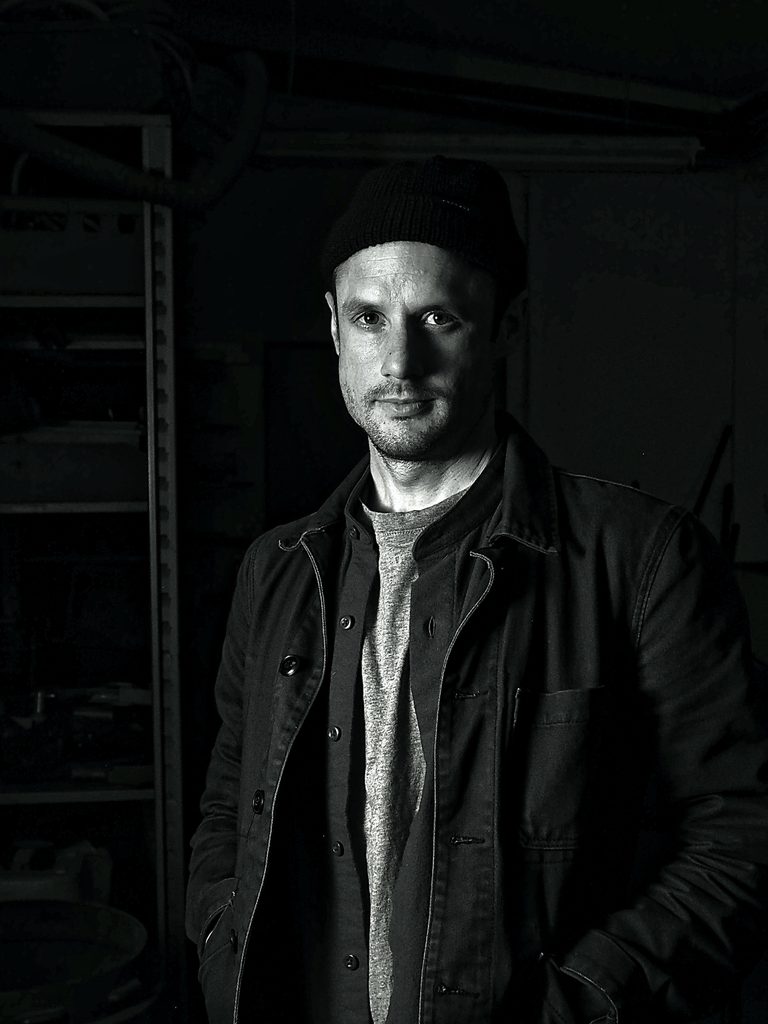
This week’s interview takes us to one of the makers who has impressed me the longest. Every piece I see is true to his style and looks flawless. But looks are never the whole story, I am very pleased to share his.
To start off, please tell us a little about yourself.
Hi, my name is Oliver Märtens. I live in a small city in central Germany, where I make hand-forged, performance-focused kitchen knives full time.
Before that, I worked as a tool mechanic, with a strong focus on CNC-milling, but after doing that from age 16 to 25, I ended up taking a few detours along the way – from working as a full-time bicycle courier to being part of Berlin’s specialty coffee
scene, including co-owning a coffee place for a few years.
What sparked your interest in knives?
I kind of stumbled into this topic with a friend, and we just thought it would be really cool to be able to make your own knife. He was pretty busy with his studies back then, but the idea kept growing in my head.
So, I started watching a bunch of knife-making tutorials on YouTube to get an idea of how to make a first, simple knife, without having a fully equipped workshop.
Even though kitchen knives would have made more sense at the time because of my environment, I ended up focusing on bushcraft knives at first. So, the very first knife I made was a pretty heavy, robust one, with a Scandi grind and jade G10
scales. It actually didn’t turn out too bad, but I’ll probably never show it to anyone, haha.
What inspired you to do this and how did you learn?
Once the idea had taken shape and I started diving deeper into the subject, I became more and more fascinated by it. After having been away from hands-on work for quite some time, I also felt the urge to bring that kind of physical, manual work back into my life.
Luckily, I could rely on my metalworking background when I started making my first knives, which helped a lot. Even today, I still benefit from that foundation. Back then, as a very young person, I didn’t fully appreciate it, but looking back now, I’m
really grateful I took that path.
I’ve come to realize that knife making is a surprisingly complex craft. Beyond the metalworking itself, there are countless other areas I knew very little about when I started. You quickly discover that it’s not just about shaping steel – you need to understand different materials, heat-treat your blades, work with different types of wood, and so much more. Every step brings its own challenges, and that’s part of what makes the process so interesting.
But ultimately, most of what I know about these things I learned from the internet.
Back then, I rarely dared to ask other knife makers for help, which is different today, and I really enjoy being part of this network of kitchen knife makers. It’s nice to know there’s a network of people with similar interests, even if most of the work still happens in the workshop alone.
When did you start making knives?
The very first bushcraft knife I made back in 2015, but I started to make culinary knives about one year later, after I had made quite a few outdoor knives.
What did you make your first knife with?
I ordered handle and blade materials from a knife supplier here in Germany, picked up a few basic tools from a local shop, and got one of those cheap belt grinders that run at a million RPM. I brought everything into the kitchen of my coffee place
and tried making my first knife there.
For some reason, I figured it would be smarter to annoy the café’s neighbors than the ones next door to my apartment. Later on I did build a small studio into my apartment though, in which I ended up making quite a few knives.
Do you have a favorite knife you made, tell me about it?
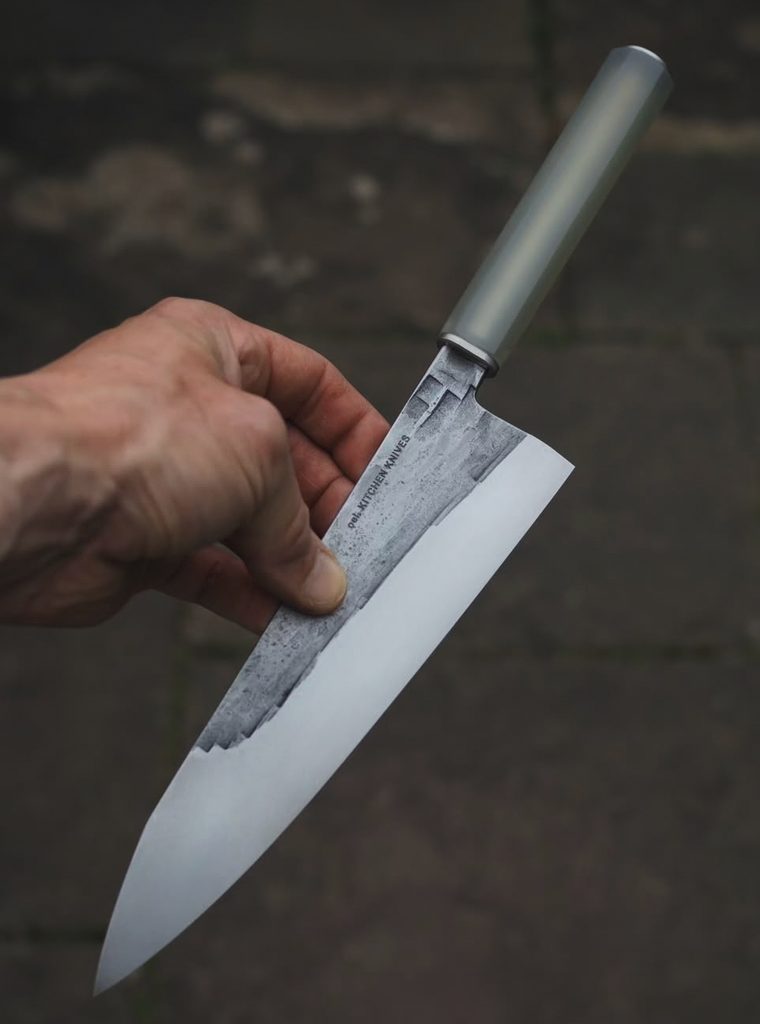
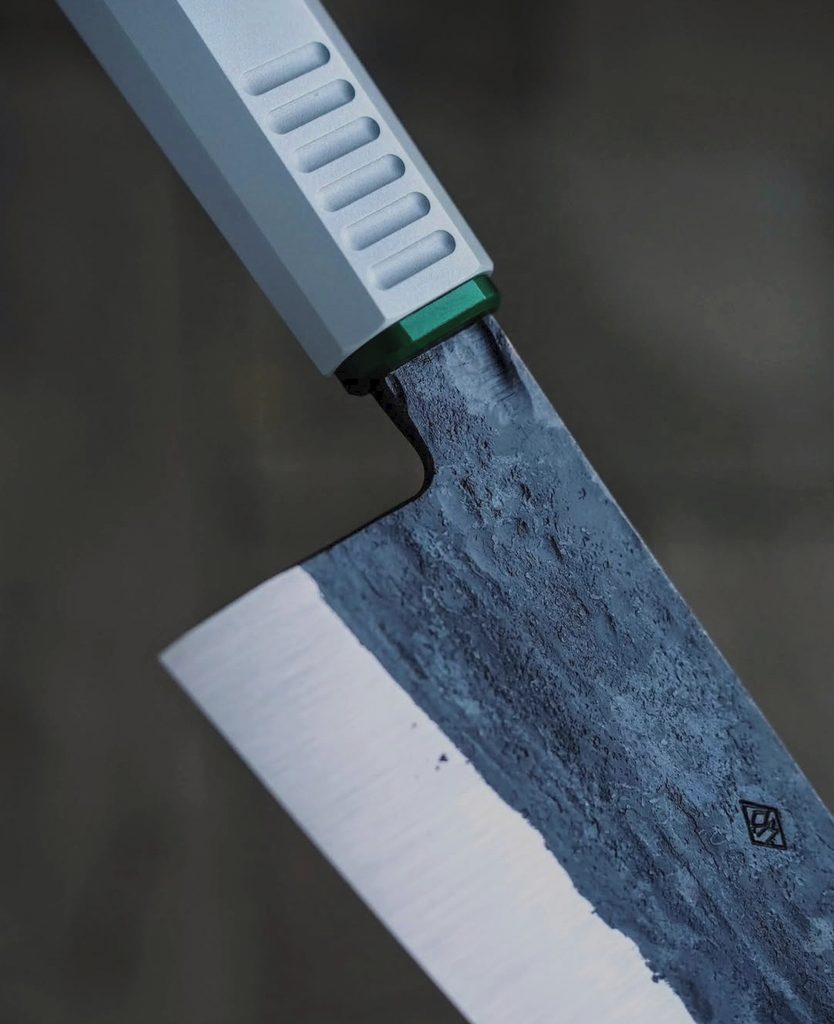
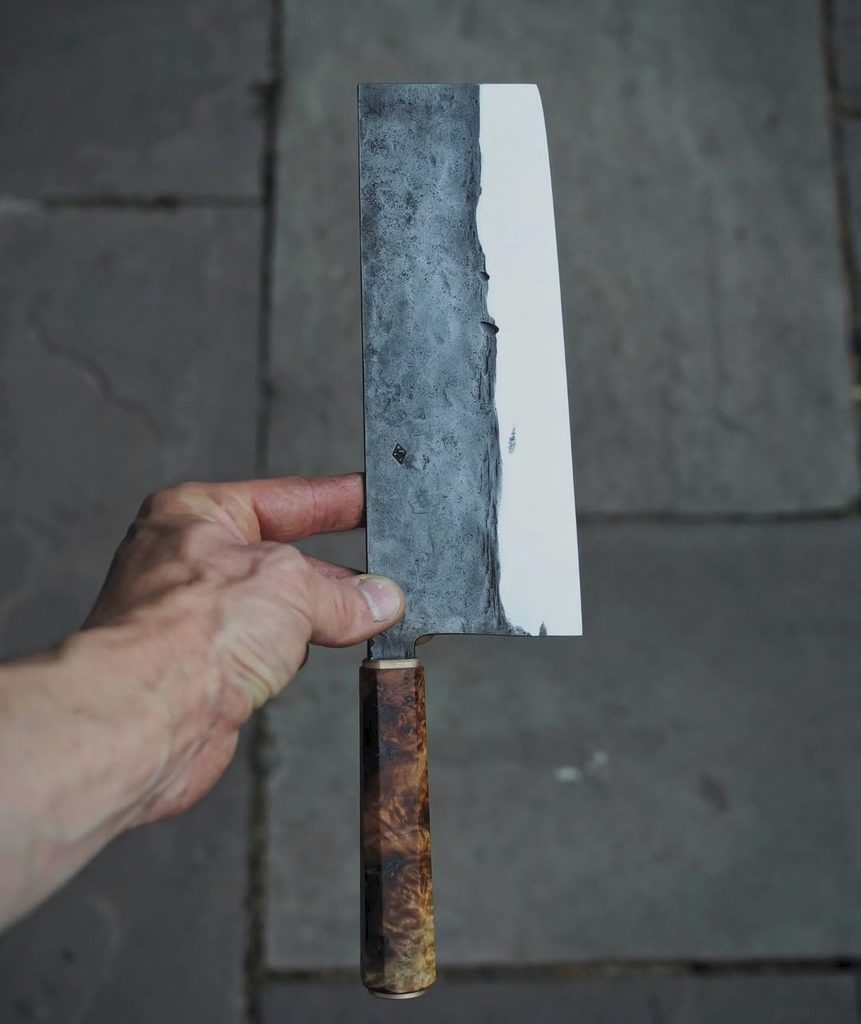
I don’t really have a single favorite knife. There are certainly some that have stuck in my memory, but it’s usually specific aspects or features of a knife that I liked in particular. This could be already small things like the appearance of the brute de forge, the way the knife lays in hand or a handle finish.
What is the most important aspect of a well-made knife?
Of course, there’s a lot more that goes into making a good knife, but for me, functionality and aesthetics are the main ingredients. Honestly, I couldn’t even say which I’d put first, haha. Some of you may have heard me say “appearance before function” — which, of course, isn’t meant entirely seriously — but I think I’ve finally
managed to find a reasonable balance between the two.
What keeps you going?
Bringing ideas to life is one of my biggest motivators. As soon as I come up with something, I usually order the materials right away and want to get started on it as quickly as possible. And of course, making a living is another reason I head into the workshop every day — it’s probably a mix of passion and purpose.
Biggest struggle?
I’d say I struggle with a lot of the tasks that come with running your own business, beyond the actual knife making – Things like taking photos of finished knives, creating content and of course, all kinds of paperwork. On the other hand, getting into the workshop and actually making knives never takes much effort for me.
What kinds of knives do you make?
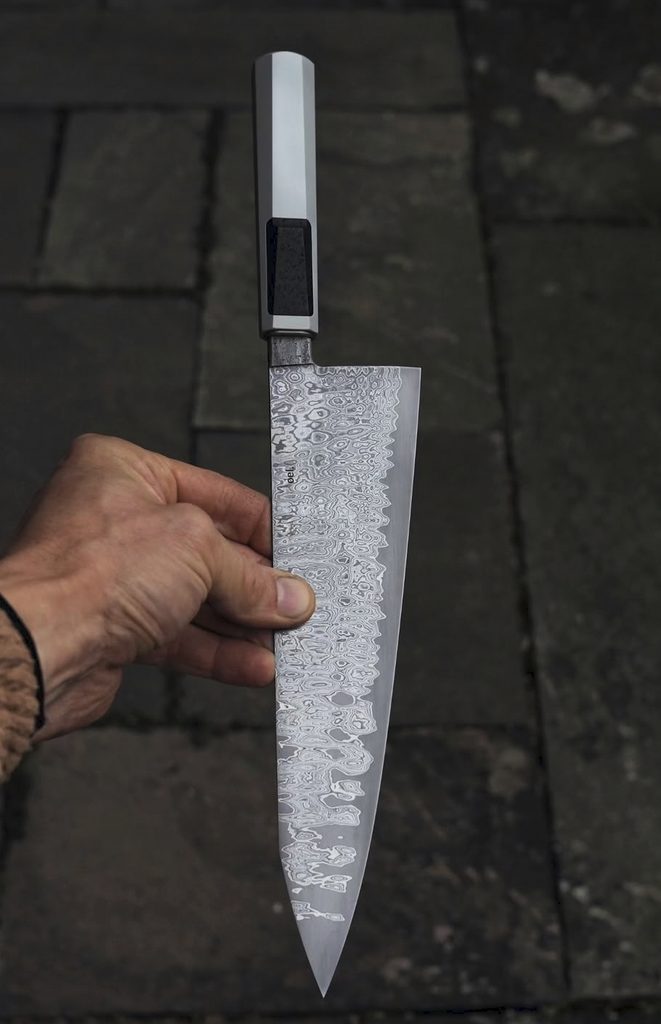
I try to make kitchen knives that are both functional and visually appealing, and I’m always looking to improve both aspects over time. Ideally, I manage to add my own personal touch, because I think visual identity is really important in a field where there are literally thousands of other makers.
How did your background affect your approach to knives?
As I mentioned earlier, I was lucky to receive solid training in metalworking, which has always been helpful from a technical perspective. Aesthetically, I think I’ve been influenced by my long time as a cycling enthusiast. Even in my early youth, I built my own bicycles and later also made my own parts. Things like a head tube angle that was a little too steep or similar things could
totally mess up my day, lol.
Furthermore, I’m also likely influenced by my partner, who works in interior design and has shaped my living space and my sense of form and design over many years.
Who helped you early on?
Since I’m a bit on the shy side, I didn’t really dare to reach out to other makers I looked up to for quite a while. That said, there was a young guy in my neighborhood in Berlin who was also making knives as a hobby and had an incredible amount of knowledge. We exchanged ideas a lot back then, and that was hugely helpful for
me.
Apart from that, most of my questions were answered by YouTube, the internet in general, and a few specialist books.
Who are your influences?
My work is probably influenced by functional industrial design, Japanese knives, and maybe a bit of Bauhaus as well — at least that’s something others have mentioned to me. Either way, I definitely see a minimalist, functional approach in my work, along with a sense of visual calm and a focus on the essentials.
When I first started making my own kitchen knives, I was definitely inspired by the work of „Hohenmoorer Messermanufaktur“, with its simple materials and clean, angular shapes.
What other knife makers out there impress you these days? Do you take inspiration from anyone else in the field?
Even though it’s pretty much unavoidable to get inspired by other makers, I try to stick to my own ideas as much as possible and keep my designs independent and recognizable. Once you’ve found your own design language, that becomes easier –
New ideas usually build on what you’ve already done anyway.
But of course, there are plenty of makers whose work I really admire, even if I wouldn’t necessarily call them an influence on my own work. Especially when it comes to forging, some of them make me seriously question my own abilities.
Any specific breakthroughs or revelations in your knife making journey?
Of course, this happens all the time – Usually on a pretty small scale. You’re constantly discovering new approaches that make life a bit easier. For example, I learned that glass bead blasting can be used to straighten hardened blades to a certain extent, which sometimes saves an incredible amount of time. There are
probably hundreds of these small tricks that add up over the years.
What is the perfect knife?
Oohhhh… the perfect knife?! I don’t know, but if it exists, it is definitely not made by me.
How do you approach knife testing?
I have to admit, I hardly ever test knives anymore. I usually only put them to the test when I’m trying something completely new. Since my processes, geometries, and shapes often stay pretty consistent over long periods, I don’t really feel the need to
test every single knife.
What’s always incredibly helpful for me though, is customer feedback. Many of my customers have huge collections and, naturally, a ton of experience with knives from dozens of different makers. They’re basically living knife-performance databases.
How do you develop a design, select a steel, and fine-tune a heat treatment?
My designs seem to develop very slowly, over a long period of time. They more or less stay the same, change only gradually and build up on one another.
It sort of is the same with steels and heat treatment. I don’t jump back and forth between a lot of different steels and tweak heat treating recipes only gradually from time to time.
Once I’ve got a system in place – whether it’s with designs or anything else – I usually stick to it and just keep building on it.
How has the knife world changed since you started?
I have the feeling it became a lot more professional and the standards rose a lot. There are just so many excellent knife makers out there these days. Out of that seemed to have developed a great community as well and I think that might not have been the case as much 10 years ago.
What’s up next for you? Any exciting new projects to tell us about?
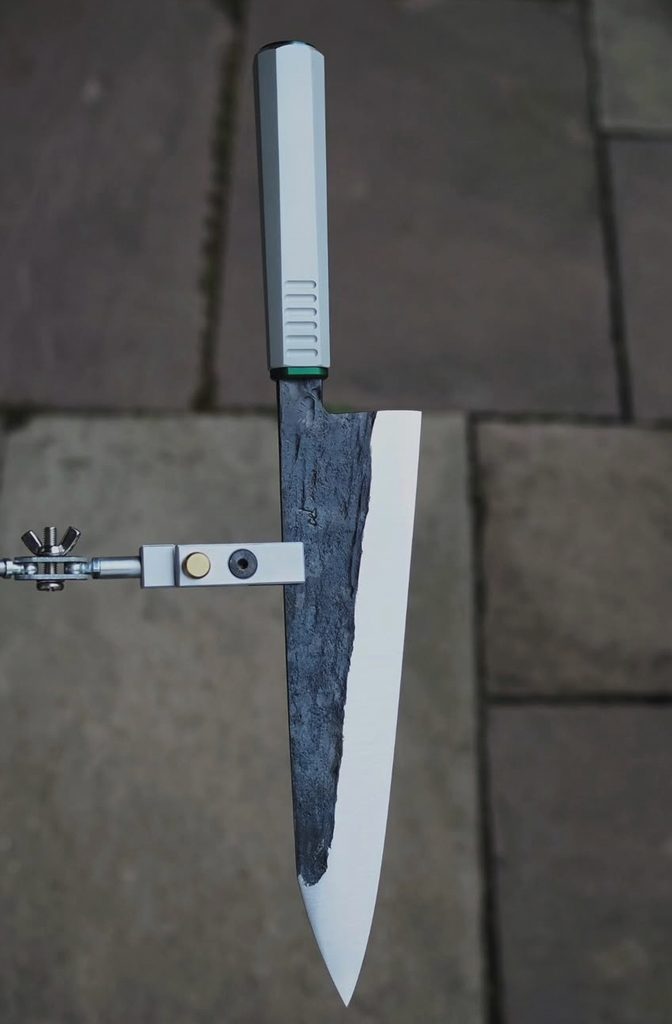
All in all, I’ll keep working on developing my current designs, which I’m pretty happy with at the moment, and the handle design is perfect for playing around with different materials and shapes. Beyond that, I might manage to add a new machine or two to my rather minimalist workshop this year. But apart from that…nothing too crazy 🙂
To keep up with what Oliver is working on give him a follow on his Instagram https://www.instagram.com/oel.kitchen.knives/
Leave a Reply