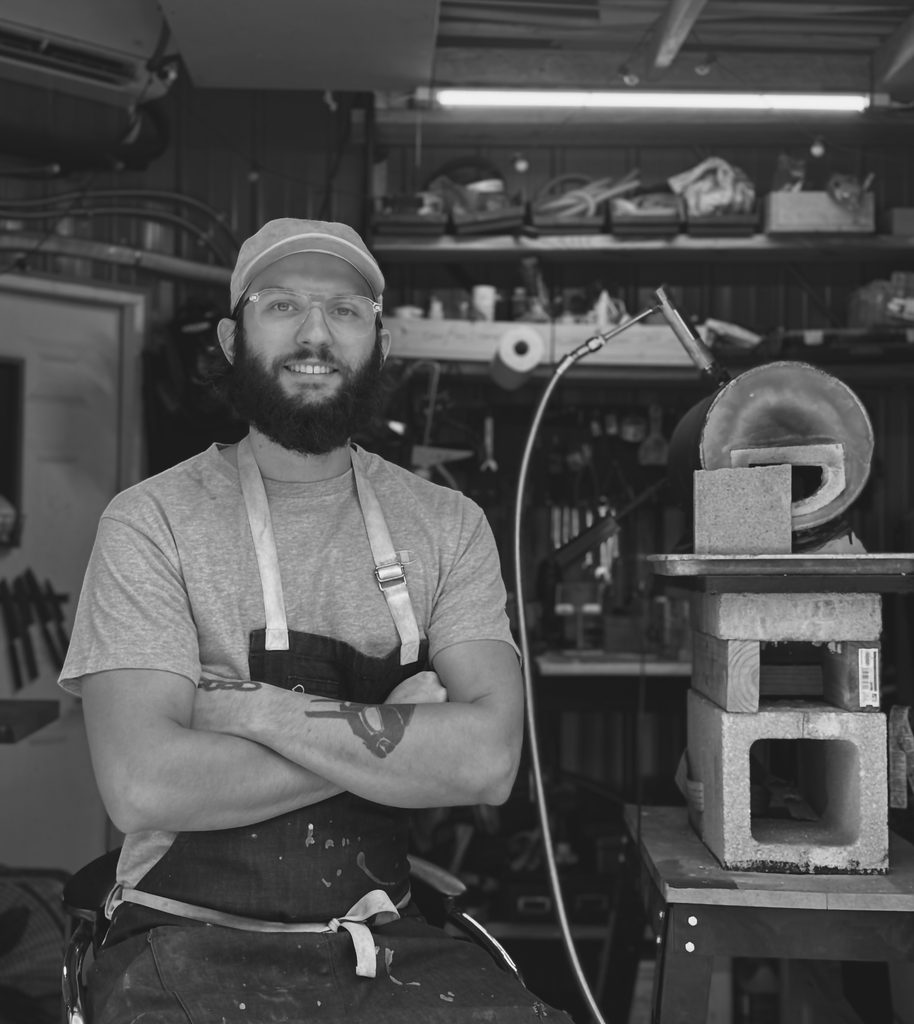
This week’s interview brings us to the workshop of a maker’s whose story in some ways reminds me of my own entry into the knife world. Organically choices lead to choices, and sometimes figuring out our destination along the way can be a gift in itself. A newer maker, certainly, but I couldn’t be happier to share his story.
To start off, please tell us a little about yourself.
Hey there, it’s very nice to meet you! My name’s Andrew Moreno, sole maker behind Prod Knives. I’m based out of Leander, Texas, just north of Austin, Texas. I’ve been making knives for around 4 years, after cooking for about 10. When I’m not in the workshop, I enjoy spending time with my girlfriend and two cats, cooking for friends and family, making fresh pastas/pizza, and keeping up with my fermented vegetable larder.
What sparked your interest in knives?
It was definitely a gradual interest I developed that started when I got my first set of mercers in culinary school. After graduating, I drove from Austin to Aspen, Colorado, to work at an upscale hotel where I got to cook alongside chefs from all over the world. That really exposed me to a variety of knife styles and shapes. I fell in love with Chinese cleavers there. Eventually I came back to Austin and while hopping around the restaurant scene my interest grew more and more, picking up a knife here and there. I began to really appreciate a good knife and enjoyed every chance I got to sharpen my kit.
What inspired you to do this and how did you learn?
What inspired me to try making a knife was a maker from Australia who I don’t believe is making anymore. He went by Hobart Ironworks. I stumbled across his etsy and fell in love with his style, super rustic and simple yet elegant in its own way. I bought a Serbian chef knife from him and adored all the handmade touches on it. It led me to dive into and research what it takes to make a chef knife.
When I started out, most of my learning came from YouTube! Lots of beginner tutorials and videos to help me understand what happens to steel through all the working processes. That and also just looking at my existing collection of knives and repeatedly asking myself things such as, “What makes you cut so good? Why is the handle shape comfortable? What are the ways this polish can be achieved?” And then attempting to replicate the things I considered good qualities of a knife.
When did you start making knives?
I made my first knife in 2022, and really got into it at the beginning of 2023.
What did you make your first knife with?
My first knife was with a piece of flat stock 1095 and some pine from a scrap 2×4. I used a little 15 lb anvil to make some dents with a ball-peen hammer, a small starter propane forge from Amazon, and an old masa pot filled with canola oil to quench. It was love at first knife. I had no idea the can of worms I was opening and had never really did any wood or metal-working. It was equally awkward and intriguing.
Do you have a favorite knife you made, tell me about it?
It’s hard to pick a favorite looking at past knives I’ve made. Every time I finish a batch of knives you could say those become my favorites because I try to make a better knife every time I make.
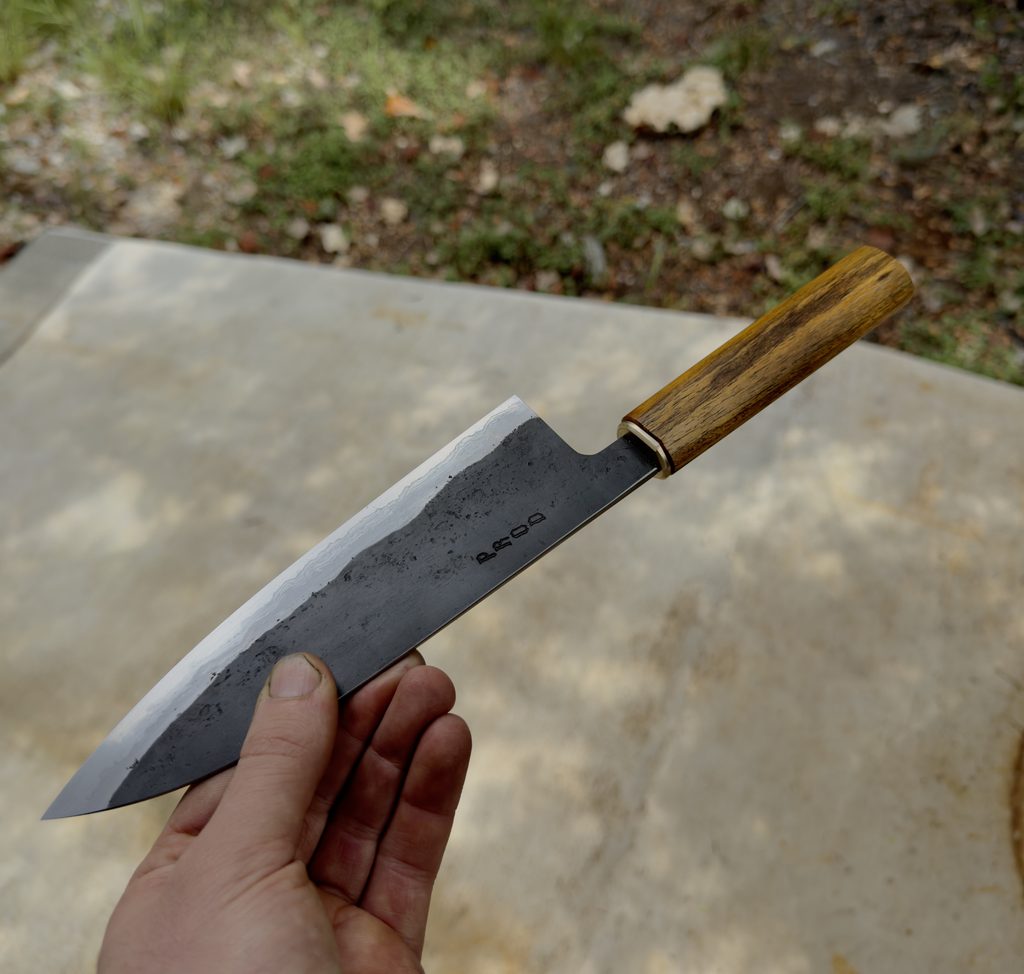
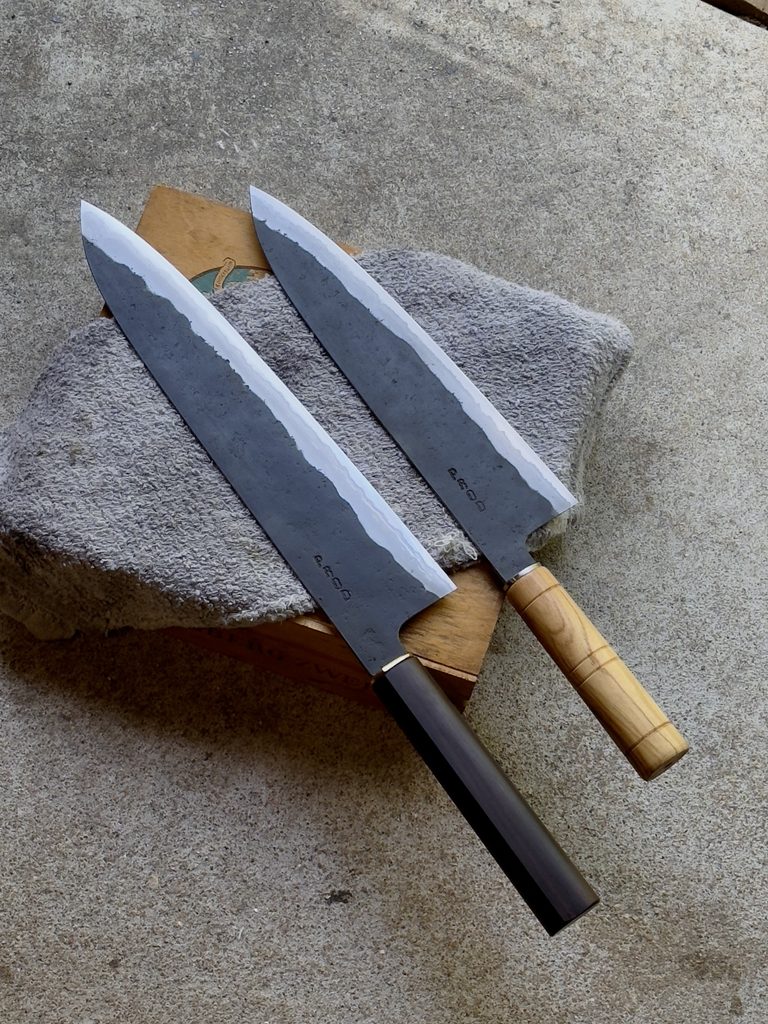
But I will say, I have a soft spot for turned handles. So those probably rank just a little higher for me.
What is the most important aspect of a well-made knife?
In my opinion, it’s a knife that is true to the makers creative values. That it fulfills its purpose and represents the blacksmith’s vision accurately. Performance and finish are definitely important aspects, but I think there’s an enchantment that occurs when a knife is made by hand that the user can feel and to me that’s the most crucial.
What keeps you going?
I think many are familiar with the vices that run alongside the restaurant industry. Knife-making truly pulled me out of a darker, more stagnant time of my life. This might sound cheesy but it really gave me a new purpose that helped me change my trajectory permanently. It’s a pleasure reconnecting with that inner child on a regular basis and I wouldn’t trade it for anything. Every knife I make is an opportunity to grow and improve. As I get billets ready for a new batch, my excitement builds knowing I have a chance to make something better than the last, or try something different than the last.
Biggest struggle?
I think my biggest struggle was learning to get very comfortable with failure. It was tough when I came from kitchens where I got used to having to get things first try with little to no room for mistakes. With knife-making, hours of hard work can get lost in an instant over something seemingly small but structurally detrimental; that one little detail you thought you could either skip or rush over comes back to haunt you after days of work. The failures hit hard, that’s for sure. But they also hold so much motivation and insight for growth.
What kinds of knives do you make?
Kitchen knives! And the occasional bull cutter.
How did your background affect your approach to knives?
The most influential job I had cooking professionally was a spot where we were able to put out some really ambitious food with an incredibly small kitchen. My chef there, Andre Molina (@youngmanchego), has a style with food that hugely influenced the way I perceive my own creative endeavors. Simple and intentional dishes that had strong visual appeal. We cooked everything using only a plancha, some single induction burners, and an oven. It really embedded a “less is more” mantra into my outlook with knives and gave me a newfound appreciation for limitations.
Who helped you early on?
Early on I learned a lot from watching Simple Little Life’s videos on YouTube, as well as reading plenty of knifemaking forum posts and articles from knifesteelnerds. Milan Gravier has also been a saint and helped me with quite a few different areas; he’s given me invaluable input and is an enigma in his own right. I also really couldn’t have even began making without the help from my mom and step-dad, who donated their garage to me for about a year when I was getting started. Yeah, friends and family have all been so helpful. I feel very lucky to have so much support.
Who/what are your influences/inspirations and how do you think those inspirations translate into your work?
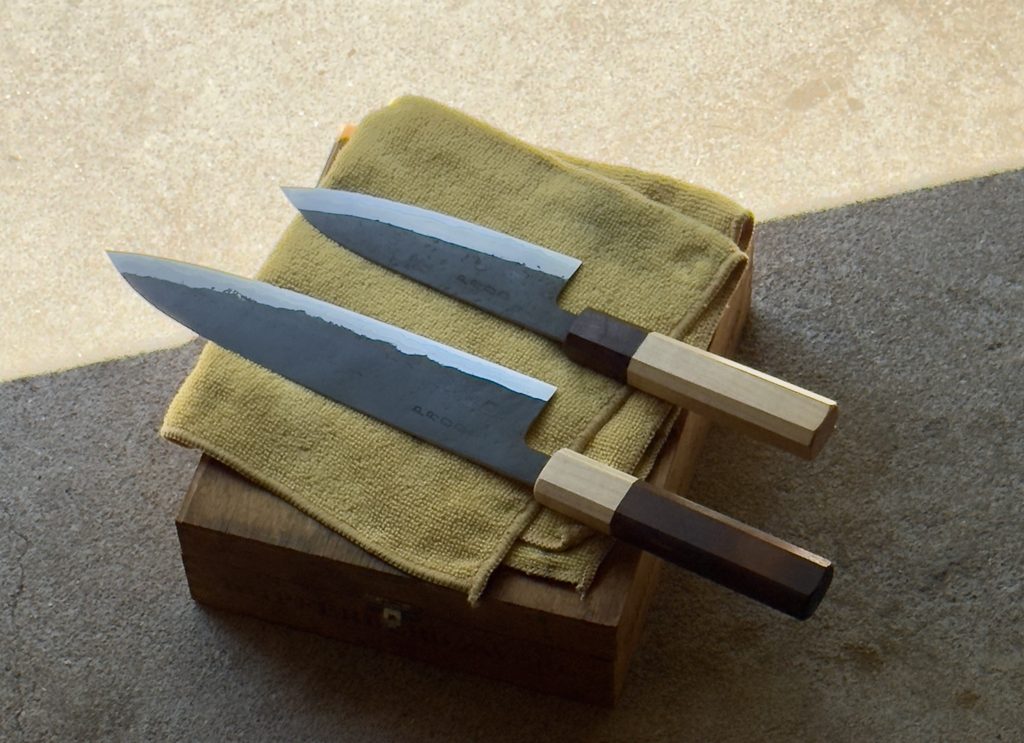
I love the look of antique hand tools with those bulkier turned wood handles, where the metal has taken on an aged dark patina. Classic Wa handles, oval and octagonal, all of it is charming to me. Utilitarian design inspires me quite a bit as well.
Where I grew up in southern Connecticut, there were (and still are) a healthy selection of mom & pop pizza places scattered around. They all had their own recipes and styles of crust, all equally great. There was something special about these generational family owned places that stayed with me, in that they weren’t necessarily trying to be the “best” or most innovative pizza shop in town, but that they were just happy serving their local community and doing what they do best.
That’s kind of how I like to think of knives and other makers, with the added notion that there’s always something to learn from them as well as opportunities to share what I’ve learned myself. Every knife I see I try to make mental notes of the aspects I like about it and kind of fill this stockpile of inspiration for future use.
Any specific breakthroughs or revelations in your knife making journey?
There’s been so many! But one pretty big one is if I’m seeing a repetitive failure with something, I learned to put it down for a bit and go back to it another day. That mental reset almost always gives me an “aha” moment where I can change strategies. If not, I’ll end up brutish with my attempts and just have more mistakes.
What is the perfect knife?
I think the perfect knife is one that aligns well with its user, and also is true to the maker. Everyone has different preferences on what a great knife is to them. To me it’s about making the knives you make well, and being unapologetic with your style.
How do you approach a new concept and that concept’s implementation?
When approaching a new concept, I first like to draw different iterations to really visualize what I want to make. Through the actual making process the knife almost always changes, and at that point I like to let the knife tell me what it wants to do and try not to force it one way or the other.
How do you approach knife testing?
For the cutting experience I test with mainly onions, carrots, sometimes denser root veg. For sharpness I test with newspaper and paper towel.
How do you develop a design, select a steel, and fine-tune a heat treatment?
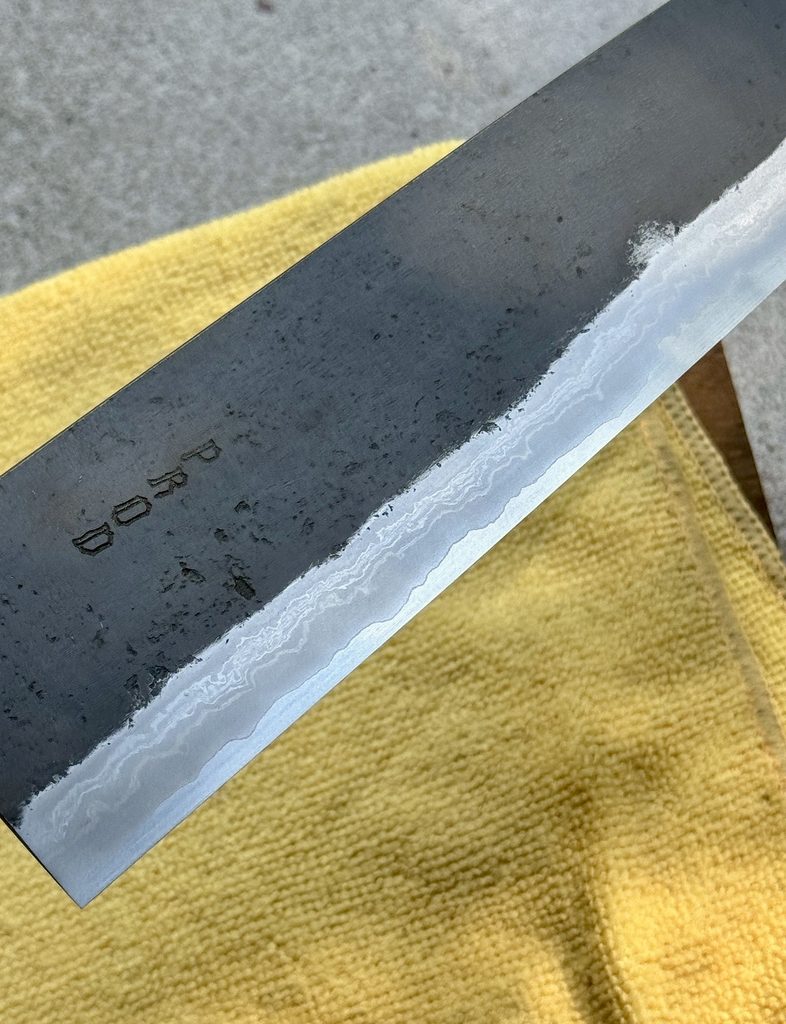
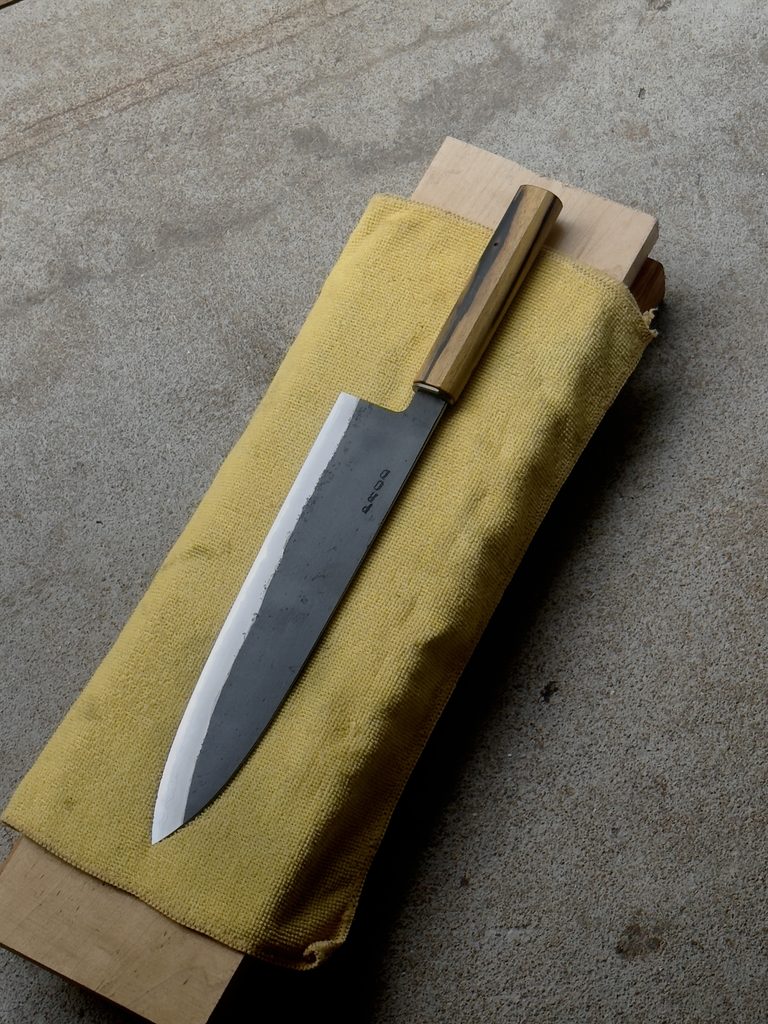
For a knife design, I find myself aiming for more and more gradual curves and traditional shapes, focusing more on gradually improving my polishes/surface finishes/geometries.
For my steels, I’ve pretty much stuck with 52100 for quite a while. I know it’s not a super steel but I’ve just really enjoyed it and like its edge revivability.
With heat treating, I definitely will tweak or test here and there but I try to keep it as simple as possible, and to not overthink it too much once I’ve found success.
What do you like about 52100?
52100 has been my go-to for some time. I’ve tried Pop’s ProCut, W2, 26c3 and a few others, but keep finding my way back to 52100. I love how easy it is to sharpen, and that it stays work-sharp for a long time.
How has the knife world changed since you started?
Since my first knife was in 2022, it’s hard to say as it’s not too long ago but it’s very motivating to see other makers push themselves to make more and more ambitious knives and watch their styles flourish.
What’s up next for you? Any exciting new projects to tell us about?
I really am focused on just gradual improvement. There’s something to learn every time you make and I just want to put out solid knives. Not too crazy, just simple and executed well.
To keep up with what Andrew is working on head over to his website https://prodknives.com/ and follow him on Instagram https://www.instagram.com/prod.knives/
Leave a Reply