
This week’s interview takes us to Tasmania, and the workshop of Alex Norton. I absolutely love getting to know how creative individuals approach their craft. It always amazes me the ways in which the human mind finds to make new and exciting things. And if like me you really appreciate someone who not only has a unique lens for the world, then you are in for a treat. I am very excited to be able to share his story.
To start off, please tell us a little about yourself.
I’m a former Behavioural Game Theorist who forged steel as a hobby. About 8 years ago I quit my career, sold my house and my car, cleared all my debts and moved from the big city to a tiny cottage in rural Tasmania to take up forging full-time. Now I spend my days making blades, bushwalking and tending to my chickens.
What sparked your interest in knives?
I’ve always been a big bushcraft guy and extremely interested in self-reliance. Part of that journey many years ago was to learn to make my own tools from scrap. I taught myself to forge and eventually got bitten by the knife bug. Given my years of bushcraft work, farm work and a life-long passion for cooking, knives have been a big part of my life forever – at least since being given my first pocket-knife at age 8.
What inspired you to do this and how did you learn?
I was inspired by my incessant need for self-reliance. I like to do everything for myself. I even built my own solar battery system and use bore water haha back when I first started learning, I actually made the – very incorrect – assumption that this was a niche historical skill that nobody would be doing anymore, and so I didn’t expect that there was a whole global community keeping the art alive, and so I tracked down books in order to learn. Eventually I discovered the YouTube community and quickly made friends with people like Roy Adams, Dan Moss and especially Sam Towns, who I actually ended up hosting a podcast with on the topic for a good six years, called ‘The ForgeCast’. But yeah, largely self-taught, but I owe a lot to the YouTube community for spreading so much knowledge. Now I’m part of it myself with almost 10,000 people learning from me, which is pretty cool.

When did you start making knives?
I was forging decorative ironwork for probably four years before I really got into knives, and even then, I did them as a specialty item, rather than my main thing. So, I’ve been doing knives as my only product now for about four years.
What did you make your first knife with?
Haha, my first knife ever was an ugly, pitted, awkwardly shaped cheese knife made from rebar steel and water quenched. I was too embarrassed by it to even try and sell it, and it’s probably still kicking around somewhere in my shed. I did a bunch of testing on water-quenched rebar (the rebar that I had, anyway) and found I could get it to hold somewhat of an edge, so from there I made a few very small neck knives – only around a 1″ cutting edge, with wooden handle scales to look pretty, and awful little leather sheaths. But people loved them and wanted them, so I made a handful of those before someone in the community reached out and let me know that they worked at a factory which made shock absorber springs for cars, and they had a bunch of rods of SUP9 steel they’d be willing to trade for one of my neck knives. It was a solid deal, but it led to me beginning to learn proper knifemaking so quickly that I actually still to this day have some of that rod stock in my steel rack.
Do you have a favorite knife you made, tell me about it?
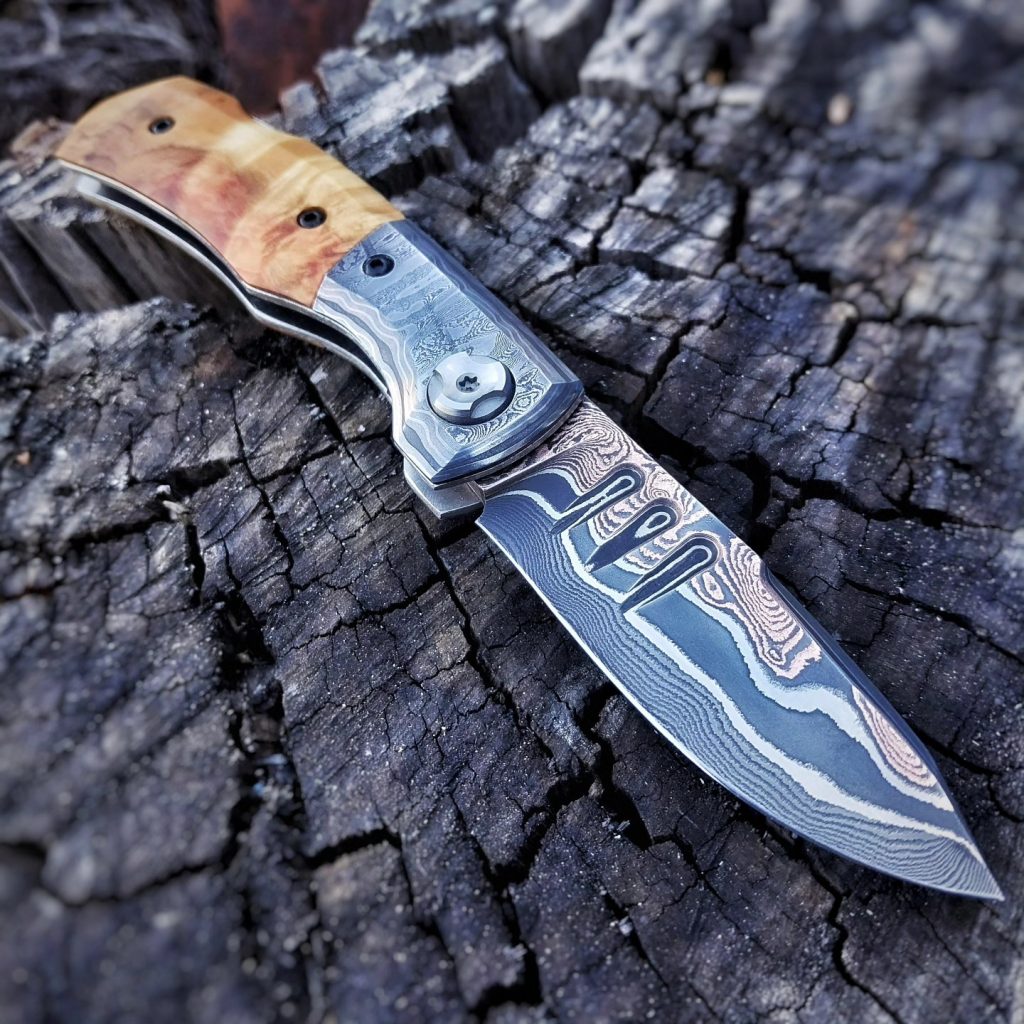
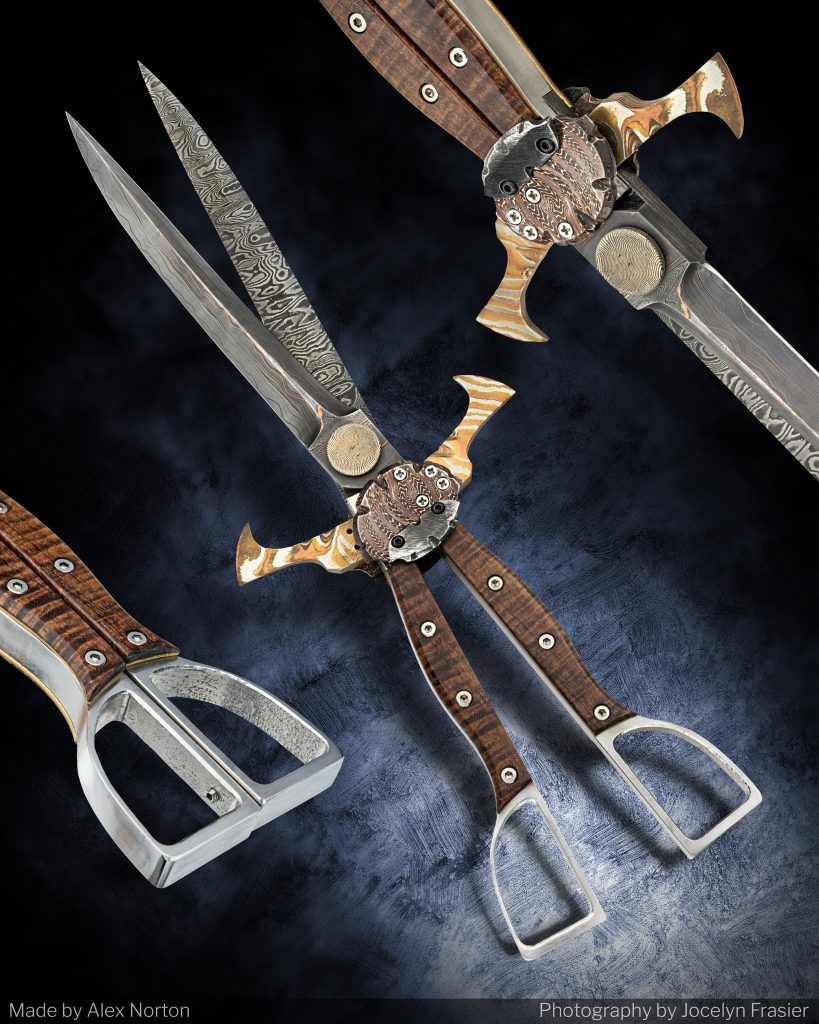
It’s genuinely hard to pick a favourite. I used to do a lot of commission work, but after a while I found that doing other people’s designs was so draining that I began losing the love of the craft, so I made the scary decision (as a full-time maker) to cast aside the guaranteed work and start only doing my own designs rather than taking commissions. That really helped, and I felt like I was able to find my own style – and let me tell you, I’ve done some wild designs since then! So, choosing just one as a favourite is difficult. In my folding knife range, I have a design called “The Highwayman” which I’d say is my favourite, and the first one of those I ever did was probably the one I’d pick from there. For fixed blades, I love doing daggers, but one design I’m known for is my scissor daggers, which are daggers which unlatch to become a functional pair of scissors, or a dagger when closed – so that’d probably be favourite fixed blade design. Lately I’ve been getting asked to do a lot of swords, which is amazing. They’re a big ticket item and a lot of work, so I feel particularly privileged to have so many people wanting them from me. My favourite sword ever would probably be a katana I finished recently, named “Cloverleaf”. It was a build I’d wanted to do for years, but the expense of the design made it hard to find a customer. Luckily someone came through and I got to build it. I practised Kendo and Iaido for years, so katana have been a big part of my life, so to actually get to make my dream katana was huge. It was cu-mai steel the entire length, with the copper line representative of the hamon. An ornate tsuba made of 150 year old wrought iron and mosaic coppermai, a Tasmanian salmon-skin wrapped handle with copper leaf menuki, all tied up in Japanese Ito silk and a stunning blackwood saya. It took me months to make, but both I and the customer were very happy with it. Katana are one of those things where you really have to take the time to do it right or not do it at all.
What is the most important aspect of a well-made knife?
That it fits your needs. I think one thing that’s been lost in the community is the understanding that a knife is a tool and nothing else. Just like any other tool, using the right one for the right job is important, as is having expectations of it which are realistic for the appropriate task. I see so many people talking about this and that when it comes to knife performance, all of which tends to bypass this fact. A straight razor is for shaving. A chef knife is for slicing. A puukko is for utility. Talking big game about how one should be able to do the work of another is just posturing. The differences between geometries, tempers, material choices… It all matters, yes, but should be tuned to the task at hand. Even if that required task is to be a very pretty bit of pocket jewelry used to open packages. I work to try and make all of my knives over-perform in their required field, it’s true, but only for their required field. You wouldn’t use an engraving hammer to do timber framing, and you wouldn’t use a sledgehammer to set a pin nail. Treat knives the same.
What keeps you going?
I spent far too many years living a life and working a job that I hated, purely because I got caught in the assumption that it was the done thing, and just how life had to be. Since breaking away from that and living the way I want to for so long, it’s maintaining that freedom that keeps me going. Now I live where I want to be, in the environment I want to be in, doing a job that I want to be doing, and doing it on my own schedule. I won’t ever go back to my old way of living.
Biggest struggle?
Not many people know it since I try not to advertise it, but I actually live with a fairly significant disability, and am experiencing some form of pain or other suffering at all times because of it. Not only that, but it keeps me in a fairly constant state of exhaustion. So working such a physical job as forging steel as well as keeping as many balls in the air as is needed to provide for my family full time really does keep me on the struggle bus. But it’s better to be doing it here, on my own schedule, than working for someone else in an office somewhere.
What kinds of knives do you make?
My favourite things to make are swords and daggers, but they’re big ticket items (since I like making fancy ones) and so it’s not always easy to find customers for them. Luckily my reputation has grown considerably in the last few years, so I’ve been extremely lucky in that regard lately. But when I’m not making those, my main fare is pocket knives. Usually more traditional models, like slipjoints and backlocks. I just love the classic look and feel.
How did your background affect your approach to knives?
I’ve certainly become a bit of an acquired taste in the community because of my background. As a former Behavioural Game Theorist, I’m an expert in human behaviour and decision making, and for that career I spent a great many years studying psychology and philosophy, so I tend to enforce objectivity and introspection in all aspects of what I do. Constant analysis, and constantly pushing myself to feel challenged. It’s led to many of the wilder builds I’ve done, like a folding 8″ bowie, my scissor daggers (even a folding knife scissor dagger at one point) and one time where I challenged myself to make an entire katana from scratch in just 48hrs. If I get too comfortable, I’ll stop analysing the “why” of things, and that will not do.
Who helped you early on?
Gotta give a big shout-out to Sam Towns, whose livestreams I used to haunt when I was in my early days of getting started. But also Roy Adams, Dan Moss and John Switzer with regards to forging technique. For knifemaking specifically, I was really inspired by the work of Stuart Anthony Smith and Neels van den Berg, both of whom I am now lucky to call friends.
Who are your influences/inspirations?
Stuart Anthony Smith continually inspires me for fixed blade knives. He has literally spent decades refining his style to the point of perfection. When it comes to folding knives, my main inspiration would have to be Jean-Baptiste Leveque who in my eyes produces nothing but pure perfection. For swords it’d have to be David DelaGardelle, who’s whimsical fantasy stylings are something I continually strive for.

How do you think those inspirations translates into your work?
I try very hard to have my own style, but I think we’re kidding ourselves as makers if we forget that all of our work stands on the shoulders of giants. This is a field which is literally millennia in the making. I try my very best to make sure my designs aren’t copying the work of others, as best as one is able to do that, and focus mainly on drawing inspiration from individual techniques, or even just work-ethics or philosophies. Sometimes I’ll see someone using one particular texturing technique, or forging technique, or patterning technique, which really fires me up and gets me excited to try it, and I like to ride that feeling and use it to fan my own fire.
Any specific breakthroughs or revelations in your knife making journey?
New ones all the time. I think it ultimate comes down to this – if you let yourself get comfortable, you won’t evolve. You should continuously try to improve, challenge yourself and prove to yourself that you can do things. I regularly get comments on how fast the quality of my work has evolved over the past few years since starting to make knives seriously, and most of the credit for that comes down to the fact that I will actively take on projects which I don’t know how to do, or have no idea how I’ll achieve. By the end of it, when it’s finished, I have learned at least the basics of a set of new skills, which I am more likely to try again, which further evolves them. I think in all of my career I’ve only had one project which I wasn’t able to get working, no matter what I tried, and had to give up due to time.
What is the perfect knife?
The one which does the job perfectly. That’s it. I’m a big knife guy, and own a great many, all for different tasks. Just in my kitchen I have seven, all which see regular use. I used to rotate my edc knife so much – I must have been through 20 or 30 knives trying to find the perfect one for everyday use. Eventually one was given to me by my mentor, and I’ve carried it ever since – for almost 15 years now – and that’s an ESEE Zancudo in olive green with satin blade. A lot of people wonder why my edc isn’t one of my own knives, but that one is special because of who gave it to me. I also carry an edc fixed blade in a scout carry – that one I made for myself out of ApexUltra and black G10, designed specifically to be a beater-knife, able to just be used for all manner of rough work and stay bulletproof the whole time. So far, it has lived up to that pretty well.
How do you approach a new concept and that concept’s implementation?
Honestly? I usually just wing it. It drives some people who see my process mad that I don’t plan things out. But I have hyperphantasia, so I can see the finished thing in my head in exquisite detail, and feel how it will feel to hold already. Once I’ve built that mental image, I usually just build it from my mind.
How do you approach knife testing?
Brutally haha, very early on I learned how easy it is to mess things up with knife construction, so I became pretty paranoid about it. I’ve been known to baton my blades into steel bars, slam them tip-first into old, dry stumps over and over, repeatedly slice through thick rope that has been buried in sand… Even on something pretty going out into the world, I like to know that it’ll survive. Once again, though, it does depend on the intended use of the knife. A bushcraft fixed blade I make goes through the ringer with testing, but a straight razor gets a bit more gentle treatment. I remember once a customer (a local hunter) questioned the ability of a handmade knife to hold up under the kind of use they put their knives through, so right in front of him I bashed one of my knives repeatedly into an antler I had on the bench then used it to cleanly slice a piece of paper and then shave my arm. He bought the knife.
How do you develop a design, select a steel, and fine-tune a heat treatment?
I’m quite consistent in my steel choices, mainly because I like to experiment a lot with heat treatment to refine my grain. If I have to use a new or different steel to what I’m familiar with for a one-off build, I’ll often get it professionally heat treated rather than do it myself. But for the steels I know and love, I have a process I follow rigorously. Steel choice is always based on what duties the knife is designed to do. As for aesthetic designs, I kind of just “let it flow”. I build the picture in my mind, and then make it work. I don’t like making “perfect” builds. If something is so cleanly made that it is flawless, then how can the buyer know it wasn’t just CNC built? I like my knives – even my high end pretty knives – to look handmade, and have that aesthetic story which reminds the customer of the hours and hours of work which went into them. That’s not for everyone, I know, but my customers seem to like it.
Any favorite steels?
It’s probably opening a can of worms, but I think there’s a lot of unnecessary wank around steel choices. Every industry has gatekeeping in it – “you’re not doing it right unless you’re doing it this way or that way”. You see it in everything, from crochet to cars to painting. Knifemaking is no different. You can make an exceptionally well-performing knife out of simple 1084 if you nail the heat treatment. Yet people see that as a “beginner steel”. Yet for all the people who say that, they’ll still froth over a fancy mosaic damascus blade, despite half of that blade most likely being made of 1084. So I use the steel that is appropriate for the task, and nothing more. I usually work with 1084, 15n20, 80crV2, SUP9(5160) and 52100. If I’m doing something special I might use VG10, Hitachi Blue, DamaSteel, etc, but I dont heat treat those myself since I just don’t have the setup required to do them justice. If I had to fan-boy over one particular steel it’d be ApexUltra – a newer custom steel being made by Tobias Hangler. It’s fully forgeable (though it’s a workout to do), heat-treatable at home and produces performance results which are absolutely out of this world. Even when stacked up against the brutality I put knives through.

How has the knife world changed since you started?
As a behavioural expert it’s been fun to watch. I don’t really get involved in the community much, as I’m not really a people person, but I do observe. Mostly it’s just watching trends come and go. People love to do things just because they’re the popular thing at the time, without ever really bothering to try and understand why they’re doing them. It’s fun to watch. To be honest I wouldn’t say much has changed in the time I’ve been observing. The main difference is the aesthetic standards of steel. The arrival on the scene of Coy Baker and his special steels really lifted the bar for what damascus could look like, and we saw a huge evolution in aesthetics because of that, which was cool. I wouldn’t say it changed the functionality at all, or evolved much else, but in terms of what a pretty knife could be, it really empowered a lot of makers in a big way.
Any exciting recent projects you’d like to tell us about?
An interesting one, actually. I completed a set of three matching swords – all very ornate – which will actually be urns. They will become family heirlooms which house the family’s patriarch. It was quite an honour to have been selected to do this for them, so I really wanted to do the project justice to the best of my ability.
To keep up to date with what Alex is working give him a follow on Instagram https://www.instagram.com/valhallaironworks/ and subscribe to his YouTube channel https://www.youtube.com/valhallaironworks
One response to “Valhalla Ironworks”
-
Alex turns out some amazing work. I enjoyed learning a little more about his blacksmithing/ knife making journey.

Leave a Reply