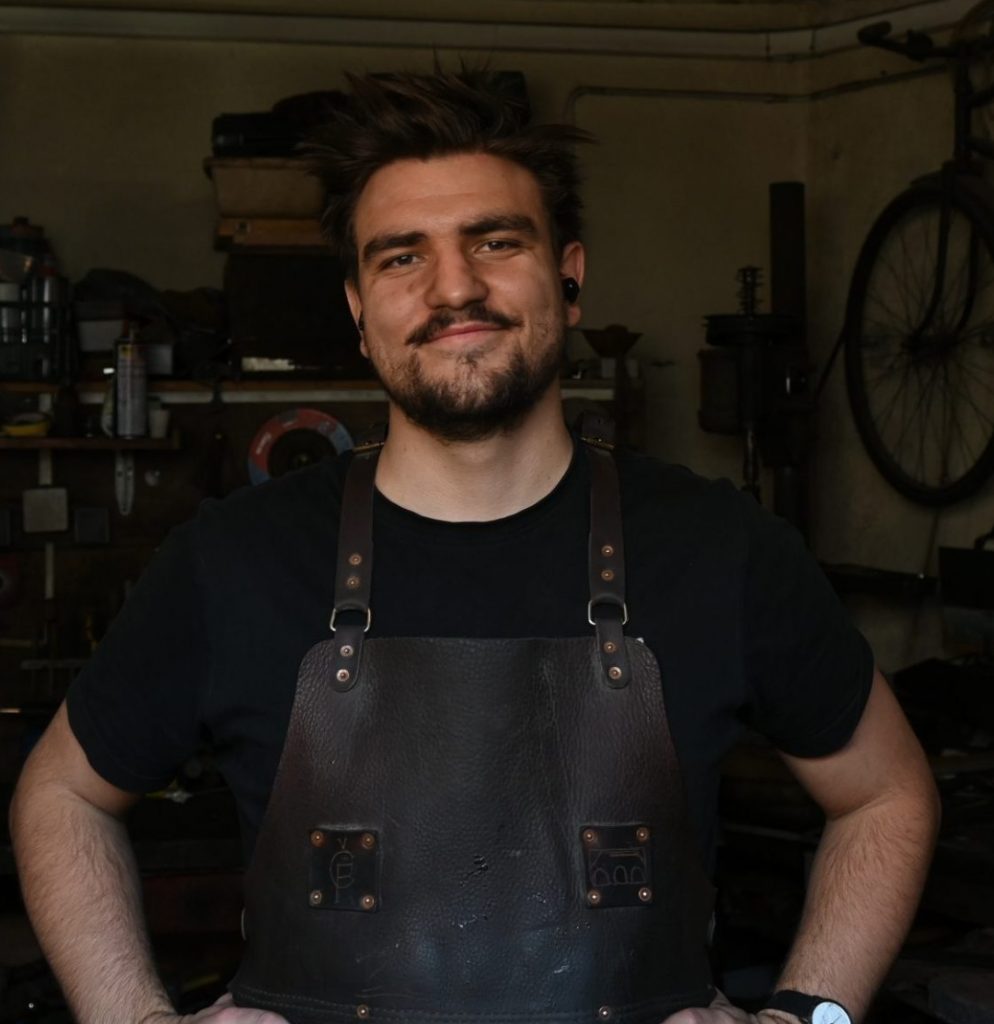
This week’s interview brings us to a workshop that is built with the building blocks of the past. Familial past, the past of the place, the roots run deep, and they have grown into a knife maker who makes some absolutely beautiful work that he strives to put himself into. I am absolutely happy to be able to share his story.
To start off, please tell us a little about yourself.
My name is Lovro Jurečič, and I come from Podbočje – a small village in southeastern Slovenia. My great-grandfather was a blacksmith, and some of his knowledge was passed down to me through my grandfather. Throughout my life, I hadn’t really thought much about creating things with my hands. I attended a Diocesan classical gymnasium in Ljubljana and later went on to study mechanical engineering at a university in Ljubljana. Since the studies were mostly theoretical, I began to feel the need to do something more hands-on. In 2019, I took a break from my studies and decided to try making a knife. I already had much of the necessary equipment at home thanks to my great-grandfather – all I needed to do was start.
Today, I’ve been living entirely off my own business – Vorančeva Kovačija (Voranc smithy) – for two years. I’m lucky to be the husband of a wonderful wife and the father of two little girls. Outside of work, I love singing, hiking in the mountains, and playing basketball.
What sparked your interest in knives?
During my student years, I loved cooking, and I was always frustrated with bad knives. That was definitely one of the triggers. Also, in my free time I started to watch some videos of katana making and forging all kinds of stuff. I think I was also drawn to the idea of creating something beautiful and useful with my own hands.
What inspired you to do this, and how did you learn?
I’ve always loved our traditions and customs, and in my family, a knife that had been around for 20 or 30 years always carried many stories. It fascinated me that a piece of metal attached to a
wooden handle could hold such meaning.
A big part of my inspiration definitely came from my great-grandfather and his son – my grandfather. My great-grandfather was a blacksmith, and my grandfather helped him a lot as a young
man. That’s how the knowledge was passed down to me. Especially at the beginning, my grandfather and I talked a lot about how to do things and how to improve the tools and equipment.
When did you start making knives?
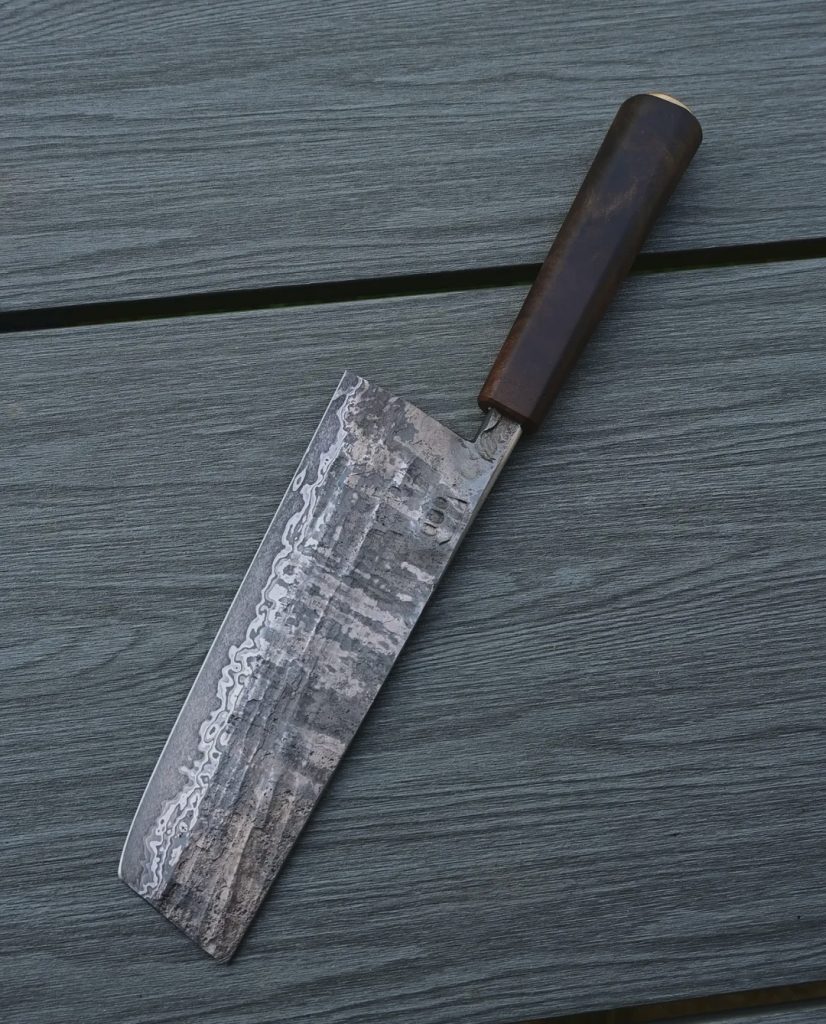
My first knife was made in August 2019. I made it for a friend from university who had a birthday at that time. It was a 160mm nakiri with a walnut handle. I’ll just say that it cut and that was enough,
haha.
What did you make your first knife with?
My equipment at the start was very modest. From my great-grandfather, I had an anvil, a few tongs, a hammer, and some files. I bought a small gas forge, and for grinding I used a wood sander
turned upside down. It was really bad, but I wanted to make everything the hard way first so that I appreciate it when I get better equipment.
Do you have a favourite knife you made? Tell me about it.
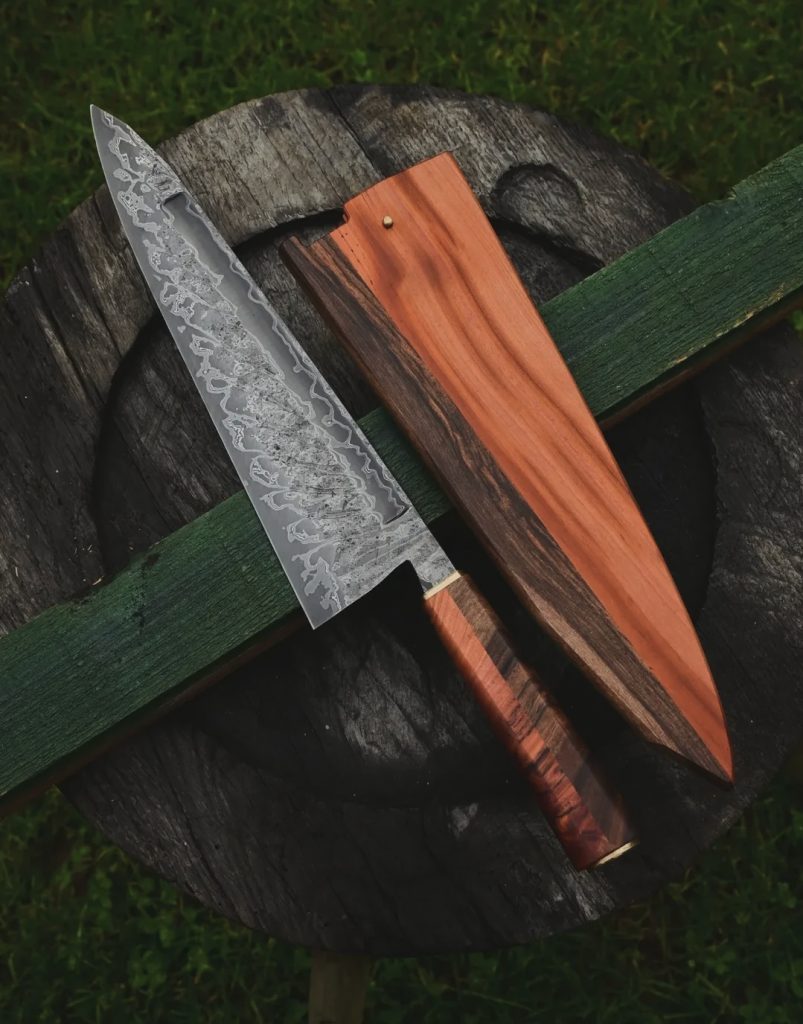
My favourite knife is probably the Toplar knife, which has an especially interesting story. A Toplar is a haystack and is a well-known Slovenian agricultural building used for drying hay. Since
agricultural heritage is such an important part of Slovenia’s culture, the Toplar is also one of our national symbols.
When I was researching the Toplar, I discovered that its construction followed strict and fascinating rules – the golden ratio, specific types of wood, geographical orientation, etc. I decided to transfer these principles to a knife, carefully defining every dimension and design aspect. It was a very demanding project, but also incredibly fulfilling.
What is the most important aspect of a well-made knife?
That the user wants to use it. In the end, it doesn’t matter how polished the knife is, how many layers of damascus it has, or what the handle looks like. If the knife performs its job well and the user
loves to pick it up, that’s the most important quality of all.
What keeps you going?
The desire to improve and the challenges that come with it. Of course, also the responsibility of providing for my family. That shapes my work ethics and my need for consistency in production and quality. When I was on my own, it didn’t matter much if one month wasn’t great – but now, there’s less room for joking around.
Biggest struggle?
I wouldn’t say that I struggle with anything in particular lately, but right now I’m focusing a lot on breaking into the international market and finding regular clients. And since social media isn’t really helping it is quite difficult.
What kinds of knives do you make?
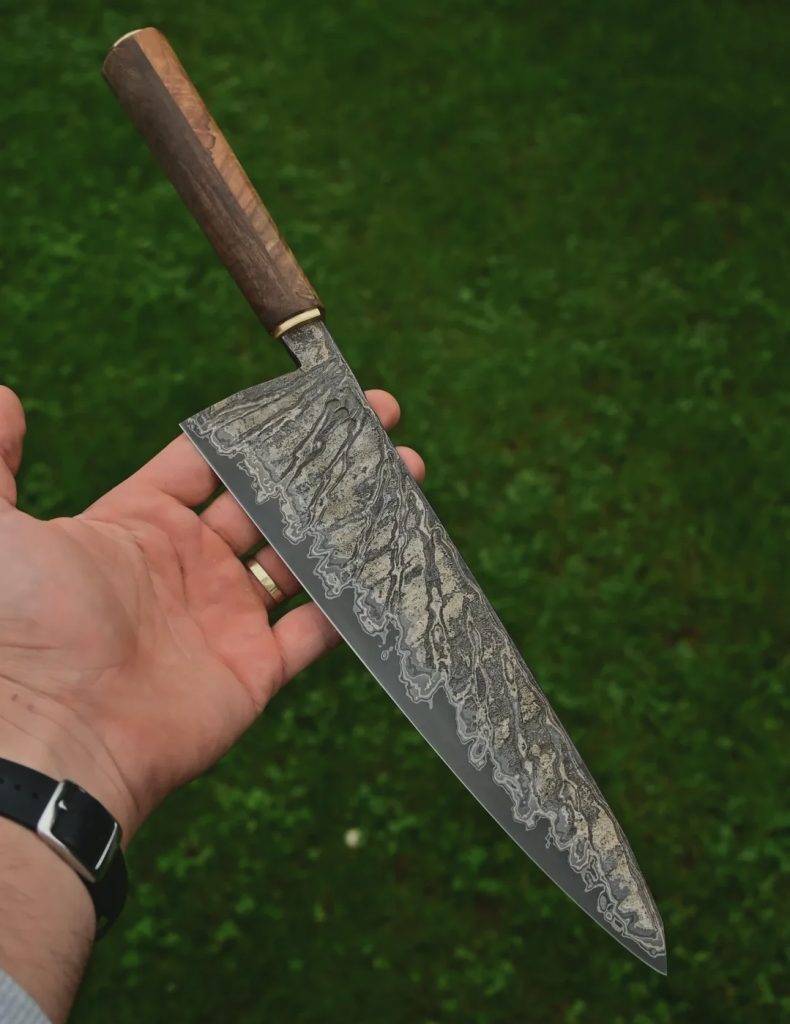
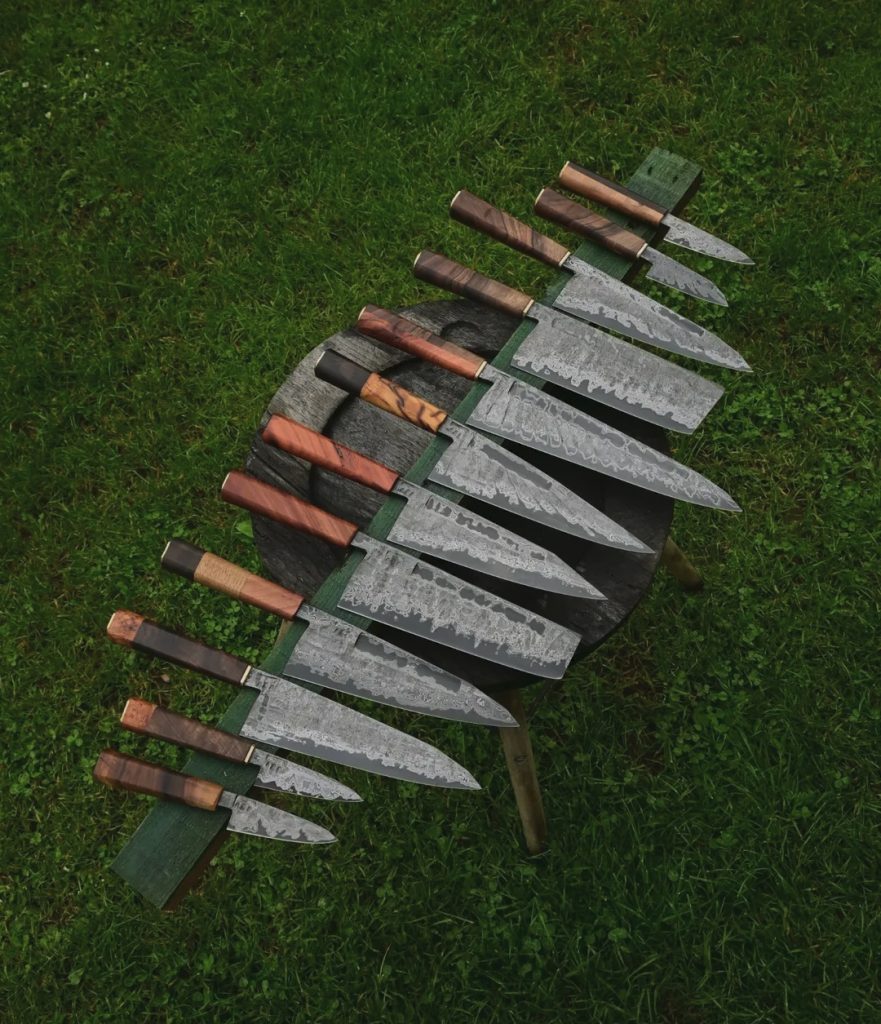
I mostly make kitchen knives. Lately, I’ve been focusing on forging knives as close to their final shape as possible, so that minimal grinding is needed. Forging is really the heart of knife-making in
my opinion, and I want to get as close to the final product as I can during that stage.
How did your background affect your approach to knives?
The biggest influence is my connection to my environment. Each knife carries the stories of my home region, and the people close to me. Being able to tell these stories through a knife – and
imagining someone in the U.S. cutting steak while sharing those stories – makes me incredibly proud.
Then there’s my mechanical engineering background, which helps me understand steel on a theoretical level, hopefully improving the quality of my knives.
Who helped you early on?
As I mentioned earlier, my grandfather was my main helper – practically my coworker. His knowledge and enthusiasm drastically sped up my early progress and saved me from many mistakes.
Who are your influences/inspirations?
It’s definitely my family. I work because of them, and if I had to stop knife-making to do something else for their sake, I would. Don’t get me wrong – I love making knives, just not as much as
I love my family.
If you are asking about a knifemaker I’m not sure I have a specific knife-making idol. I like following different bladesmiths and learning whatever I can from them. If I had to choose one, it
would probably be Benjamin Kamon, mainly because he’s such a skilled blacksmith. His monolith knife is a great example – very demanding to make.
How do you think that inspiration translates into your work?
The first one drives me to give my best effort and find optimal solutions for my business. The second source of inspiration pushes me to improve something with every knife and to always strive for progress.
Any specific breakthroughs or revelations in your knife-making journey?
One realization was that, by deciding to use only locally sourced Slovenian wood, I discovered how much beautiful wood our small country has. It made me realize that “exotic” is just a matter of
perspective. Another is that if someone else can succeed, so can I – all knowledge is accessible and attainable.
What is the perfect knife?
The perfect knife is different for everyone. It’s the knife you always reach for, even when you have twelve others to choose from. I wouldn’t say a perfect knife is defined by a single feature – it’s
more about the feeling you have while cooking. A perfect knife feels like an extension of your hand and works for you.
How do you approach a new concept and its implementation?
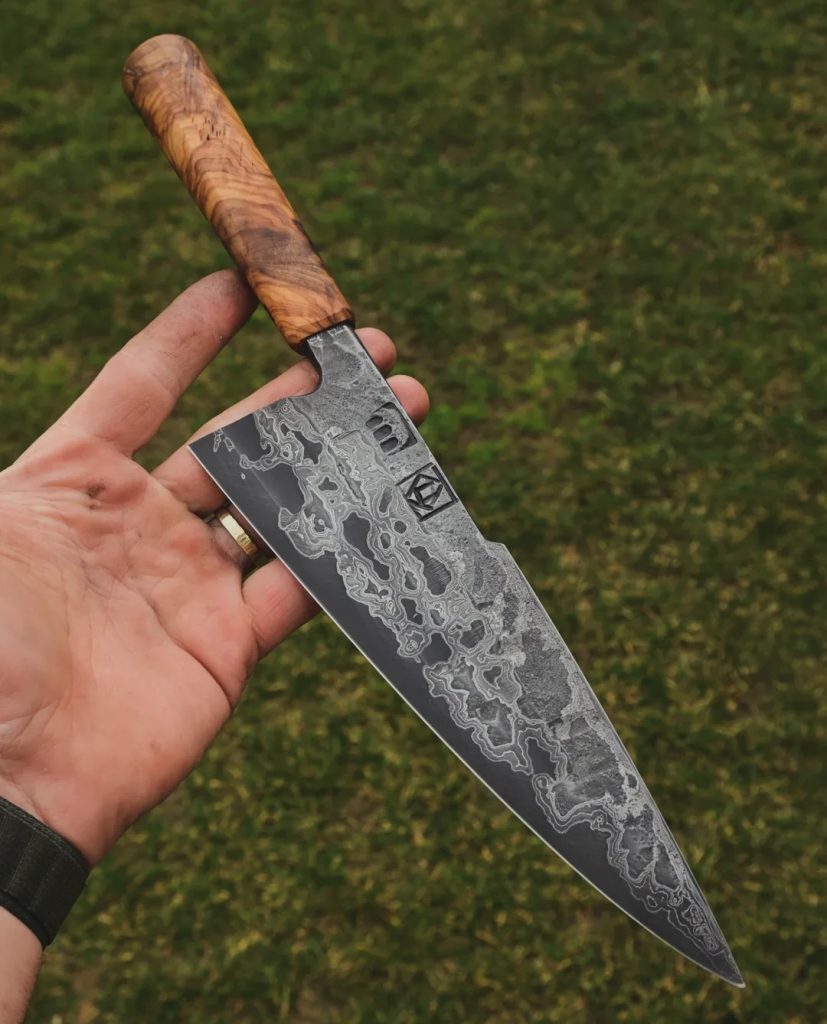
Every year, I set myself one project that’s a bit more complex and refined. That involves a lot of research, reading, conversations, and building a good story. I want every detail to be thought-out and executed with purpose. My goal is for a knife to open a window into its world the moment you look at it. Also, I always try to learn a new technique when I’m working on a special project so that it keeps me on my toes.
How do you approach knife testing?
Nothing too extreme. The most important thing is the feeling while cutting. After making 350+ knives, you can tell very quickly if one is right or not. If I’m working on something completely new – like a special grind (e.g., S-grind) – I take extra time to test it and figure out what might work best or what could go wrong.
How do you develop a design, select a steel, and fine-tune heat treatment?
Design mostly develops during the making process. I see what works well and what shapes I’m drawn to during the forging. Sometimes that’s the best way for creativity to flow. For handles, I follow one simple rule: the more complex the wood, the simpler the shape – and vice versa.
For the core steel of my knives, I usually use 52100. I currently treat it to reach around 63–63.5 HRC, which I’ve found perfect for cutting performance. Thanks to my university connections, I had
access to modern testing equipment, which helped me find the best results through experimentation.
What do you like about 52100 steel?
At first, I started using it simply because I got it for free – from old bearings – when I had to watch every cent spent on materials. Later, I realized it really suited me. It welds well, holds an edge, and
doesn’t crack. Once sharpened, it’s easy to maintain, which I think is very important for home cooks.
How has the knife world changed since you started?
Looking at Slovenia, not much has changed. There are quite a few knife-makers, but most are hobby smiths. Only a handful of us do this professionally. Globally, though, the biggest change seems to be how social media platforms work against knife- makers, under the pretense that we’re selling weapons. That makes it very hard to reach people and find new customers.
On the bright side, I’m very happy about the positive spirit within the knife-making community. I think we can count ourselves among the healthier online communities. Whenever I ask anyone a question, they take the time to answer. Truly a wonderful group of people.
What’s up next for you? Any exciting new projects to tell us about?
I recently bought a new hydraulic press, which opens up a whole range of new possibilities for me. I’m especially interested in mosaic damascus and stainless damascus.
I’m preparing a project with Slovenian chefs and culinary enthusiasts. It’ll be a big challenge for me, as I hope to include not just knives but also video content as part of the project.
To keep up with what Lovro is up to head over to his website https://vorancevakovacija.si/ and follow him on Instagram https://www.instagram.com/voranceva_kovacija/
Leave a Reply