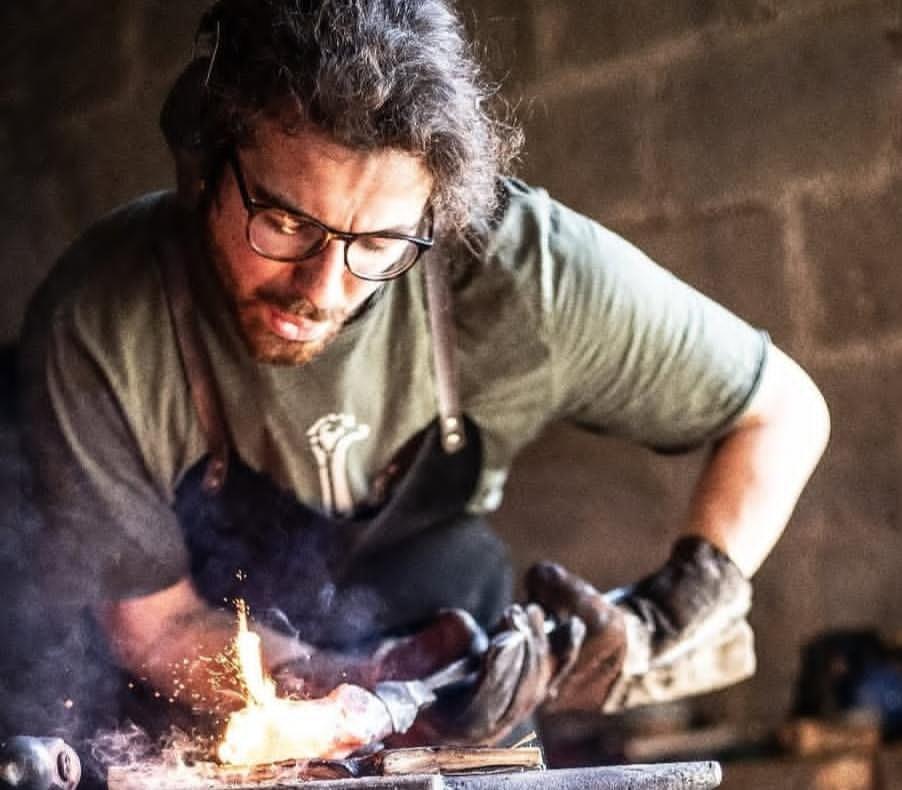
This week’s interview brings us back to Germany, and to a maker who can help you with addiction during his day job, and when he makes knives perhaps the opposite. I have always appreciated his approach to the craft, and I am very pleased to be able to share his story.
Tell us a little bit about yourself:
Hi everyone, my name is Christoph Wild, I am a 28 year-old guy from Germany and I like to make knives. My main job is being a psychologist/psychotherapist and I work at a rehabilitation center.
What sparked your interest in knives?
To be honest I was never really interested in knives growing up. The interest really only came when I started making them. I was always interested in making things, probably because my grandfather, who lives in the same village I grew up in, taught me how to do little wooden projects when I was young. In my teenage years I also spent time in his shop, mainly making simple musical instruments and working on old bicycles. Then I saw a knifemaking-video on YouTube and had to try it for myself.
What inspired you to do this and how did you learn?
Inspiration only came as soon as I started digging into online content regarding knifemaking. I had no blacksmiths in my family or in my village, so it was hard to source equipment and knowledge. But I learnt it from watching a whole lot of YouTube. First, I did some stock removal knives, then I bought a forge and anvil and then a power hammer (small one haha) and slowly converted the workshop of my grandfather towards knifemaking. It is located in an old barn, that is no longer needed for its intended use. I did a lot of learning by doing, forging out blades, forming integrals, Heat treating etc. For a long time, my knives had a very rustic appearance, it took a long time before they were really presentable. In Summer of 2021 I met the guys from MAK Olching for the first time. It is a formal knifemakers community based near Munich, Germany. Then I became a member of that community and really profited from all the shared knowledge and experience. Also, the guys are very fun to hang out with.
Do you have a favorite knife you made? Tell me about it.
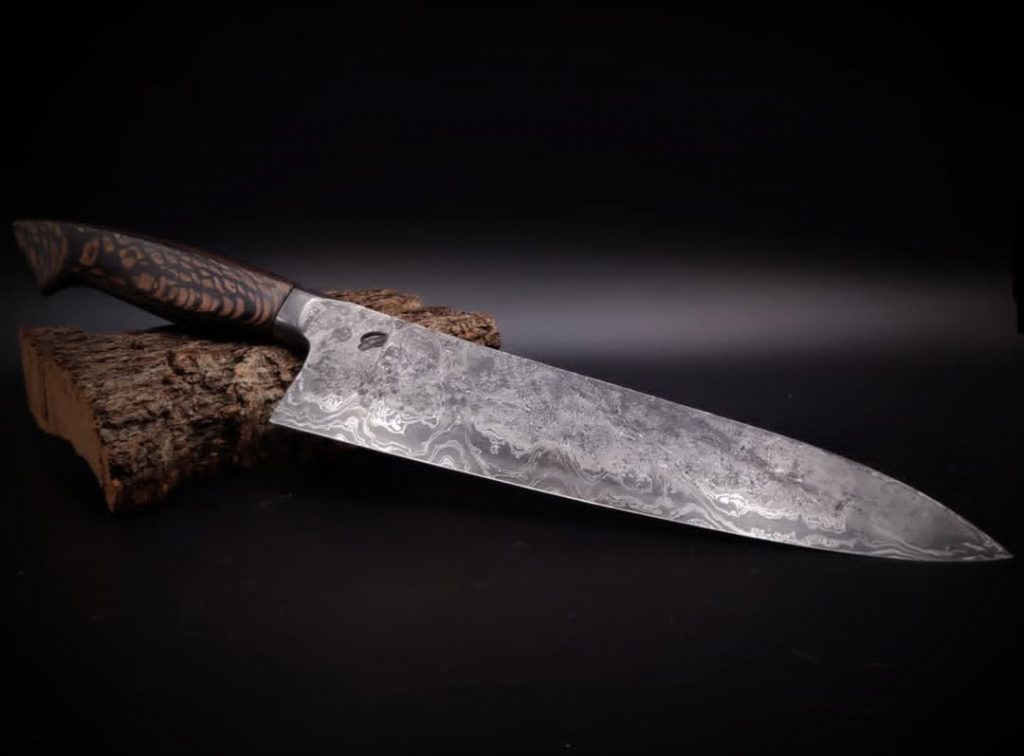
I kind of have no favourites. From time to time, I have projects that really challenge me and I really like them. For example, I made a sword a couple years ago, that was a huge challenge and I am really proud having done that. The last few years I have been experimenting with stone polishing, which is also very hard to do but fun to play around with. I think my favourite knife is always the next one I am going to build.
What kind of knives do you make?
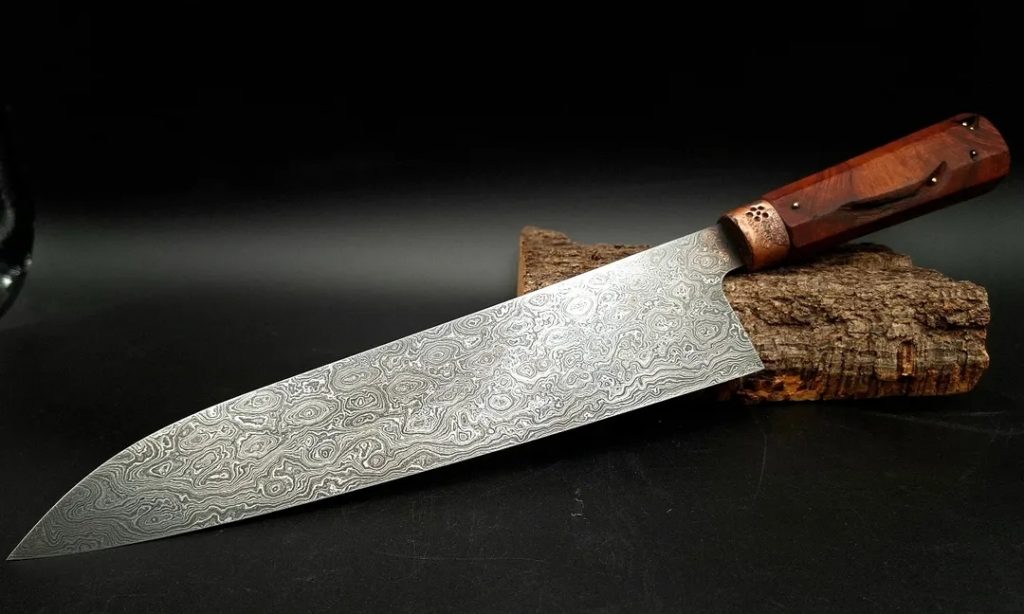
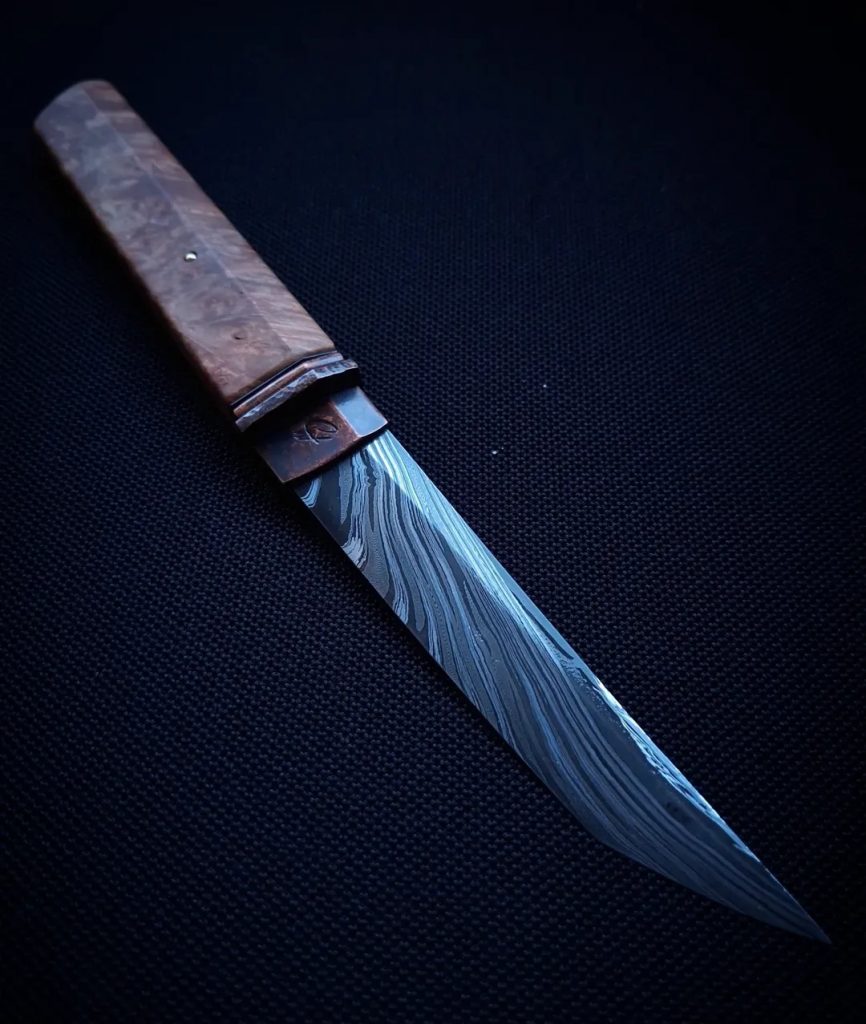
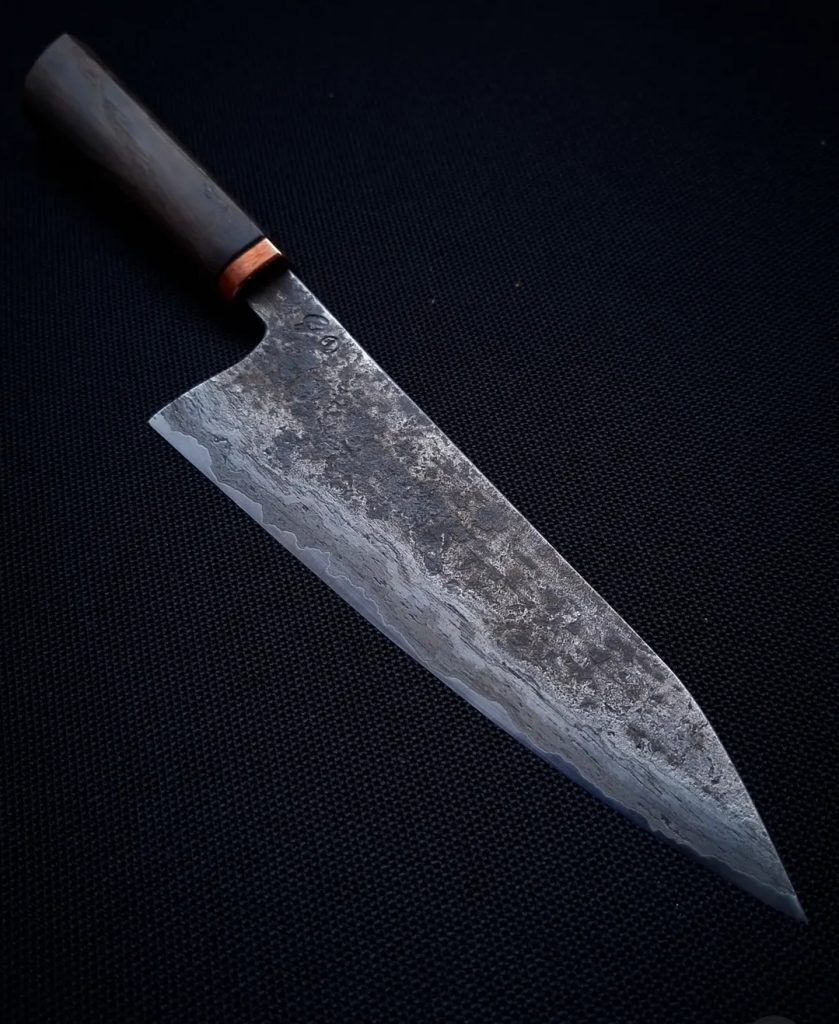
Basically, I do a lot of different stuff. Mainly I do kitchen knives, I like Japanese inspired blades and looks. Gyutos, Sujis, Pettys etc. Mostly from laminates, SanMai or also full damascus blades. All steel is made by me. I very rarely use purchased damascus. But apart from culinary knives I also have these phases where a certain knife-style just catches me, and I make a few blades in that style. last year I was really into Scandinavian blades like Puukkos and Leukus, after that I was inspired by tantos and the shorter Japanese blades including the mountings. I also made a folding knife and a pizza-wheel. So, there is a lot to do and explore!
What is the most important aspect of a well-made knife?
Regarding a kitchen knife (this really is the category I have the most expertise in) … well difficult to answer. I would say the five most important things in that order are:
- Edge profile – this is the most important one. You want a nice continuous cutting action on the board that does not have any unwanted flat spots. this defines how the knife feels during use.
- Straightness and symmetry of the blade – straight in every way possible. Straight spine, straight edge, edge needs to be aligned with the spine, symmetrical grind and forging,
especially on SanMai blades. - Taper – A nicely tapered blade feels better and cuts nicer. Especially a thin tip is beneficial performance wise.
- Haptics – Important not to have stress on your hand while using the knife: rounded over choil and spine, smooth handles without aggressive facets.
- Materials – A good, well-known steel with correct heat-treatment is a very important aspect of a knife. Also, high quality handle materials are nice, because you do not need to refinish a handle as often. Fit and finish is also regarded as a important topic… I am split on this one. Of course, you should not have huge delaminations in your steel or gaps in your handle. But I think a little scratch here or there is more charming than a bad thing.
Biggest struggle?
This one has to be time-management. I have a busy life, moved to another city due to my job as a psychotherapist. Now I only have my little storage compartment in the basement for making knives. I still visit my grandparents and parents semi-regularly and the I can access my big workshop with a grinder, blacksmithing-equipment, big saws etc. But most of the time, I am far away from that luxury.
So I have to use that time very efficiently, do the forging, heat treatment and pre-grinding work during those weekend visits and finish the knife up with very basic equipment when I have time during the week. Considering this I am actually proud of how many knives I can put out. My basement room only has a little belt grinder and a little bandsaw, a hand drill and some hand tools.
How did your background affect your approach to knives?
Well, first of all, I am not a very precise craftsman. I do my measurements mostly by eye and only have rudimentary equipment when it comes to keeping tolerances. I do not use or own a milling machine, surface grinder or other means of reaching very fine, even and flat surfaces. I think not badly about this though. Being in a community where most other bladesmiths are machinists of some sort, in the beginning I was very insecure about that aspect and sure, you can build amazing knives on a milling machine. But it is just not what I am used to and also not really what I like. I try to keep it simple, not too many complex machines and processes. But efficient in what I do, nevertheless. My background in psychology does affect the knifemaking I think, in a way I myself don’t yet really understand. But I think
buying and using a knife also always has a psychological component, the knife really has to speak to you and has to spark a certain emotional response. With a market that is filled with really great makers who are doing excellent work, I am really honored that some people seem to find my knives fascinating and choose to buy them.
Who helped you early on?
I have to say that my knifemaking journey was greatly supported by my family. I think none of us would have thought that my work would sell around the globe some years ago. And I am really thankful for my dad and mom supporting this hobby, and also to my grandparents for letting me set up a shop on their property. Also, my grandma makes the best lunch and cake for me when I am on visit so that’s delightful.
Who are your influences/inspirations?
Countless ones! and always changing I guess… I was and am still very impressed by the damascus of Joshua prince. However, I usually do not have enough time to do elaborative damascus
patterns. Also, great inspirations are Milan Gravier, Simon Maillet and Joel Black for forged geometry knives and stone-polishing. I am really looking up to these guys. These are, however, people whose work I never held in my hands so it is limited what you can observe. I am truly impressed by the worksvof my good friends Nils Busch, Marc Schauder, Moreno Feltresi, Flo Krepold and many more.
How do you approach knife testing?
When I get a new steel in, I usually forge some knives and inform myself on how to heat treat the steel. I usually keep one of the knives in my kitchen and use it a lot so I can observe the edge retention. Also, I do test cuts with every knife I sell to a customer.
Any specific breakthroughs or revelations in your knifemaking journey?
I think breakthroughs are very rare. Most of the progress you make as an artisan comes from iteration and filing on the details of the work. I enjoy trying some new stuff from time to time but also slowly improve the little things.
How do you develop a design?
Not to brag or anything but I think I just have made so many knives I have developed a certain feeling for lines and proportions, especially when it comes to blade profile and the transition to the handle. Not every knife comes out as beautiful and harmonic as I want but a lot of them look really nice, I guess. I do experiment with steels and patterns a lot, which is always fun but I kind of don’t plan those too meticulously.
How has the knife world changed since you started?
I think it got a lot bigger and also more professional. Knifemaking became a market and now there are much more suppliers for knifemaking related tools. I really love this development as it gives you the chance to use professional and purpose-built tools. For example, I got a Tobin RM-1 Rolling mill that I really love. Also, I want to get a mini hell kiln, all these things were not available when I started out. There was even difficulty finding a good belt grinder. And I did not start out a long time ago, maybe seven years or so.
What’s up next for you? Any exciting new projects to tell us about?
I did a lot of SanMai in the last few years; it would be nice to shift the focus a bit “back” to normal damascus and experiment with patterns.
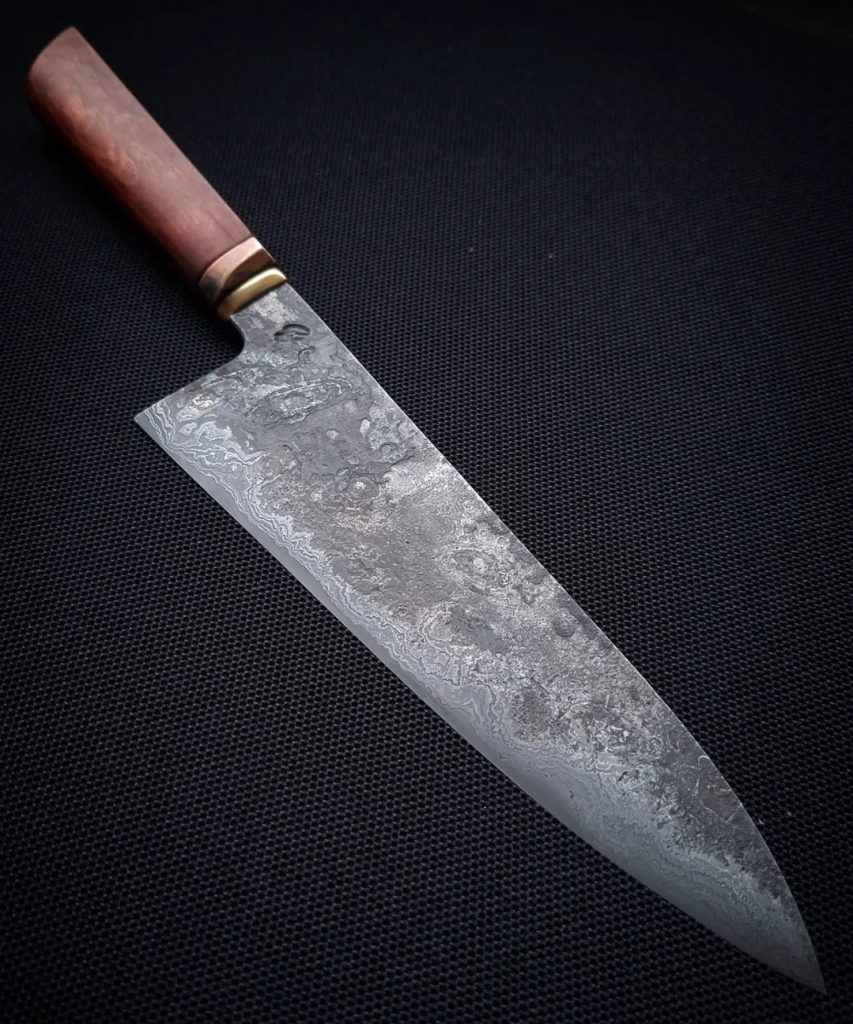
To keep up to date with what Christoph is working on head over to his website https://wwwildworld.de/ and follow him on Instagram https://www.instagram.com/wwwild_world/
Leave a Reply