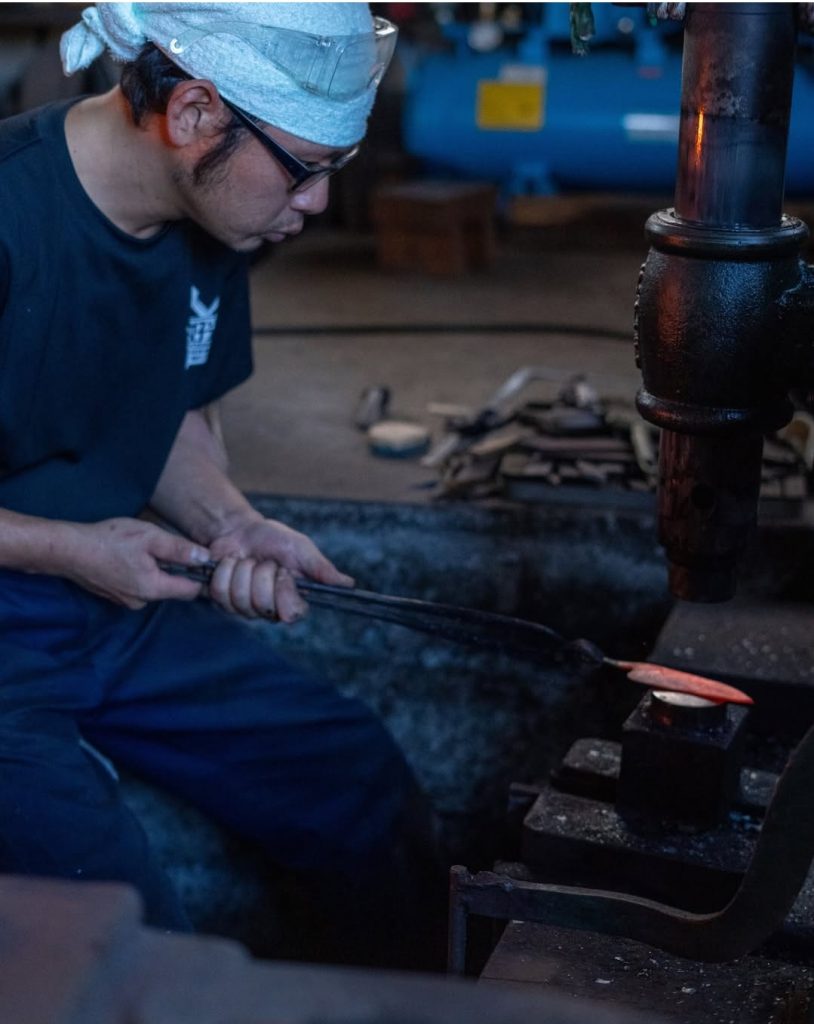
photo credit Studio Pal
This week takes us to the south of Japan. I have posted more of their knives than any other maker, I love how he combines rustic kurouchi with a polished cutting edge. His blades have a geometry that makes them incredibly fun to use in the kitchen. When we speak, we both use translator software, so his answers below are a bit briefer than you may be accustomed to; however, when I started doing these interviews, I knew that I needed to make sure he was included. I am so glad he agreed, as he is a maker I am very pleased to draw attention to. In addition, he did me the honor of making his first, and to my knowledge, only full tang knife blank, which he sent to me so that I could finish the piece. It is something I will always treasure.
To start off, please tell us a little about yourself.
Junichi Ide, aged 45. With 25 years’ experience as a blacksmith. I am from Shimabara in Nagasaki prefecture in Japan.
What sparked your interest in knives?
My interest only began once I started working as a blacksmith.
As a child, I honestly had no interest in my family’s trade.
What inspired you to do this and how did you learn?
My family business is blacksmithing, and I followed in my father and grandfather’s footsteps. I learnt the blacksmith’s trade to take over the family trade. I learnt the basics from my father, but I also have another person whom I can call my teacher, and I am still learning from that person.
When did you start making knives?
I began making them around the age of 23.
What did you make your first knife with?
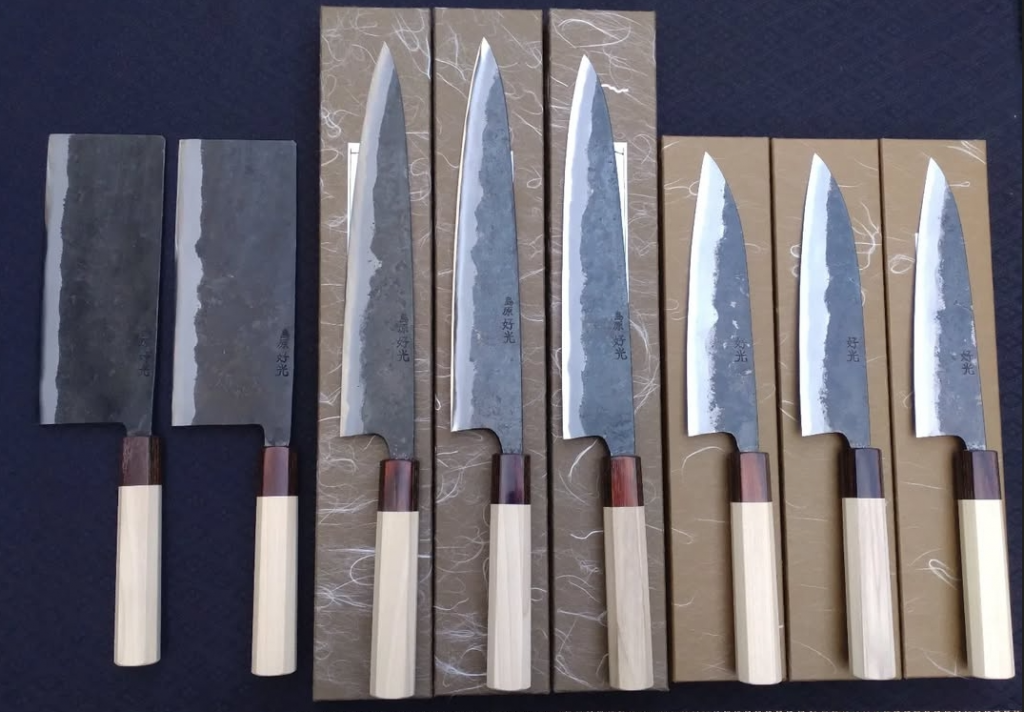
Using Sirogami No. 2 steel, I crafted the most basic small kitchen knife.
Do you have a favorite knife you made, tell me about it?
It was a small santoku knife.
What is the most important aspect of a well-made knife?
The temperature of the flame and the temperature of the water during heat treatment.
What keeps you going?
“Not being able to cut is sad; being able to cut brings joy.”
I always set out for work with these words in my heart.
Biggest struggle?
Temperature control during heat treatment.
Japan experiences significant temperature variations across its four distinct seasons, making it quite challenging each time to adjust the flame intensity and water temperature appropriately to suit the day’s weather.
What kinds of knives do you make?
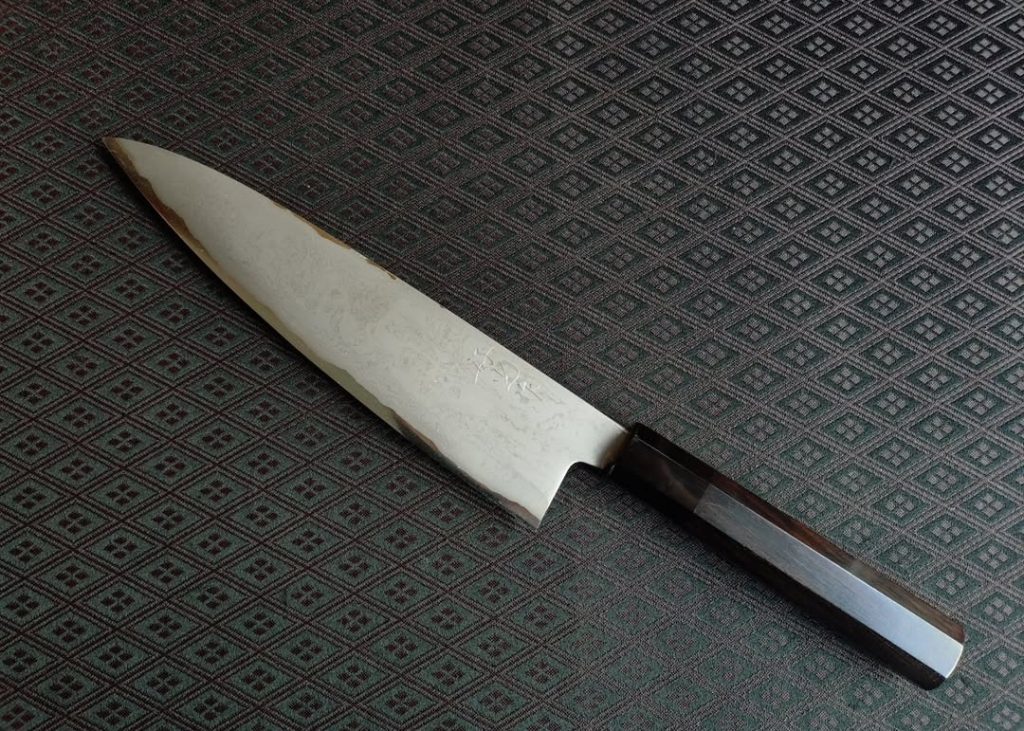
General-purpose kitchen knives suitable for everyday household use.
Who helped you early on?
Yes. My father, who is my master, is one such person, as are Mr. Shoji Yoshida, the head of our main branch, and Mr. Genroku Matsunaga, the swordsmith.
The “main branch” refers to the shop where my grandfather trained.
In Japan, there exists a tradition known as “norenwake”, whereby the master’s shop is termed the “main branch”, and the shop of an independent apprentice is called a “branch family”.
A strong bond remains, and to this day, we continue to receive instruction from the main branch.
Who are your influences/inspirations?
I have been influenced by various blacksmiths, but the most significant are Mr. Shoji Yoshida, the head of the main branch, Okahide, a saw smith from Kumamoto, and recently, it’s Mr. Taira of Morihiro Blacksmiths. That said, every blacksmith I know is a source of inspiration.
Any specific breakthroughs or revelations in your knife making journey?
Every time brings new discoveries and challenges. The most frequent experiences involve forging techniques and sharpening methods.
Even after 25 years working as a blacksmith, it remains a continuous process of discovery.
What is the perfect knife?
A knife with excellent cutting performance. For no matter how fine its appearance, no matter how splendid its looks, if it fails to cut as a blade, it serves no purpose whatsoever.
How do you approach knife testing?
We test whether it produces a clean, crisp sound when cutting paper, as well as the feel of the cut itself.
How do you develop a design, select a steel, and fine-tune a heat treatment?
Regarding design, I primarily create classic forms but adapt them to suit the user. In this respect, I place great importance on inspiration.
For steel materials, I select and use them according to their suitability for each purpose.
Heat treatment relies entirely on intuition and experience. I make fine adjustments based on my own eyes and skin sensitivity, judging by the day’s temperature, humidity, water temperature, and the red glow of the iron.
What steels do you prefer to work with?
When it comes to steel grades, I prefer Shirogami steel over Aogami steel.
While Aogami has higher hardness than Shirogami, Shirogami offers greater flexibility and versatility, and is highly cost-effective and versatile, making it the most promising steel. Therefore, Shirogami steel is my absolute favourite.
How has the knife world changed since you started?
The form has clearly changed. It gradually evolved over time to suit the era.
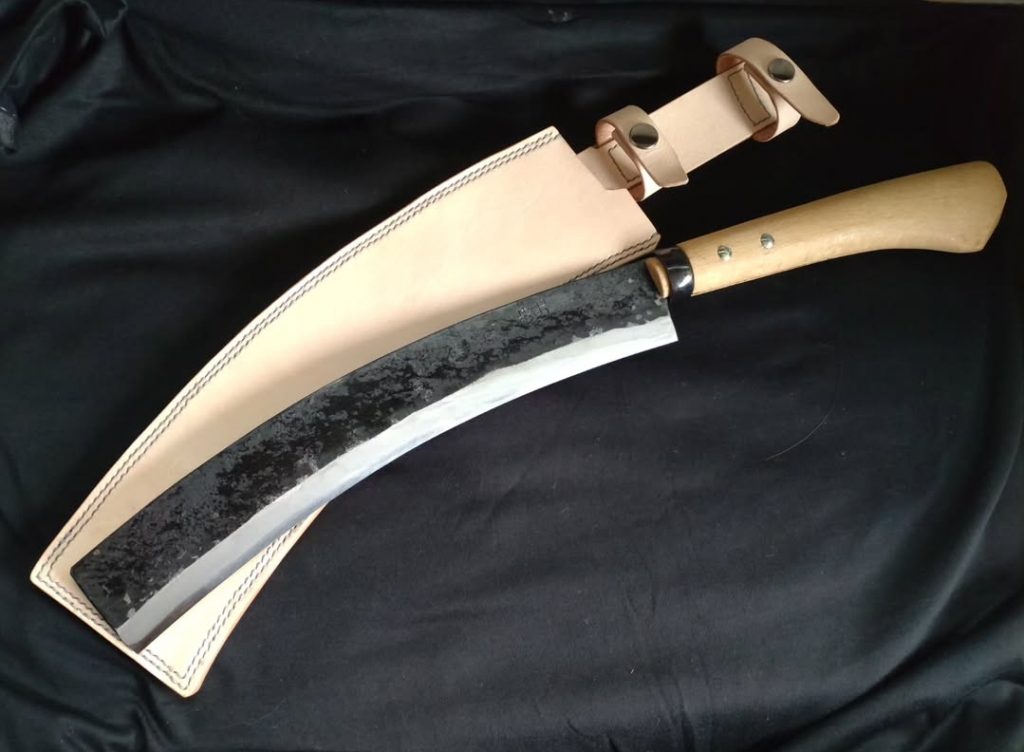
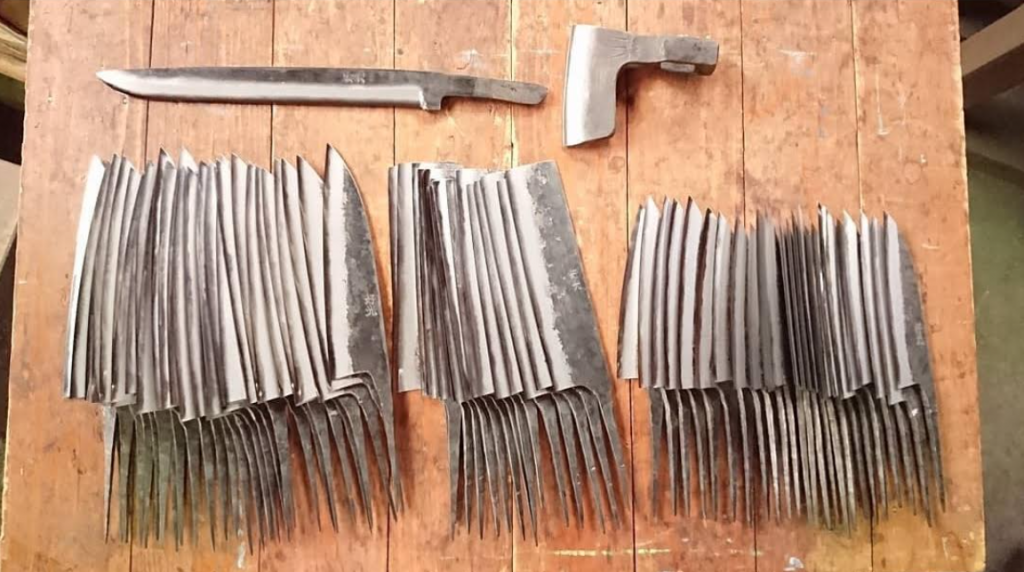
Moreover, the form changed significantly between domestic and overseas demand. My domestic customers show little interest in Kiritsuke or Gyuto knives. However, the knives most sought after by overseas customers are primarily Kiritsuke and Gyuto. Consequently, since beginning overseas trade, the range of knife types I produce has broadened considerably.
What’s up next for you? Any exciting new projects to tell us about?
I have recently acquired a very special type of steel. This steel is extremely difficult to work with, but I am currently undertaking a project to craft a knife using it.
To keep up to date with what he is working on, or to see more of his work go to his website https://yosimitu-kajiya.stores.jp/ or follow him on Instagram https://www.instagram.com/yosimitukajiya/
Leave a Reply